
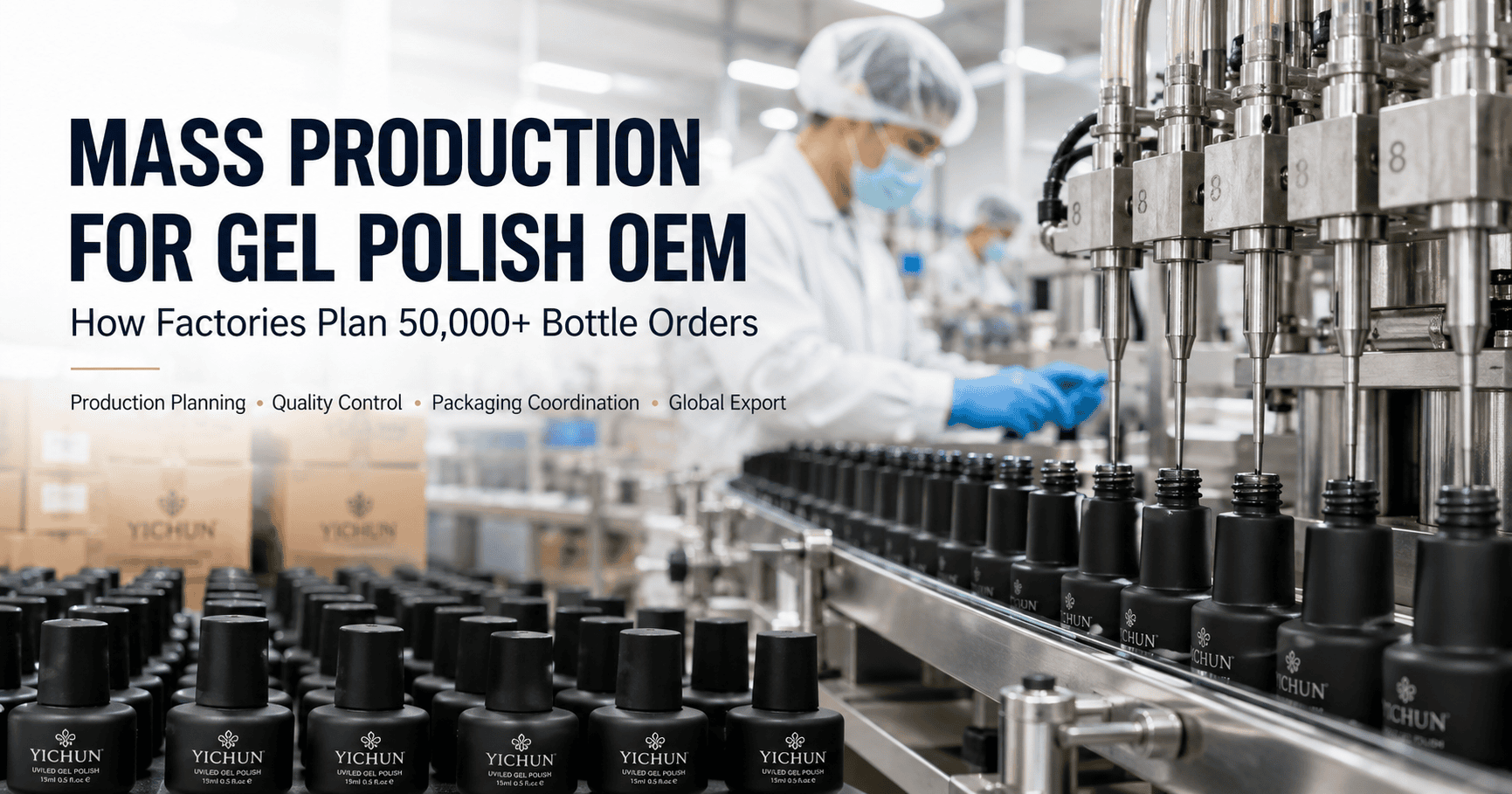
Large-volume manufacturing is often viewed as a sign that a nail brand has entered a new stage of growth. Whether supplying nationwide distributors, international retailers, salon chains, or fast-growing e-commerce brands, orders exceeding 50,000 bottles require far more than simply increasing production speed.
For buyers searching for a reliable nail gel factory China, one of the biggest concerns is not whether a factory can produce thousands of bottles—it is whether the factory can maintain consistent quality, organized production planning, stable delivery schedules, and reliable communication throughout the entire OEM project.
A professional gel polish manufacturer must coordinate raw materials, production scheduling, packaging preparation, quality inspections, warehouse management, and export logistics as one integrated workflow. Without proper planning, even small delays in packaging materials or inconsistencies in raw materials can affect thousands of finished products and disrupt launch schedules.
This guide explains how professional nail gel manufacturers organize large-scale OEM production, what buyers should evaluate before placing high-volume orders, and how systematic production management helps ensure stable quality and long-term supply reliability.
Why Mass Production Is Different from Small-Batch OEM
Producing a few thousand bottles and producing more than 50,000 bottles are fundamentally different manufacturing projects.
As production volume increases, every stage of manufacturing becomes more complex.
Instead of simply multiplying output, factories must carefully manage:
- Production scheduling across multiple manufacturing lines
- Raw material preparation for larger batch sizes
- Packaging component availability
- Batch traceability
- Quality control frequency
- Warehouse storage
- Shipment coordination
A delay in just one component—such as bottle delivery, printed labels, or outer cartons—may interrupt the entire production schedule.
For this reason, experienced factories focus on planning long before production officially begins.
What This Guide Will Help Buyers Understand
Choosing a supplier for a large OEM project should never be based on production volume claims alone.
Instead, buyers should understand how a factory plans and manages every stage of manufacturing.
In this guide, you will learn:
- How professional factories organize large-volume production
- How production schedules are planned before manufacturing begins
- Why packaging coordination is just as important as filling capacity
- How quality control is maintained across multiple production batches
- What operational factors affect delivery planning
- How experienced factories reduce production risks during large OEM projects
Understanding these operational principles allows buyers to evaluate manufacturers more objectively and build more reliable long-term supply partnerships.
What a Professional Nail Gel Factory Actually Does During Large OEM Projects
Many buyers assume that mass production begins when raw materials enter the mixing tank.
In reality, manufacturing starts much earlier through careful project planning.
A professional nail gel factory China coordinates multiple departments to ensure that production, packaging, quality inspection, and shipping all progress according to an organized schedule.
Rather than treating manufacturing as a single production task, experienced factories manage it as a complete supply chain project.
Production Planning Starts Before Manufacturing
Large OEM projects often require preparation well before the production line begins operating.
Typical planning activities include:
- Confirming approved formulas and color references
- Reviewing packaging artwork
- Scheduling production equipment
- Preparing raw materials
- Coordinating bottle, cap, brush, and label suppliers
- Arranging inspection checkpoints
- Planning warehouse space
- Confirming shipping schedules
Completing these preparations early helps reduce production interruptions and improves workflow efficiency.
Mass Production Requires Cross-Department Coordination
Successful manufacturing depends on communication between multiple departments rather than relying on one production team alone.
| Department | Primary Responsibility |
|---|---|
| Sales & Project Management | Confirm customer requirements and coordinate the project timeline |
| R&D Team | Verify approved formulas and technical specifications |
| Procurement | Arrange raw materials and packaging components |
| Production Planning | Schedule manufacturing equipment and production sequences |
| Manufacturing | Mixing, filling, capping, labeling, and packaging |
| Quality Control | Inspect products throughout production |
| Warehouse | Manage incoming materials and finished inventory |
| Logistics Coordination | Prepare export documentation and shipment arrangements |
Each department contributes to maintaining production continuity and minimizing avoidable delays.
Large-Scale Manufacturing Goes Beyond Filling Bottles
Professional OEM factories manage many activities simultaneously throughout production.
These responsibilities may include:
- Formula consistency management
- Raw material traceability
- Production scheduling
- Filling accuracy control
- Label alignment inspection
- Packaging verification
- Batch record management
- Finished goods storage
- Export preparation
- Reorder planning
Each stage contributes to maintaining product consistency from the first bottle to the final shipment.
Who Should Pay Attention to Large-Scale Production Capability?
Not every buyer requires production planning designed for tens of thousands of bottles.
However, for businesses experiencing rapid growth, understanding a factory’s mass production capability becomes increasingly important.
Established Nail Brands
Growing brands often launch multiple collections each year across different markets.
They require manufacturing partners capable of maintaining:
- Consistent product quality
- Reliable production schedules
- Stable packaging standards
- Efficient reorder management
Professional Distributors
Distributors typically purchase products for multiple customers or regional markets.
Their priorities often include:
- Inventory planning
- Batch consistency
- Packaging durability
- Organized shipment scheduling
- Reliable replenishment
Beauty Wholesalers
Wholesale buyers frequently order dozens or even hundreds of SKUs in one project.
A professional factory should be able to coordinate:
- Mixed-color production
- Carton organization
- Label consistency
- Warehouse management
- Export packaging
Amazon, Shopify, and E-commerce Brands
Fast-growing online brands often experience seasonal demand spikes.
Well-organized production planning helps them prepare inventory before promotional campaigns while reducing supply chain risks.
Procurement and Supply Chain Teams
Professional sourcing managers generally evaluate factories based on operational capability rather than marketing claims.
Typical evaluation areas include:
- Production planning systems
- Material preparation
- Batch traceability
- Quality management
- Packaging coordination
- Communication efficiency
- Risk management procedures
These indicators often provide a more accurate picture of long-term manufacturing capability than production capacity alone.
Key Factory Capabilities Buyers Should Evaluate for 50,000+ Bottle Orders
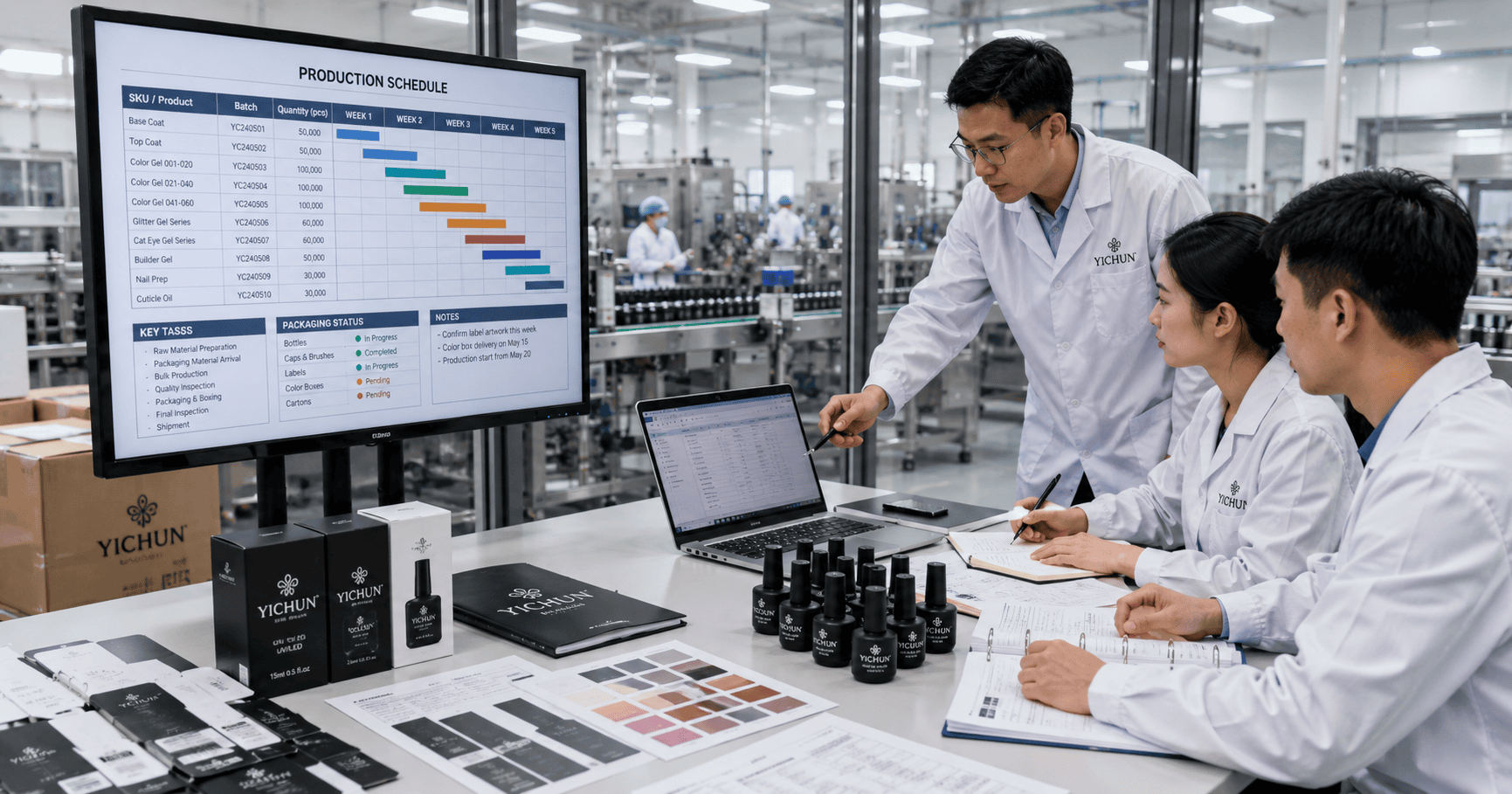
Handling a large OEM project is not simply about having more production lines or larger workshops. Buyers should evaluate whether a factory has a mature operational system capable of managing production from raw material preparation to final shipment.
When sourcing from a nail gel factory China, the following capabilities deserve close attention.
Production Planning and Scheduling
A 50,000+ bottle order cannot be treated as one continuous production run. Professional manufacturers typically divide the project into multiple production stages to maintain efficiency and quality control.
Before production begins, planners usually evaluate:
- Product categories
- Number of colors and SKUs
- Quantity per SKU
- Filling line availability
- Packaging material arrival schedules
- Quality inspection timing
- Warehouse capacity
- Shipping priorities
Instead of maximizing speed, experienced factories aim to balance production efficiency with product consistency.
Raw Material Preparation
Large-volume production starts with careful material planning.
Rather than ordering raw materials only after receiving a purchase order, professional factories normally verify inventory status and procurement schedules in advance.
Preparation may include:
- Base resin availability
- Pigment inventory verification
- Functional additive planning
- Batch identification
- Storage condition review
- Material compatibility confirmation
This planning helps reduce unexpected interruptions once production begins.
Filling Line Organization
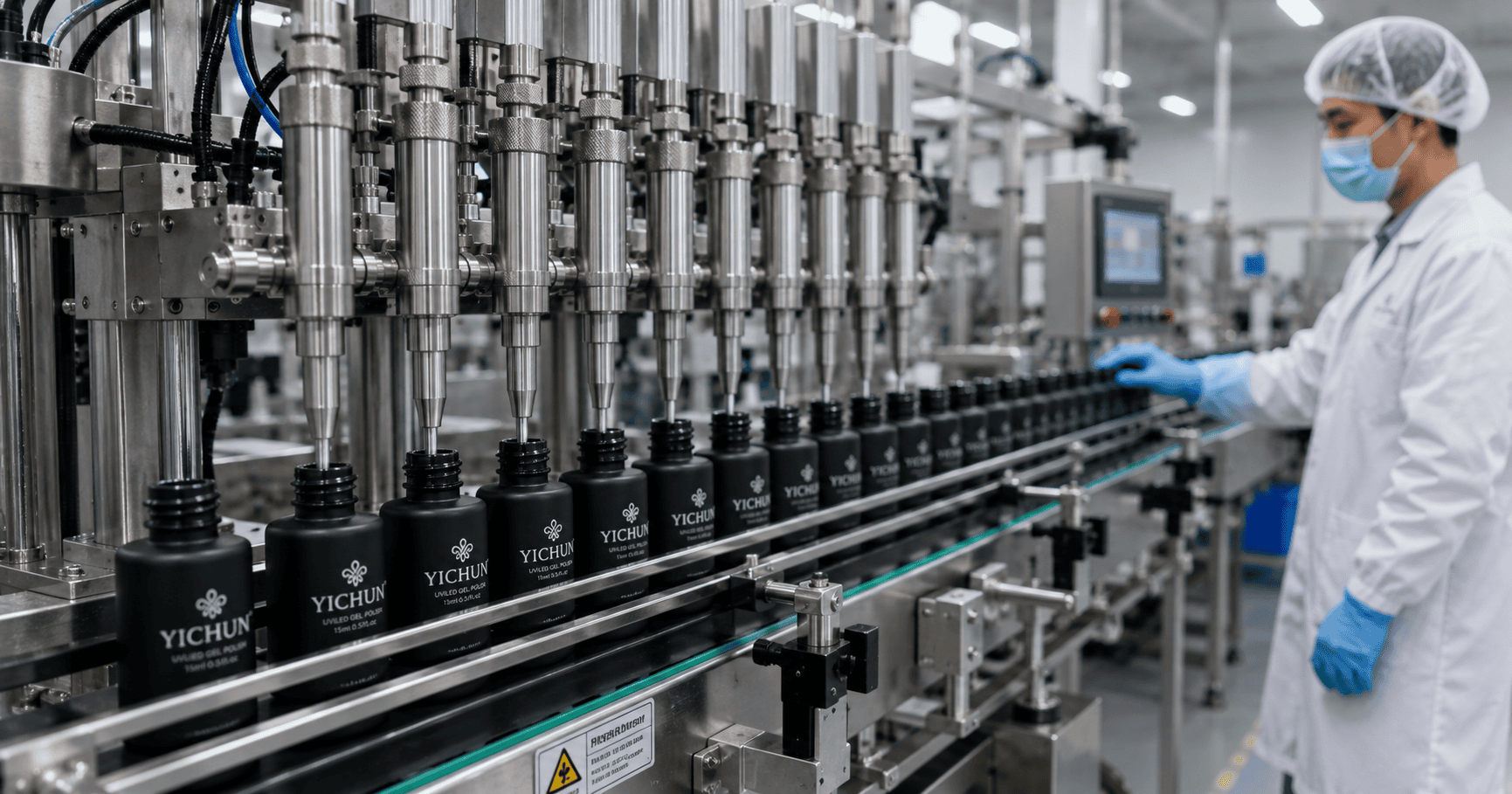
Accurate filling is one of the most visible stages of gel polish manufacturing, but consistency depends on far more than automated machinery.
Factories should establish procedures for:
- Equipment calibration
- Filling volume verification
- Production line cleaning
- Product changeover between colors
- Bottle positioning
- Production monitoring
These procedures help reduce waste while maintaining stable filling accuracy across large production batches.
Packaging Material Coordination
Packaging often becomes one of the most challenging parts of a large OEM project.
A single gel polish bottle may require components from several different suppliers.
Typical packaging materials include:
- Glass bottles
- Caps
- Brushes
- Printed labels
- Silk-screen bottles
- Folding cartons
- Gift boxes
- Inner trays
- Export cartons
If one component arrives late, the entire production schedule may need to be adjusted.
For this reason, packaging preparation is usually coordinated alongside manufacturing rather than after production is complete.
Quality Control Throughout Production
Quality inspection should not occur only after all bottles have been completed.
Professional factories typically perform inspections at multiple stages of manufacturing.
Examples include:
- Incoming raw material inspection
- Formula verification
- Color comparison
- Viscosity review
- Filling volume inspection
- Bottle sealing verification
- Label positioning checks
- Packaging inspection
- Carton verification before shipment
Multiple inspection points help identify potential issues before they affect large quantities of finished products.
Export and Logistics Coordination
Completing production does not necessarily mean the project is ready for shipment.
Large OEM orders often require additional preparation before goods leave the factory.
This may include:
- Carton marking
- Packing list preparation
- Commercial invoice coordination
- Pallet arrangement where applicable
- Warehouse staging
- Container loading plans
- Shipping schedule confirmation
Coordinating these activities early can reduce delays during export preparation.
Step-by-Step OEM Process for a 50,000+ Bottle Order
Large-volume production follows a structured workflow rather than a simple manufacturing sequence. Each stage builds on the successful completion of the previous one.
Step 1 — Project Requirement Confirmation
Production begins with a detailed review of the buyer’s requirements.
Typical discussions include:
- Product types
- Number of colors
- Packaging specifications
- Target market
- Expected shipment schedule
- Documentation requirements
Clear communication at this stage helps reduce revisions later.
Step 2 — Formula and Color Confirmation
After project requirements are confirmed, the factory verifies the approved formula and color standards.
Depending on the project, buyers may choose:
- Existing production formulas
- Previously approved custom colors
- ODM color development
- Seasonal collections
The approved sample serves as the production reference throughout manufacturing.
Step 3 — Packaging Artwork Approval
Before production begins, packaging details should be finalized.
Typical approval items include:
- Label layout
- Brand logo placement
- Ingredient information
- Barcode position
- Warning text
- Batch number location
- Carton printing
Artwork approval helps prevent unnecessary rework during production.
Step 4 — Material Procurement and Preparation
Once technical specifications are confirmed, procurement teams begin preparing all required production materials.
These may include:
- Gel raw materials
- Pigments
- Bottles
- Brushes
- Caps
- Labels
- Color boxes
- Shipping cartons
Material readiness is one of the most important factors affecting production schedules.
Step 5 — Production Scheduling
Rather than producing every SKU simultaneously, factories generally create a manufacturing schedule based on production efficiency.
Scheduling considerations may include:
- Similar formula groups
- Color change frequency
- Equipment availability
- Packaging readiness
- Inspection timing
This approach helps reduce unnecessary downtime between production batches.
Step 6 — Bulk Manufacturing
After preparation is complete, manufacturing begins.
Typical production activities include:
- Mixing
- Filling
- Capping
- Labeling
- Carton packing
Throughout production, operators and quality inspectors monitor each stage according to established procedures.
Step 7 — Quality Inspection and Batch Verification
Before products are released for shipment, completed batches undergo final verification.
Inspection may include:
- Appearance review
- Color consistency
- Filling volume
- Cap security
- Label alignment
- Packaging condition
- Carton integrity
Where applicable, representative production samples may also be retained for future batch comparison.
Step 8 — Warehouse Preparation and Shipment Coordination
After passing inspection, finished goods are organized for export.
Final preparation may involve:
- Carton labeling
- Pallet organization
- Shipping documentation
- Container loading plans
- Logistics scheduling
Only after these activities are completed is the order prepared for international shipment.
Production, Customization, and Operational Variables
Even when two projects involve the same quantity of bottles, production complexity can vary significantly.
Several operational variables influence manufacturing planning, production efficiency, and overall project management.
| Factory Variable | Why It Matters | Buyer Decision Impact |
|---|---|---|
| Number of SKUs | More SKUs require additional production changeovers | Affects scheduling complexity |
| Quantity per Color | Larger runs improve production efficiency | Influences manufacturing sequence |
| Formula Type | Different formulas require different processing conditions | Impacts production planning |
| Color Effects | Glitter, cat eye, and specialty pigments require additional control | May increase inspection frequency |
| Bottle Style | Different bottle designs require equipment adjustments | Influences packaging efficiency |
| Label Process | Standard labels and silk-screen printing have different lead times | Affects packaging preparation |
| Packaging Structure | Retail boxes and gift sets require additional assembly | Extends packaging operations |
| Documentation Requirements | Different markets require different supporting documents | Impacts export preparation |
| Shipping Method | Sea, air, or express shipment affects packing strategy | Influences warehouse planning |
Understanding these variables helps buyers communicate project requirements more accurately and enables factories to create more realistic production schedules.
MOQ, Capacity, Cost, Timeline, and Large-Order Planning
One of the most common misconceptions among buyers is that placing a larger order automatically results in faster production or lower costs. In reality, large-scale OEM manufacturing involves careful coordination between production planning, material preparation, packaging suppliers, quality control, and logistics.
When evaluating a nail gel factory China, buyers should focus on how the factory manages these operational variables rather than asking only about production capacity.
MOQ Depends on the Entire Manufacturing Plan
Minimum Order Quantity (MOQ) is not determined by bottle quantity alone.
For gel polish OEM projects, MOQ may be influenced by:
- Formula type
- Bottle size and style
- Number of colors
- Label printing method
- Packaging customization
- Production line scheduling
- Packaging supplier requirements
For example, a project with one bottle style and ten standard colors is generally easier to organize than a project with multiple bottle designs, custom gift boxes, and dozens of special-effect shades.
Professional factories evaluate the overall production complexity before recommending a suitable MOQ.
Large Orders Require Material Planning Rather Than Material Purchasing
A 50,000-bottle project may involve hundreds of thousands of individual components.
These components can include:
- Gel raw materials
- Pigments
- Bottles
- Caps
- Brushes
- Labels
- Folding cartons
- Master cartons
- Protective packaging materials
Rather than purchasing everything at once, experienced manufacturers usually coordinate procurement according to the production schedule to reduce storage pressure and improve material traceability.
This approach also allows packaging inspections to be completed before components enter the production line.
Production Capacity Is Only One Part of Manufacturing Capability
Some suppliers emphasize daily production output as their primary selling point.
However, experienced buyers typically evaluate broader operational capabilities, including:
- Production scheduling efficiency
- Material preparation
- Equipment organization
- Batch management
- Quality inspection procedures
- Packaging coordination
- Warehouse management
- Export preparation
A factory with excellent planning systems may deliver more consistent results than one with simply higher production volume.
Cost Is Influenced by Multiple Operational Factors
Large-order pricing is affected by numerous variables throughout the manufacturing process.
Common cost factors include:
| Cost Factor | Why It Affects Pricing |
|---|---|
| Formula Type | Different formulations require different raw materials and processing methods. |
| Bottle Selection | Bottle shape, material, and size influence packaging costs. |
| Cap and Brush | Different component specifications affect procurement costs. |
| Label Process | Standard labels, silk-screen printing, and specialty finishes require different production methods. |
| Packaging Structure | Color boxes, gift sets, and custom inserts increase assembly requirements. |
| Number of SKUs | More SKUs increase production changeovers and planning complexity. |
| Inspection Requirements | Additional quality inspections require more production resources. |
| Shipping Method | Export packing and transportation methods affect final logistics costs. |
Instead of comparing quotations based solely on unit price, buyers should evaluate the complete manufacturing scope included in the proposal.
Production Timelines Depend on Project Readiness
Production schedules are influenced by much more than filling speed.
Typical timeline stages include:
- Requirement confirmation
- Formula or color approval
- Packaging artwork confirmation
- Packaging material production
- Raw material preparation
- Production scheduling
- Bulk manufacturing
- Quality inspection
- Final packaging
- Export preparation
Each stage depends on the successful completion of the previous one.
Early confirmation of product specifications and packaging details often contributes more to project efficiency than attempting to accelerate manufacturing after production has begun.
Quality Control, Batch Consistency, and Documentation
Quality control becomes increasingly important as production volume grows.
Inspecting a few hundred bottles is relatively straightforward. Inspecting tens of thousands of bottles requires standardized procedures that can be repeated consistently throughout production.
Professional manufacturers establish inspection checkpoints before, during, and after manufacturing rather than relying solely on final product inspection.
Raw Material Verification
Quality begins before production starts.
Incoming materials are typically reviewed for factors such as:
- Material identification
- Batch records
- Appearance
- Storage condition
- Compatibility with approved production formulas
Verifying raw materials early helps reduce the possibility of production interruptions later.
In-Process Production Inspection
During manufacturing, quality inspectors monitor production continuously instead of waiting until production has finished.
Typical inspection activities include:
- Color comparison
- Viscosity observation
- Filling volume verification
- Bottle appearance
- Cap installation
- Label positioning
- Packaging accuracy
Continuous inspection allows potential issues to be identified before they affect larger quantities of finished products.
Final Product Inspection
Before shipment, completed products typically undergo another verification process.
Final inspection may include:
- Bottle appearance
- Product consistency
- Filling accuracy
- Leakage inspection
- Label quality
- Carton condition
- Packaging completeness
Only after these inspections are completed are products prepared for shipment.
Batch Traceability Supports Long-Term Reorders
Large OEM projects often become long-term supply programs.
For this reason, maintaining production records is important for future reorder consistency.
Depending on the manufacturer’s internal procedures, production documentation may include:
- Batch production records
- Raw material batch information
- Filling records
- Inspection reports
- Packaging verification records
- Sample retention where applicable
These records help buyers and manufacturers compare future production batches with previously approved products.
Documentation Should Match Market Requirements
Documentation requirements differ by country, product category, and distribution channel.
Depending on the project, buyers may request documents such as:
- MSDS
- COA
- Ingredient information
- Product label information
- Packing List
- Commercial Invoice
- Shipping documentation
- Product testing reports where applicable
Because compliance requirements vary across international markets, buyers should confirm documentation requirements before bulk production begins.
Professional Judgment: How Buyers Should Evaluate a Factory
When comparing suppliers for a 50,000+ bottle project, buyers should evaluate how the factory manages complexity rather than focusing only on production output.
The following questions often provide a more accurate picture of manufacturing capability.
Does the Factory Explain Its Production Planning Clearly?
Professional manufacturers should be able to explain:
- How production schedules are organized
- How materials are prepared
- How packaging is coordinated
- How inspection checkpoints are arranged
- How shipment planning is managed
Clear explanations usually indicate structured operational management.
Can the Factory Discuss Quality Control in Detail?
Instead of providing only general statements about quality, experienced manufacturers should be able to describe:
- Incoming material inspection
- In-process quality checks
- Final product inspection
- Batch documentation
- Traceability procedures
Buyers should look for practical workflows rather than marketing claims.
Does the Factory Understand Both Manufacturing and Packaging?
Large OEM projects require packaging coordination equal to manufacturing capability.
A reliable supplier should understand:
- Bottle selection
- Label processes
- Carton specifications
- Packaging assembly
- Export packing
Managing both manufacturing and packaging together reduces unnecessary project delays.
Is Communication Structured Throughout the Project?
Production planning often changes as projects progress.
Professional project management includes:
- Requirement confirmation
- Sample feedback
- Artwork approval
- Production updates
- Inspection communication
- Shipping coordination
Consistent communication reduces misunderstandings and supports smoother project execution.
Can the Factory Support Long-Term Growth?
Many successful OEM relationships begin with relatively modest production volumes before expanding over time.
Rather than evaluating only current production capacity, buyers should consider whether the factory demonstrates the organizational capability to support future product expansion, additional SKUs, and repeat orders.
Factories that invest in structured production management often become stronger long-term manufacturing partners.
Common Mistakes Buyers Should Avoid When Planning Large OEM Orders
As order quantities increase, the cost of small mistakes also grows. A misunderstanding during the planning stage can affect thousands of bottles, delay product launches, or create unnecessary rework.
Below are some of the most common mistakes buyers should avoid when placing large-volume gel polish OEM orders.
Focusing Only on Production Capacity
Many buyers ask, “How many bottles can your factory produce per day?”
While production capacity is important, it does not provide the full picture.
A factory’s ability to organize raw materials, coordinate packaging, manage quality inspections, and schedule production efficiently often has a greater impact on project success than output alone.
Confirming Packaging Too Late
Packaging components usually have their own production schedules.
Waiting until bulk production begins to finalize labels, cartons, or bottle designs can delay the entire project.
Before mass production starts, buyers should confirm:
- Bottle specifications
- Label artwork
- Carton design
- Barcode placement
- Warning information
- Packaging structure
Early approval helps keep both packaging suppliers and production teams aligned.
Ordering Too Many SKUs in One Production Cycle
Launching dozens of colors at the same time may appear efficient, but it can significantly increase manufacturing complexity.
Additional SKUs often require:
- More production changeovers
- More packaging materials
- More inspection points
- More warehouse organization
- More production scheduling
For new collections, some brands choose to divide projects into multiple production phases to simplify quality control and inventory management.
Skipping Sample Validation Before Mass Production
Even if a formula has been produced previously, buyers should review production samples whenever packaging, artwork, or product specifications change.
Sample approval helps verify:
- Color appearance
- Label positioning
- Bottle presentation
- Packaging quality
- Product performance
Investing time in sample validation is generally less costly than correcting thousands of finished products after production.
Underestimating Export Preparation
Manufacturing is only one part of an international OEM project.
Buyers should also confirm:
- Carton specifications
- Shipping marks
- Documentation requirements
- Pallet configuration where applicable
- Container loading preferences
- Destination market labeling requirements
Preparing these details in advance helps reduce delays during shipment.
Large OEM Order Readiness Checklist
Before confirming a large-scale gel polish production project, buyers can use the following checklist to evaluate whether key preparation work has been completed.
| Evaluation Item | Ready? |
|---|---|
| Product formula approved | ☐ |
| Color samples confirmed | ☐ |
| Packaging artwork approved | ☐ |
| Bottle specifications confirmed | ☐ |
| Label content verified | ☐ |
| Carton design approved | ☐ |
| Production quantity per SKU confirmed | ☐ |
| Quality inspection requirements discussed | ☐ |
| Required documents confirmed | ☐ |
| Shipping method determined | ☐ |
| Warehouse receiving requirements reviewed | ☐ |
| Reorder planning discussed | ☐ |
Completing these checkpoints before production begins helps reduce unnecessary revisions and improves communication between buyers and manufacturers.
How YICHUN Gel Factory Supports Large-Scale OEM Projects
As a professional nail gel factory China, YICHUN Gel Factory supports brands throughout the complete OEM manufacturing process, from initial planning to long-term reorder management.
Rather than focusing solely on manufacturing, our team works with buyers to coordinate each stage of production in a structured and transparent manner.
Our support may include:
Product Planning and Technical Consultation
Depending on the project requirements, we can assist with:
- Product category selection
- Formula recommendations
- Existing color selection
- Custom color development
- Collection planning
- Packaging suggestions
This collaborative planning helps buyers establish a clearer production roadmap before manufacturing begins.
Sample Development and Approval
Before bulk production, we support buyers through an organized sampling process that may include:
- Formula samples
- Color matching
- Bottle selection
- Label mockups
- Packaging evaluation
Sample approval provides a practical reference for subsequent mass production.
Production Coordination
Large OEM projects require close communication across multiple departments.
Our project management workflow emphasizes:
- Production scheduling
- Packaging coordination
- Material preparation
- Manufacturing progress tracking
- Quality inspection communication
- Export preparation
This structured approach helps improve project visibility throughout the manufacturing process.
Quality and Batch Consistency
During production, our quality management process focuses on maintaining consistency across approved specifications.
Inspection activities may include:
- Raw material verification
- Production monitoring
- Filling inspection
- Packaging inspection
- Batch documentation
- Finished product verification
Depending on project requirements, production records and supporting documentation can also be prepared where applicable.
Long-Term Manufacturing Partnership
Many brands begin with trial orders before gradually expanding into larger production programs.
As production requirements evolve, YICHUN Gel Factory aims to support customers with:
- Repeat order management
- Product line expansion
- Packaging updates
- New color development
- Production planning for growing order volumes
Our objective is to establish a stable manufacturing partnership that supports long-term brand development rather than simply completing individual purchase orders.
Frequently Asked Questions
Is producing 50,000 bottles significantly different from producing 5,000 bottles?
Yes. Large-volume production requires more detailed planning for materials, packaging, scheduling, quality control, warehouse management, and logistics. The focus shifts from manufacturing individual batches to coordinating an entire production system.
How should I evaluate a nail gel factory in China for large OEM projects?
Look beyond production capacity. Review the factory’s production planning process, quality management system, packaging coordination, communication workflow, and ability to support repeat orders.
Can one production line manufacture all colors at the same time?
Not usually. Different colors and formulas often require scheduled production sequences and cleaning procedures between batches to maintain consistency.
Why should packaging be confirmed before production starts?
Packaging materials often have separate manufacturing lead times. Confirming artwork, labels, bottles, and cartons early helps prevent delays once production begins.
What documents should I discuss before placing a large OEM order?
Depending on your destination market, you may need documents such as MSDS, COA, ingredient information, packing lists, commercial invoices, or other supporting documentation. Requirements vary by country and product category.
Does a larger order always reduce the unit cost?
Not necessarily. Pricing depends on multiple factors, including formula type, packaging complexity, number of SKUs, inspection requirements, and logistics arrangements—not simply the total quantity ordered.
How can batch consistency be maintained across large orders?
Professional manufacturers use standardized production procedures, controlled raw material management, in-process inspections, and batch documentation to help maintain consistency throughout production.
Can YICHUN Gel Factory support both trial orders and larger production programs?
Yes. Depending on the product type, packaging requirements, and production schedule, YICHUN Gel Factory can support both product sampling and larger-scale OEM manufacturing projects, allowing brands to scale production as their business grows.
Final Thoughts
Large-scale gel polish manufacturing is not defined solely by the number of bottles produced. It reflects a factory’s ability to coordinate production planning, raw material preparation, packaging management, quality control, documentation, and logistics into one well-organized manufacturing system.
For buyers searching for a reliable nail gel factory China, evaluating these operational capabilities provides a more meaningful assessment than comparing production capacity alone. A factory that communicates clearly, manages production systematically, and maintains consistent quality is better positioned to support long-term brand growth and repeat orders.
Whether you are preparing your first large OEM project or expanding an existing product line, developing a clear production plan before manufacturing begins can reduce sourcing risks and improve project efficiency.
If you are planning a high-volume gel polish OEM project, the YICHUN Gel Factory team is available to discuss your product requirements, packaging specifications, production objectives, and long-term manufacturing plans to help you prepare for a smooth and well-organized production process.