

Acrylic resin in gel nail products plays a critical role in determining performance, durability, and curing behavior across base coats, builder gels, and top coat systems.
The performance of any gel nail product begins long before color, effect, or packaging. It starts at the molecular level, with the structure of the base material that defines how the product behaves under real application conditions. Among all materials used in gel nail formulations, acrylic resin continues to play a central role. Despite the introduction of newer additives and specialty modifiers, acrylic-based systems remain the foundation upon which most modern gel products are built.
Understanding why acrylic resin maintains this position requires looking beyond its chemical definition and focusing on how it functions within a formulation system.
The Structural Nature of Acrylic Resin
Acrylic resin is not a single material but a broad family of polymers derived from acrylate and methacrylate monomers. These monomers can be polymerized and modified in numerous ways, resulting in materials with a wide range of physical and chemical properties.
One of the defining characteristics of acrylic resin is its molecular architecture. It typically consists of a stable carbon backbone with side groups that can be adjusted during synthesis. This structure provides a rare combination of stability and flexibility in design.
The backbone offers mechanical strength and resistance to environmental stress, while the side groups allow formulators to fine-tune performance characteristics such as polarity, reactivity, flexibility, and compatibility with other components.
This dual nature is the key reason acrylic resin is so widely used across industries, including coatings, adhesives, inks, and, most importantly, UV-curable systems.
In gel nail formulations, this structural adaptability translates directly into performance control.

Why Acrylic Resin Dominates UV Gel Systems
Modern gel nail products rely heavily on UV or LED curing technologies. These systems require materials that can polymerize efficiently under light exposure while forming a durable and stable film.
Acrylic resin is particularly well suited for this environment.
Its chemical structure allows it to participate in free-radical polymerization, which is the primary mechanism behind UV-curable gel systems. When exposed to UV or LED light in the presence of photoinitiators, acrylic-based monomers and oligomers rapidly form crosslinked networks.
This reaction produces a solid film with the following critical properties:
• strong adhesion to the natural nail surface
• high surface gloss
• chemical resistance
• mechanical durability
• fast curing speed
These characteristics are essential for professional nail applications, where both performance and efficiency are required.
Other resin systems may offer specific advantages in niche applications, but very few can match the overall balance provided by acrylic-based systems.

Film Formation: The Foundation of Gel Performance
In gel nail products, film formation is one of the most important performance criteria.
A well-formulated gel must form a smooth, continuous film after curing. This film determines the final appearance, including gloss, clarity, and uniformity. It also influences durability, flexibility, and resistance to cracking.
Acrylic resin excels in film formation due to its ability to create tightly crosslinked networks while maintaining sufficient flexibility.
If the crosslink density is too high, the film becomes brittle and prone to cracking. If it is too low, the film becomes soft and lacks durability. Acrylic systems allow formulators to balance these properties by adjusting monomer composition and molecular weight distribution.
This level of control is critical in nail products, where the film must withstand mechanical stress from daily activities while maintaining aesthetic quality.

Adhesion and Compatibility with the Nail Surface
Another major advantage of acrylic resin is its strong adhesion capability.
The natural nail plate is composed primarily of keratin, a protein-based material with a relatively complex surface structure. For a gel product to perform well, it must bond effectively to this surface without lifting or peeling.
Acrylic-based systems can be engineered to improve adhesion through the use of functional monomers that interact with the nail surface. These monomers enhance bonding by increasing polarity and creating stronger interfacial interactions.
In addition, acrylic resins show excellent compatibility with primers, base coats, and other adhesion-promoting systems. This compatibility allows formulators to build layered systems where each component works together to improve overall performance.
This is one of the reasons why base coats, builder gels, and top coats can all be developed within the same acrylic-based framework while serving different functions.
Tunability: The Real Power of Acrylic Systems
The most important reason acrylic resin remains dominant is not any single property. It is the ability to adjust and fine-tune multiple properties simultaneously.
By selecting different monomers and adjusting formulation ratios, manufacturers can control:
• viscosity and flow behavior
• hardness and flexibility
• curing speed and reactivity
• adhesion strength
• resistance to yellowing
• surface gloss and clarity
This tunability allows acrylic systems to be adapted for different product categories within the nail industry.
For example:
Base coats require strong adhesion and moderate flexibility to accommodate natural nail movement.
Builder gels require higher viscosity, structural strength, and self-leveling properties to create nail extensions or overlays.
Top coats require excellent gloss, scratch resistance, and long-term clarity to maintain the final appearance.
All of these performance profiles can be achieved within acrylic-based systems by modifying the formulation design.
Light Stability and Long-Term Appearance
In nail products, long-term appearance is just as important as initial performance.
Consumers expect gel nails to maintain their gloss and color over time. Yellowing, dullness, or surface degradation can significantly reduce perceived product quality.
Acrylic resins offer strong resistance to UV degradation when properly formulated. Their chemical stability allows them to maintain transparency and gloss even after prolonged exposure to light.
This makes them particularly suitable for top coats and clear gel systems, where visual clarity is critical.
Processing and Manufacturing Advantages
From a manufacturing perspective, acrylic resin also provides practical advantages.
It is relatively easy to process, compatible with a wide range of additives, and stable during storage. These characteristics simplify large-scale production and improve product consistency.
In addition, acrylic systems can be formulated to meet different regulatory requirements across global markets. This flexibility is important for manufacturers supplying products to regions with varying safety standards.
Acrylic Resin as a System, Not Just an Ingredient
In modern gel nail formulation, acrylic resin should not be viewed as a simple raw material.
It functions as the structural framework that defines how the entire system behaves.
Photoinitiators, pigments, fillers, and additives all interact within the resin matrix. The performance of these components depends heavily on the properties of the base resin.
This means that even small changes in resin design can have significant effects on the final product.
For manufacturers, this creates both a challenge and an opportunity.
The challenge is to achieve consistent performance across batches and product lines. The opportunity is to differentiate products through advanced resin design.
At Yichun Gel Factory, this understanding is central to product development. When designing base coats, builder gels, top coats, and functional systems, the starting point is always the base resin architecture.
Because in many cases, the final performance of the product can be traced back to how the resin was designed.
The Core Composition of Acrylic-Based Gel Systems
To fully understand why acrylic resin dominates gel nail formulations, it is essential to examine how it is actually used inside a complete system.
A modern UV/LED gel is not a single material. It is a carefully engineered combination of multiple components working together within an acrylic-based framework.
At its core, a gel nail formulation typically consists of:
• acrylic monomers
• acrylic oligomers
• photoinitiators
• functional additives and modifiers
Among these, the acrylic monomers and oligomers form the backbone of the system. These components are responsible for the polymer network that forms during curing.
When exposed to UV or LED light, photoinitiators activate and trigger polymerization. The small monomer molecules begin to link together, forming long polymer chains and eventually a crosslinked network.
This transformation from liquid to solid is what gives gel products their defining characteristics: durability, gloss, and resistance to wear.

Monomers vs Oligomers: The Functional Balance
Within acrylic systems, one of the most critical formulation decisions is the balance between monomers and oligomers.
These two components serve very different roles.
Monomers: Reactivity and Flow
Monomers are small, highly reactive molecules. They are responsible for:
• controlling viscosity
• improving flow and brushability
• accelerating curing speed
• increasing crosslink density
Because of their small size, monomers move easily and react quickly during polymerization. This makes them essential for achieving fast curing under UV or LED lamps.
However, excessive monomer content can introduce challenges:
• increased brittleness
• higher shrinkage during curing
• potential irritation risks
This is why monomer selection must be carefully controlled.
Common examples in nail gels include methacrylate-based compounds such as HEMA, which contribute significantly to adhesion and reactivity.
Oligomers: Structure and Performance
Oligomers are larger molecular structures derived from acrylic chemistry. They are less reactive than monomers but play a much more important role in determining final performance.
They are responsible for:
• mechanical strength
• flexibility
• film durability
• chemical resistance
• gloss and clarity
In fact, oligomers are often considered the true “performance engine” of gel systems.
Different types of acrylic oligomers can produce very different results:
• urethane acrylates → flexibility + toughness
• epoxy acrylates → hardness + chemical resistance
• polyester acrylates → balance of strength and cost
Acrylic oligomers dominate UV-curable systems because they provide a wide range of mechanical properties while maintaining compatibility with photopolymerization processes.
They are also widely used because they allow formulators to achieve high-gloss, non-yellowing, and durable coatings in nail applications.
Crosslink Density: The Hidden Performance Driver
One of the most important but often overlooked concepts in gel formulation is crosslink density.
Crosslink density refers to how tightly the polymer chains are connected after curing.
This directly determines how the gel behaves in real use.
High Crosslink Density
Results in:
• higher hardness
• stronger chemical resistance
• improved scratch resistance
But also:
• increased brittleness
• higher risk of cracking
• lower flexibility
Low Crosslink Density
Results in:
• improved flexibility
• better impact resistance
• reduced cracking
But also:
• lower durability
• reduced wear resistance
• softer surface
Acrylic resin systems allow formulators to precisely control crosslink density through:
• monomer selection
• oligomer type
• functionality (number of reactive groups)
This is one of the key reasons acrylic systems remain dominant. Few material systems allow such precise tuning of mechanical behavior.

Why Different Gel Types Require Different Resin Logic
One of the most important insights for both formulators and buyers is this:
There is no “one perfect resin system.”
Different gel products require completely different resin architectures.
Base Coat Systems
Primary goals:
• strong adhesion
• flexibility
• compatibility with nail plate
Resin design typically includes:
• lower crosslink density
• adhesion-promoting monomers
• flexible oligomers
This allows the base coat to act as a buffer layer between the natural nail and the harder upper layers.
Builder Gel Systems
Primary goals:
• structural strength
• self-leveling
• shape retention
Resin design typically includes:
• higher viscosity oligomers
• balanced crosslink density
• controlled flow behavior
Builder gels must support physical structure while still being workable during application.
This is why resin selection becomes much more complex in builder systems compared to color gels.
Top Coat Systems
Primary goals:
• high gloss
• scratch resistance
• anti-yellowing
Resin design typically includes:
• high crosslink density
• high-purity oligomers
• UV stabilizers
Top coats are the most exposed layer, so they require the highest level of surface performance.
Color Gel Systems
Primary goals:
• pigment compatibility
• color stability
• smooth application
Resin design must ensure:
• pigment dispersion stability
• consistent viscosity
• no color shift during curing
Even here, acrylic resin plays a central role in stabilizing the entire system.
Polymerization Efficiency and Curing Behavior
Another critical factor is how efficiently the gel cures.
The curing process depends on:
• photoinitiator type
• light wavelength
• resin reactivity
• oxygen inhibition
Acrylic systems are particularly effective because they respond well to free-radical polymerization, which is the dominant curing mechanism in nail gels.
When the system is properly designed, the result is:
• fast curing
• complete polymerization
• strong final network
Poor resin design, however, can lead to:
• incomplete curing
• sticky surfaces
• poor durability
• higher sensitivity risk
This is why resin selection is not just about performance—it is also about safety and reliability.
The Real Reason Acrylic Resin Still Dominates
At this point, the conclusion becomes clear.
Acrylic resin remains dominant not because it is perfect, but because it is adaptable.
It can be:
• soft or hard
• flexible or rigid
• fast-curing or controlled-curing
• high-gloss or matte
• clear or pigment-loaded
No other resin system offers this level of versatility while maintaining compatibility with UV/LED curing technology.
This adaptability allows manufacturers to design entire product systems—from base to top—within a unified material framework.
From Material Science to Product Strategy
For manufacturers and OEM buyers, this has a very important implication.
Choosing a gel product is not just about color, packaging, or marketing claims.
Il s'agit de :
• resin system design
• formulation balance
• performance consistency
Two products may look similar on the surface, but if the underlying resin structure is different, their performance will be completely different.
This is why experienced manufacturers place so much emphasis on base resin development.
Because in the end, everything comes back to it.
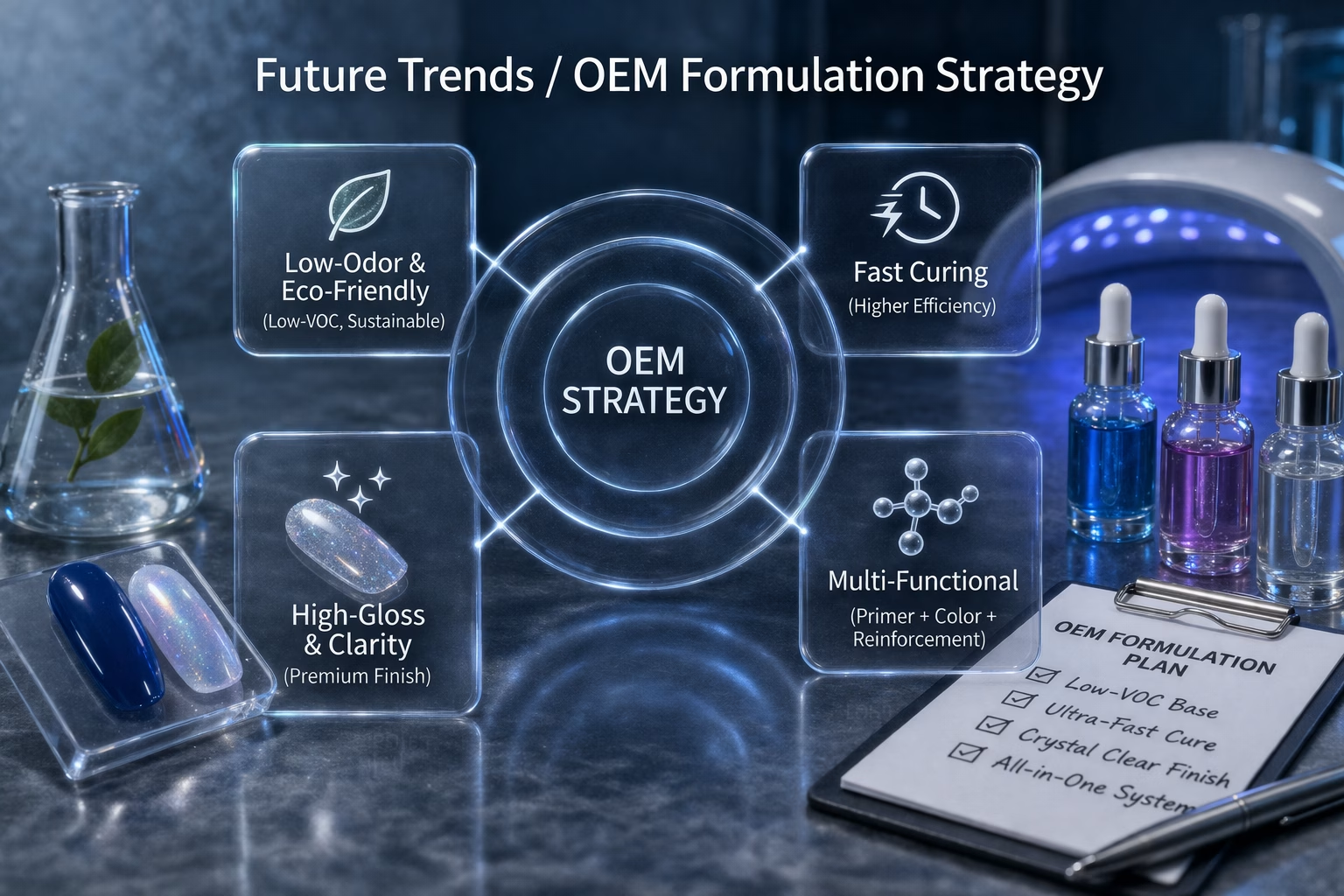
The Shift Toward Safer and More Advanced Acrylic Systems
As the nail industry continues to grow globally, material safety and formulation transparency have become increasingly important.
In recent years, both consumers and regulatory bodies have started paying closer attention to the ingredients used in gel nail products. This has led to a major shift in how acrylic-based systems are designed.
One of the most significant developments is the move toward low-sensitivity and HEMA-reduced or HEMA-free systems.
HEMA, or hydroxyethyl methacrylate, has been widely used in nail formulations for decades due to its excellent adhesion properties and high reactivity. However, it is also known to be a potential sensitizer, especially when products are improperly cured or overexposed to skin.
As awareness of these risks has increased, many manufacturers have begun reformulating their systems to reduce or replace HEMA with alternative monomers.
This is not a simple substitution.
Replacing a key monomer like HEMA requires a complete rebalancing of the formulation, including adjustments to:
• adhesion performance
• curing speed
• viscosity
• crosslink density
• compatibility with other components
A well-designed acrylic system can achieve similar or even improved performance without relying heavily on traditional sensitizing monomers. However, this requires deeper expertise in resin design and formulation engineering.
Managing Heat Generation During Curing
Another important trend in acrylic-based gel systems is the focus on low-heat curing.
During polymerization, acrylic systems release heat as a result of exothermic reactions. In high-reactivity systems, this can lead to discomfort or even pain for the user, especially in thicker applications such as builder gels.
This issue has become more visible as builder gel systems have grown in popularity.
To address this, formulators are now focusing on reducing peak exothermic reactions by adjusting:
• monomer reactivity
• photoinitiator systems
• curing kinetics
• layer thickness compatibility
The goal is to create a curing profile that is more gradual and controlled, while still achieving full polymerization.
Acrylic systems offer flexibility in this area because curing behavior can be fine-tuned through formulation design. By controlling reaction speed and network formation, manufacturers can significantly reduce heat spikes without compromising final performance.
This has become an important differentiator in professional salon environments, where comfort and consistency are critical.
Flexibility vs Strength: The New Balance in Gel Systems
Traditionally, gel nail products were often divided into two categories:
• hard, durable systems
• soft, flexible systems
However, modern formulations are moving toward a more balanced approach.
Consumers now expect products that are both durable and comfortable. Nails should resist chipping and breaking, but they should also feel natural and flexible.
Achieving this balance requires careful control of acrylic resin composition.
Too rigid a system leads to brittleness and cracking. Too soft a system results in poor durability and wear resistance.
The current trend is toward hybrid flexibility systems, where:
• flexible oligomers are combined with controlled crosslinking
• stress distribution is improved across the film
• impact resistance is enhanced
This is particularly important for:
• builder gels
• rubber base systems
• overlay applications
Acrylic systems remain the preferred material for achieving this balance because their structure can be adjusted at a molecular level.
The Role of Acrylic Resin in Multi-Functional Products
Another important development is the rise of multi-functional gel systems.
Instead of using multiple separate products, many modern formulations aim to combine functions such as:
• base + builder
• builder + color
• strengthening + repair
This reduces application time and simplifies salon workflows.
However, combining multiple functions into a single product significantly increases formulation complexity.
The resin system must simultaneously provide:
• adhesion
• structure
• flexibility
• compatibility with pigments
• stable curing behavior
Acrylic-based systems are uniquely capable of supporting this level of integration.
By adjusting monomer and oligomer combinations, formulators can create systems that deliver multiple performance attributes without compromising stability.
OEM Strategy: Why Resin Design Determines Product Differentiation
For brand owners and distributors, understanding acrylic resin is not just a technical issue—it is a strategic advantage.
In today’s competitive market, many gel products appear similar on the surface. Packaging, color names, and marketing language can be easily replicated.
What cannot be easily copied is resin system design.
The performance of a gel product—how it applies, how it cures, how it wears over time—is largely determined by its underlying resin architecture.
This creates an important opportunity for differentiation.
Brands that work with manufacturers capable of advanced resin design can develop products that:
• apply more smoothly
• cure more consistently
• last longer
• feel more comfortable
• perform reliably across different climates and conditions
These differences may not always be visible at first glance, but they become very clear in real-world use.
From Product Imitation to System Innovation
The nail industry is gradually moving away from simple product imitation toward system-level innovation.
In the past, many brands focused on copying popular colors or effects.
Today, the focus is shifting toward:
• building complete product systems
• improving technical performance
• ensuring consistency across product lines
• optimizing user experience
Acrylic resin plays a central role in this transition.
Because it serves as the foundation for all gel products, improvements in resin design can be applied across entire product systems.
For example, a well-designed resin platform can be used to develop:
• base coats
• builder gels
• color gels
• top coats
all within a unified performance framework.
This creates a more consistent and reliable experience for both technicians and end users.
The Future of Acrylic-Based Gel Systems
Looking ahead, acrylic resin will continue to evolve alongside the nail industry.
Several directions are already emerging:
More Skin-Friendly Formulations
There will be continued development of low-sensitivity systems with reduced allergen potential. This will require new monomer designs and improved formulation strategies.
Improved Curing Efficiency
As LED technology advances, formulations will be optimized for faster and more complete curing under different wavelengths.
Higher Performance Materials
Future acrylic systems will offer improved durability, scratch resistance, and long-term stability without sacrificing flexibility.
Greater Customization for OEM Clients
Manufacturers will increasingly offer tailored resin systems designed for specific brand needs, market positioning, and application scenarios.
Final Insight: The True Value of Acrylic Resin
At first glance, acrylic resin may appear to be just another ingredient in a gel nail product.
In reality, it is the foundation upon which the entire system is built.
Its true value lies in its ability to be engineered, adjusted, and optimized for real-world performance.
From adhesion and flexibility to curing behavior and long-term durability, nearly every critical property of a gel product can be traced back to the design of the base resin.
This is why, even as new materials and technologies emerge, acrylic resin remains at the core of the industry.
For manufacturers, it represents a platform for innovation.
For brands, it represents a key point of differentiation.
And for the future of the nail industry, it remains one of the most important materials driving performance, reliability, and continuous improvement.
FAQ — Acrylic Resin in Gel Nail Products
What is acrylic resin in gel nail products?
Acrylic resin in gel nail products is a polymer system based on acrylate and methacrylate monomers that forms the structural foundation of UV or LED-curable gels. It determines key properties such as adhesion, flexibility, and durability.
Why is acrylic resin important in gel nail formulations?
Acrylic resin is important because it controls how the gel cures, how it adheres to the nail, and how it performs over time. It directly affects gloss, strength, crack resistance, and overall stability.
What is the difference between monomers and oligomers in acrylic systems?
Monomers are small molecules that control reactivity and viscosity, while oligomers are larger structures that determine mechanical performance such as flexibility, hardness, and durability.
Why can gel nails crack or feel brittle?
Brittleness usually comes from high crosslink density or improper resin balance. If the acrylic resin system is too rigid, it cannot absorb stress, leading to cracks or breakage.
What makes builder gel different from base coat gel in terms of resin design?
Builder gels require higher structural strength and self-leveling properties, while base coats focus more on adhesion and flexibility. This difference comes from how the acrylic resin system is designed.
Are HEMA-free gel systems still based on acrylic resin?
Yes. Even HEMA-free systems are still based on acrylic chemistry. They use alternative monomers to reduce sensitivity while maintaining performance.
How does acrylic resin affect curing under UV or LED lamps?
Acrylic resin reacts through photopolymerization. When exposed to light, it forms a crosslinked network. The formulation determines curing speed, heat generation, and final hardness.
Why do some gels feel thick or hard to apply?
This is usually related to the type of acrylic oligomers used. Higher molecular weight resins increase viscosity and thickness, which is common in builder gels.
Can acrylic resin improve nail durability?
Yes. Properly designed acrylic systems improve wear resistance, reduce lifting, and increase the lifespan of gel nail applications.
Why do different brands perform differently even with similar colors?
Because the underlying acrylic resin system is different. Even if the color looks the same, formulation differences affect application, curing, and durability.