
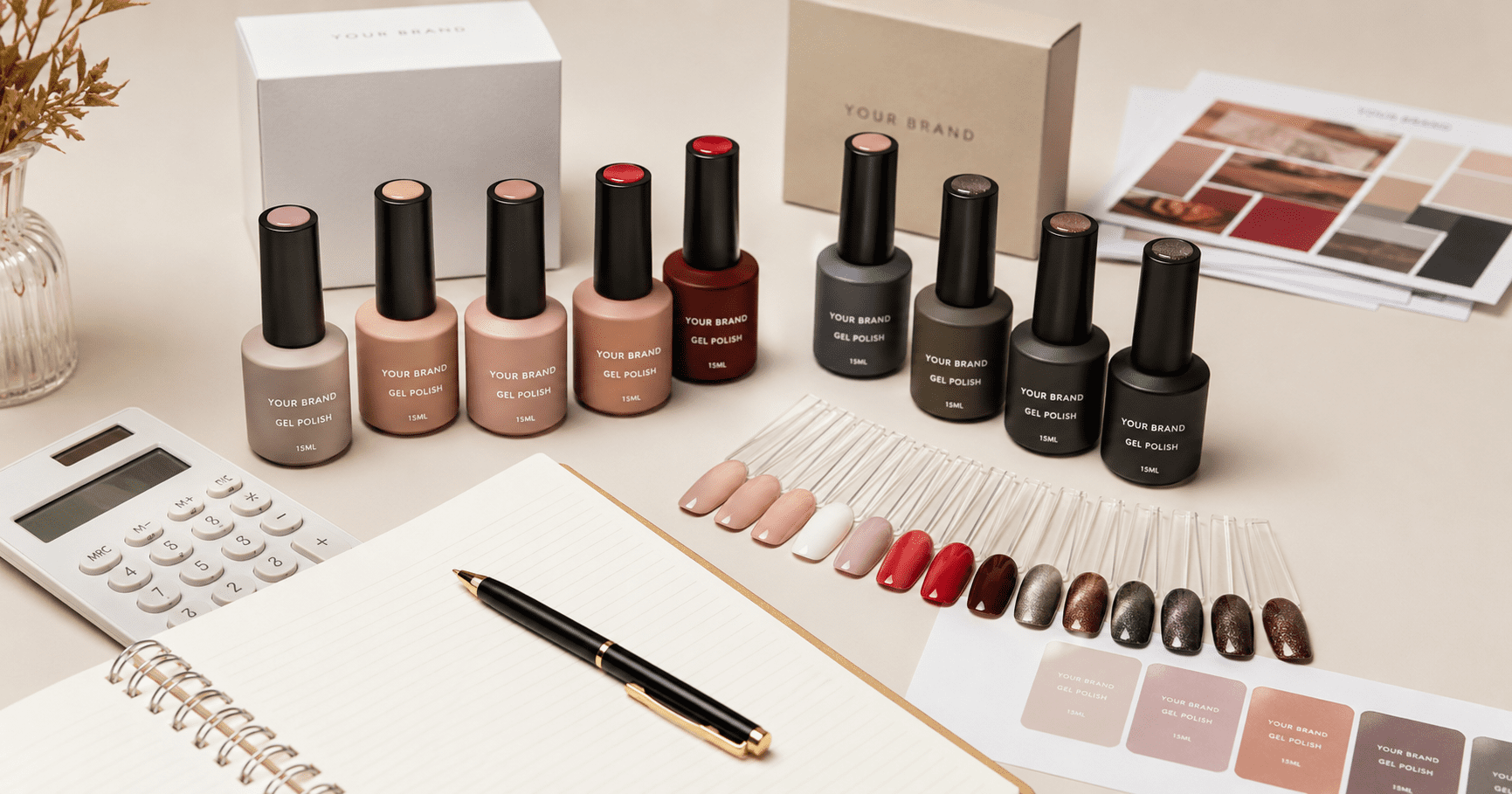
1. Introduction: Why Startup Budget Planning Matters for New Nail Brands
Starting a private label gel polish brand is not only about choosing beautiful colors and placing your logo on a bottle. For most new nail brand owners, the real challenge begins before the first order is placed: understanding what the full startup budget should include.
Many buyers search for Low MOQ Private Label Gel Polish because they want to launch a nail brand without committing to very large inventory. This is a smart direction, especially for small salons, Shopify stores, Amazon sellers, TikTok beauty creators, boutique retailers, and new distributors testing the market for the first time. Low MOQ allows a brand to start with a smaller quantity, validate colors, test packaging, create product photos, and collect real customer feedback before scaling.
However, low MOQ does not mean the project has no budget pressure. A private label gel polish startup budget usually includes more than the product itself. Buyers also need to consider samples, bottle selection, label design, packaging, product photography, shipping, documentation, launch content, and reorder planning. If these costs are not planned early, a “small first order” can still become confusing, delayed, or commercially inefficient.
A common mistake is to ask only one question: “How much is one bottle?” While unit price matters, it is only one part of the total startup budget. A more professional question is: “What budget do I need to launch a private label gel polish line that looks credible, performs consistently, and can be reordered smoothly?”
This article helps new buyers understand how to plan a practical private label gel polish startup budget before ordering. It explains what affects cost, what can be controlled at low MOQ, which customization choices are worth making first, and which upgrades should wait until the brand has sales data.
For new nail brands, budget planning is not just accounting. It directly affects product positioning, first collection size, packaging quality, sales channel readiness, customer trust, inventory risk, and long-term brand growth.
2. What Startup Budget Means in Private Label Gel Polish
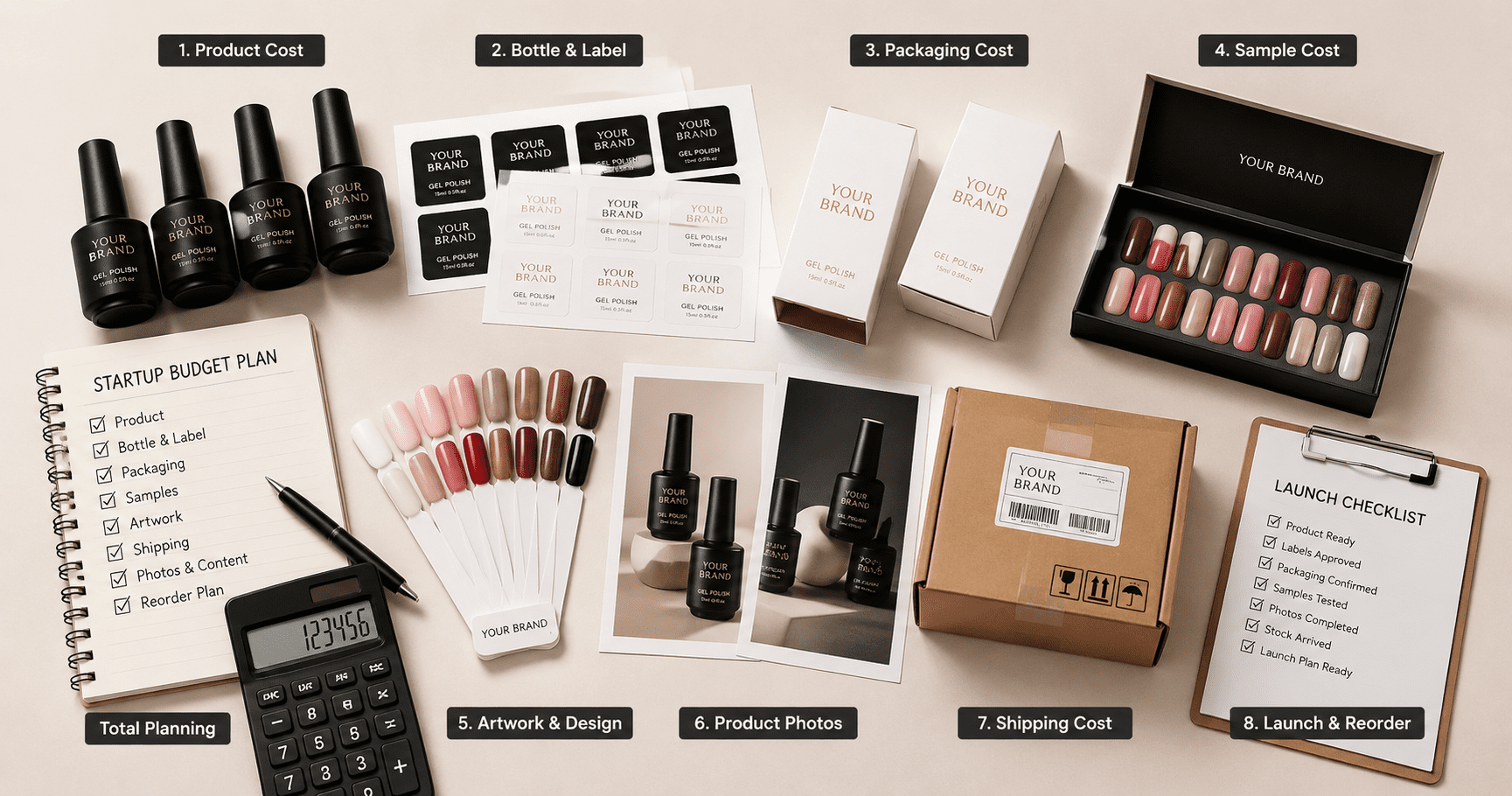
In private label gel polish, the startup budget refers to the total investment needed to move from brand idea to sellable product. It is not limited to gel polish production. It includes all the decisions required to create a professional first launch.
A private label gel polish startup budget may include:
- Product selection
- Color selection
- Formula direction
- Bottle size
- Bottle style
- Logo label or printing
- Color number label
- Packaging box or set box
- Sample preparation
- Artwork preparation
- Quality testing
- Shipping
- Export documents when required
- Product photography
- Launch content
- Sales platform preparation
- Reorder reserve
For a low MOQ project, the goal is not to customize everything at once. The goal is to choose the most important brand elements first while keeping the project commercially manageable.
What Can Usually Be Done with Low MOQ
Low MOQ private label gel polish is most suitable when the buyer starts with a practical structure, such as:
- Existing gel polish formula
- Ready color chart selection
- 15ml standard bottle
- Logo label
- Simple color number system
- Basic but clean packaging
- Small collection launch
- Sample testing before production
This approach allows new brands to enter the market faster and reduce inventory risk. It is especially useful for buyers who want to test customer demand before investing in custom molds, exclusive formulas, or luxury packaging.
What Usually Requires a Higher Budget
Some customization choices may require higher MOQ, longer preparation time, or additional cost. These may include:
- Custom bottle molds
- Fully exclusive formula development
- Deep custom color matching across many shades
- Bottle silk-screen printing
- hot stamping
- Luxury rigid boxes
- Magnetic gift boxes
- Special trays
- Complex set packaging
- Large packaging material MOQ
- Market-specific testing or compliance requirements
This does not mean these options are not valuable. For established brands, they can create strong shelf appeal and differentiation. But for a startup, they should be considered carefully. A beautiful but over-complicated first launch can create unnecessary pressure before the brand has proven sales demand.
Why Budget Planning Matters Before Ordering
Good budget planning helps buyers answer several important questions:
- How many colors should I launch first?
- Should I choose ready colors or custom colors?
- Should I start with labels or bottle printing?
- Do I need individual boxes?
- Is my packaging suitable for my sales channel?
- How much should I reserve for samples and revisions?
- Can I reorder the same colors later?
- What should I upgrade after the first launch?
A successful first order is not always the biggest order. Often, the best first order is controlled, focused, professionally presented, and easy to reorder.
3. Who This Budget Guide Is Best For
A private label gel polish startup budget looks different depending on the buyer’s sales model. A salon owner, Amazon seller, TikTok influencer, and distributor may all order gel polish, but their budget priorities are not the same.
New Nail Brand Owners
For new nail brand owners, the first budget should focus on brand credibility and market validation. This means choosing a manageable number of colors, creating a clean brand identity, testing samples, and preparing professional product visuals.
The priority is not to look like a large global brand immediately. The priority is to launch a focused collection that customers can understand and trust.
A good first budget may prioritize:
- 6–12 strong colors
- Professional logo label
- Clear product naming
- Consistent bottle presentation
- Sample approval
- Product photography
- Reorder planning
Small Salon Owners
Salon owners usually care most about performance, repeat use, and customer satisfaction. Their budget should focus less on luxury packaging and more on product quality, wearability, curing performance, brush control, color coverage, and salon-friendly shade selection.
For salons, the best first collection often includes wearable colors that clients request repeatedly:
- Nude shades
- Milky shades
- Soft pinks
- Classic red
- French manicure colors
- Seasonal accent shades
- Functional gels such as base coat and top coat
Salon buyers should avoid spending too much budget on packaging that does not improve the client experience. Product performance and color repeatability are usually more important.
Salon Chains
Salon chains need stronger planning than individual salons because consistency matters across locations. Their budget should consider batch consistency, staff training, shade numbering, reorder timing, and packaging durability.
For salon chains, a low MOQ test order can be useful for internal evaluation before expanding to multiple branches.
Budget priorities may include:
- Core shade system
- Functional gel system
- Training-friendly product names
- Consistent viscosity
- Clear curing instructions
- Reorder availability
- Internal sample testing
Amazon Sellers
Amazon sellers need to think beyond the bottle. Their budget may include packaging protection, barcode labels, listing images, product bundles, compliance-related text, and customer review risk.
For Amazon, the product must look professional in photos and survive shipping. A low-cost bottle with weak packaging may create problems if customers receive damaged products.
Amazon budget priorities may include:
- Strong box packaging
- Clean product label
- Barcode-ready packaging area
- Product image preparation
- Bundle planning
- Clear warning text
- Shipping protection
- Consistent color numbering
Shopify Sellers
Shopify sellers have more freedom to build a brand story, so their budget should focus on visual identity, product photography, collection naming, and website presentation.
A Shopify launch does not always require luxury packaging at the beginning, but it does need a consistent look. The customer should feel that the product belongs to a real brand, not a random unbranded bottle.
Useful budget priorities include:
- Brand color direction
- Product photography
- Collection story
- 6–12 shade launch
- Clean label design
- Simple but premium packaging
- Social media content
TikTok and Instagram Influencer Brands
Influencer brands often need visual impact. Their budget should support colors that perform well on camera, packaging that looks attractive in short videos, and product concepts that are easy to explain.
For this buyer type, color selection and visual storytelling are especially important. A product that looks interesting in swatches, application videos, and unboxing content may perform better than a technically complex but visually ordinary product.
Budget priorities may include:
- Trend-driven colors
- Cat eye gel
- Jelly gel
- Glitter gel
- Viral shade names
- Unboxing-friendly packaging
- Short video content
- Hand model application visuals
Nail Training Academies
Training academies need practical, repeatable products. Their startup budget should focus on kits that students can use easily, such as base coat, top coat, color gels, builder gels, and nail art products.
Academy buyers should consider:
- Functional gel kits
- Student-friendly color selection
- Clear labels
- Durable packaging
- Bulk reorder planning
- Consistent product texture
- Training demonstration needs
Local Distributors and Small Wholesalers
Distributors and wholesalers need to think about resale, shelf appeal, and inventory turnover. Their budget should not only cover the first purchase but also support sample distribution, sales materials, and reorder planning.
A distributor may start with low MOQ to test which colors sell best in the local market before building a larger inventory.
Budget priorities may include:
- Market-friendly shade selection
- Sample kits for clients
- Display-ready packaging
- Bestseller testing
- Reorder timing
- Wholesale margin planning
- Regional preferences
4. How It Works in a Low MOQ OEM Project
A low MOQ private label gel polish project usually starts with controlled customization. Instead of developing everything from zero, the buyer works with an OEM manufacturer to select existing formulas, choose ready colors, apply private label branding, and prepare a first launch collection.
For suitable low MOQ private label gel polish projects, YICHUN / GELOEM can support orders starting from 60 bottles per color with 15ml net content, depending on product type, packaging method, customization level, and production schedule.
This MOQ logic is important. It should not be understood as universal for every possible customization. A standard private label project with existing colors and logo labels is more low-MOQ friendly. A project involving custom formula development, exclusive colors, special bottle molds, or luxury packaging may require higher MOQ and longer preparation time.
Basic Low MOQ Project Logic
A practical low MOQ gel polish project may follow this structure:
| Project Element | Low MOQ-Friendly Choice | Budget Advantage | Buyer Benefit |
|---|---|---|---|
| Formula | Existing proven formula | Lower development pressure | Faster sample approval |
| Colors | Ready color chart selection | Lower color matching cost | Easier first launch |
| Bottle | 15ml standard bottle | Stable packaging supply | Professional appearance |
| Branding | Logo label | Lower setup cost than mold printing | Suitable for startups |
| Emballage | No box or simple folding box | Controlled packaging cost | Flexible channel testing |
| Collection Size | 6–12 colors | Lower inventory risk | Easier market validation |
| Testing | Sample kit before order | Reduces quality risk | Better launch confidence |
This structure allows a new buyer to create a real branded product without taking on the complexity of full custom development.
Why Low MOQ Helps Budget Control
Low MOQ helps buyers reduce three major risks:
First, it reduces inventory risk. New brands often do not know which colors will sell best. Starting with fewer bottles per color allows the buyer to test demand before committing to large stock.
Second, it reduces decision risk. Buyers can test product performance, packaging appearance, and customer feedback before upgrading.
Third, it reduces cash flow pressure. Instead of spending too much on the first order, the buyer can reserve budget for marketing, photography, platform setup, and reorder.
Why Low MOQ Still Needs Professional Planning
Low MOQ does not mean casual ordering. Even a small project needs clear decisions:
- Which customer group will buy the product?
- Which colors fit the market?
- What product category should launch first?
- What bottle and label style match the brand?
- Is the product for salon use, retail, Amazon, TikTok, or wholesale?
- What information must appear on the label?
- How will the buyer reorder the same shades later?
Without these answers, even a low MOQ order can become inefficient.
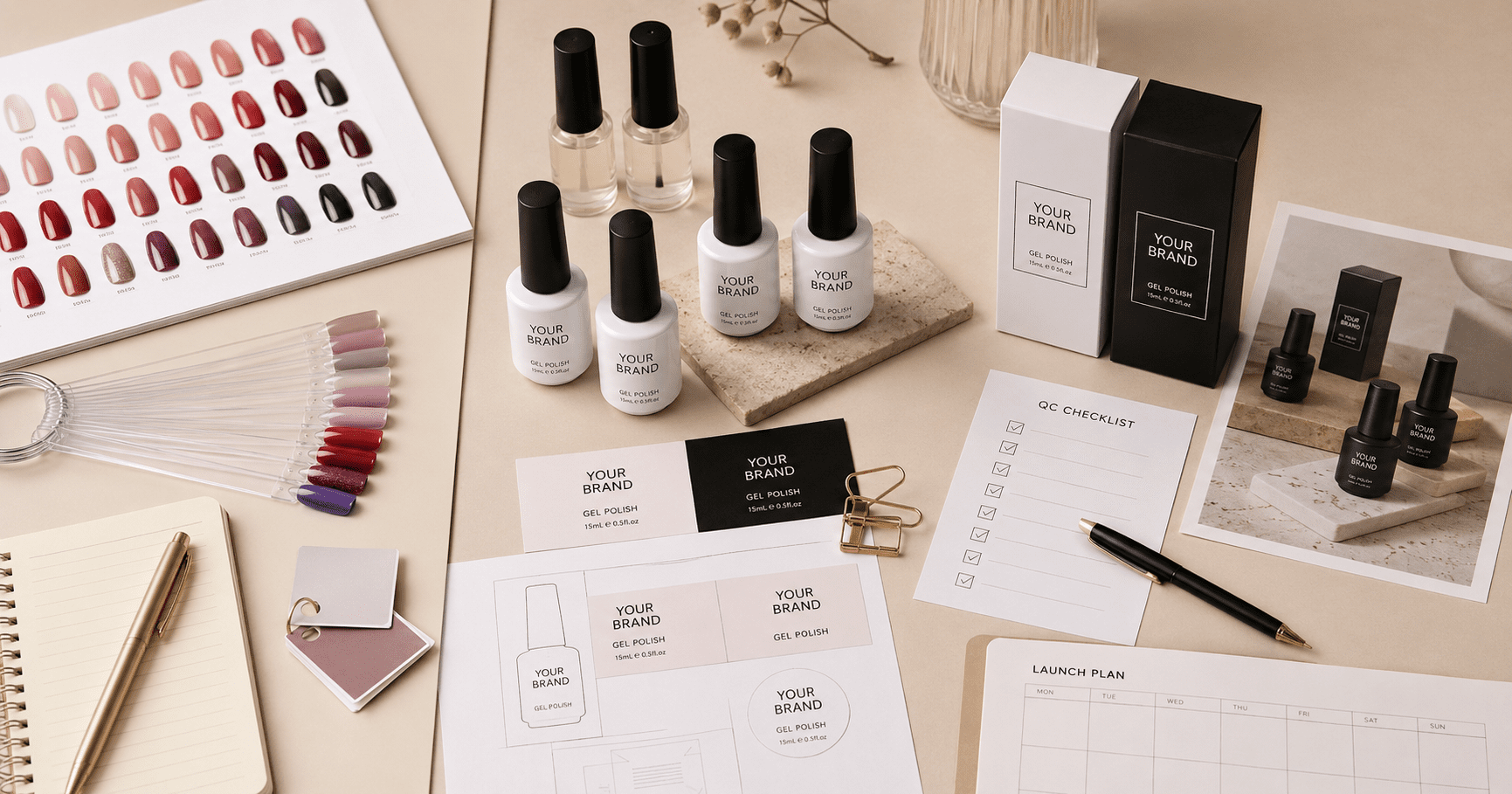
5. Step-by-Step Process: How to Plan Your Startup Budget Before Ordering
A private label gel polish startup budget should be planned in stages. Each stage affects cost, timeline, and launch quality.
Step 1: Define Your Sales Channel First
Before choosing colors or packaging, define where the product will be sold.
A salon brand does not need the same packaging as an Amazon product. A TikTok launch does not need the same budget priorities as a distributor catalog. A Shopify brand may need stronger visual identity, while a training academy may need practical kit structure.
Ask yourself:
- Will I sell in salons?
- Will I sell online?
- Will I sell through Amazon?
- Will I sell through TikTok or Instagram?
- Will I sell wholesale to other salons?
- Will I use the products inside my own academy?
- Will I sell single bottles, sets, or both?
This decision affects bottle design, label information, packaging strength, product photography, and SKU planning.
Step 2: Separate Your Budget into Core and Optional Parts
A professional startup budget should separate essential costs from upgrade costs.
Essential budget usually includes:
- Product cost
- Bottle and cap
- Label
- Basic packaging
- Samples
- Shipping
- Basic product photos
- Launch preparation
Optional upgrade budget may include:
- Custom color development
- Bottle printing
- Luxury packaging
- Special box structure
- Premium tray
- Extra sample rounds
- Advanced product video
- Influencer seeding
- Additional testing documents
This separation helps buyers avoid spending too much on upgrades before the product concept is validated.
Step 3: Choose Your First Product Category
Not every gel product is suitable for every startup. A first launch should be easy to understand and easy to sell.
Common first-launch categories include:
- Color Gel Polish
- Gel pour yeux de chat
- Jelly Gel
- Builder Gel
- Rubber Base Gel
- Couche de base
- Top Coat
- Matte Top Coat
- Steel Top Coat
- Gel Blooming
- Nail Art Gel
For most new brands, a focused first collection is better than a scattered catalog. For example, a buyer may choose one of these launch directions:
- A 12-color nude and milky collection
- A 12-color seasonal color gel collection
- A cat eye gel collection for social media
- A functional gel starter kit
- A salon base and top system
- A small builder gel range
A clear product category makes budget planning easier.
Step 4: Decide How Many Colors to Launch
Color quantity is one of the biggest budget factors. More colors mean more bottles, more labels, more inventory, more product photos, and more SKU management.
For many startups, 6–12 colors is a practical first launch range. It is enough to create a real collection, but not so large that inventory becomes difficult to manage.
A useful first-order structure may include:
| Collection Type | Suggested First Launch Size | Best For | Budget Logic |
|---|---|---|---|
| Mini Starter Collection | 6 colors | Very new brands, salons, testing | Lowest inventory pressure |
| Standard Launch Collection | 12 colors | Shopify, salon retail, influencers | Balanced visual impact and control |
| Expanded Salon Collection | 24 colors | Growing salons, distributors | More complete shade coverage |
| Professional Full Set | 60 colors | Established brands, wholesalers | Higher inventory and planning needs |
The right number depends on sales channel, brand maturity, and available budget.
Step 5: Choose Ready Colors or Custom Colors
Ready colors are usually more suitable for low MOQ startup projects. They allow buyers to reduce development time and focus on branding, packaging, and launch.
Custom colors can be valuable, but they may require more sample rounds, color matching, communication, and sometimes higher MOQ. For a new brand, it may be better to start with ready colors and customize shade names, collection stories, packaging style, and product visuals first.
A practical approach is:
- Use ready colors for the first launch
- Collect customer feedback
- Identify bestsellers
- Develop custom colors for the second or third collection
- Upgrade packaging after sales validation
This approach protects budget while still allowing brand development.
Step 6: Confirm Bottle, Label, and Packaging Level
Bottle and packaging decisions can change the budget significantly.
For a low MOQ project, a standard 15ml bottle with a clean logo label is often the most practical choice. It looks professional, supports private label branding, and avoids the higher setup pressure of custom bottles or complex printing.
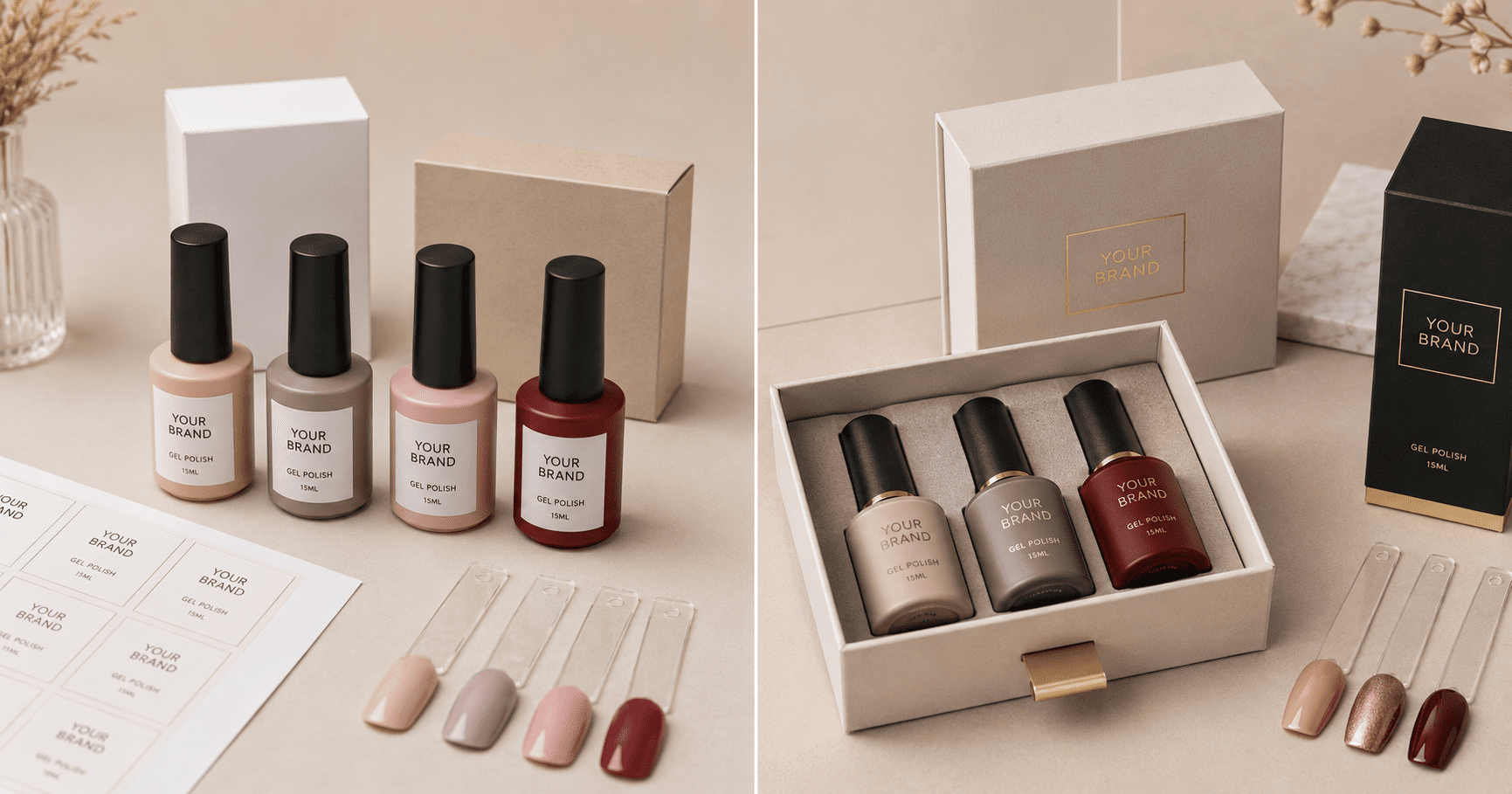
Packaging options may include:
- Bottle only
- Bottle with label
- Bottle with color number label
- Single folding carton
- Set box
- Display box
- Rigid box
- Drawer box
- Magnetic gift box
Startups should match packaging to the sales channel. For example, Amazon sellers may need stronger packaging protection, while salon-use products may not need luxury boxes. Influencer brands may benefit from attractive unboxing packaging, but should still avoid over-investing before demand is proven.
Step 7: Prepare Complete Label Information Early
Incomplete label information can delay production and create extra revisions.
Before confirming artwork, buyers should prepare:
- Brand logo
- Product name
- Color name or color number
- Net content
- Usage direction
- Curing instruction
- Warning text
- Ingredient information if required
- Country or distributor information if needed
- Barcode if needed
- Batch or tracking information if needed
Label content may vary depending on market requirements, product type, and sales channel. Buyers should confirm required label information before production.
Step 8: Request Samples Before Bulk Production
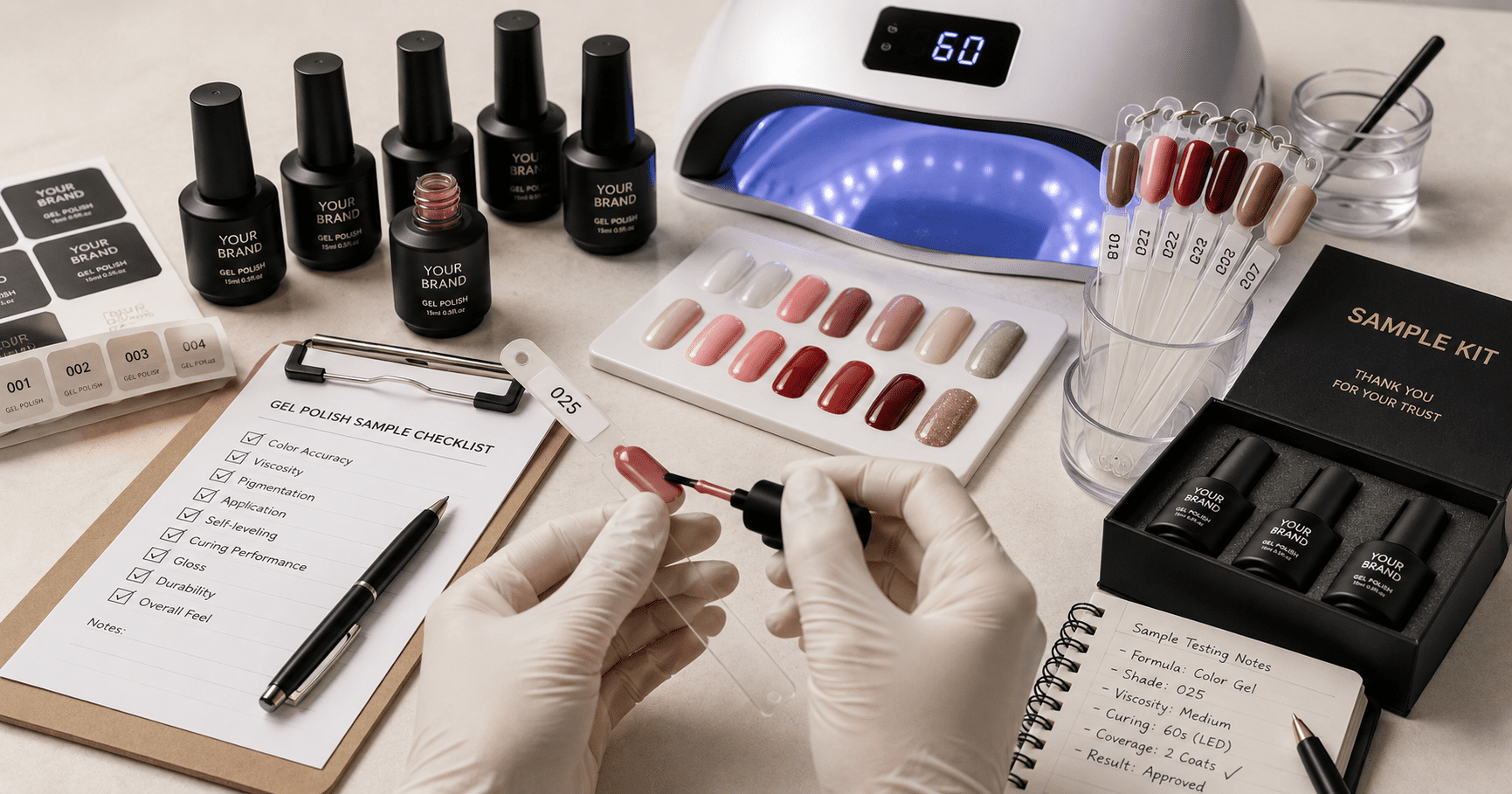
Sample testing is one of the most important budget protection steps. It may feel like an extra cost, but it can prevent more expensive mistakes later.
Samples help buyers check:
- Color accuracy
- Viscosity
- Pigmentation
- Gloss
- Curing performance
- Brush feel
- Bottle appearance
- Label position
- Packaging direction
- Overall brand presentation
For gel polish products, buyers should not judge only by bottle appearance. They should test application, curing, finish, and wear performance in real use conditions.
Step 9: Reserve Budget for Launch Content and Reorder
Many startups spend all their budget on product and forget launch content. This creates a problem: they receive the goods but do not have enough product photos, videos, listing images, swatch charts, or marketing materials to sell effectively.
A realistic startup budget should reserve resources for:
- Product photos
- Swatch photos
- Application videos
- Short-form video content
- Website product pages
- Amazon listing images
- Social media launch posts
- Sample seeding
- Reorder planning
A private label gel polish launch is not complete when the product is manufactured. It is complete when the product is ready to sell.
6. Customization Options and Key Budget Variables
Customization is where many startup budgets become unclear. Buyers often ask, “Can I customize this?” The answer is usually yes, but the more important question is: “Is this customization suitable for my first budget?”
Some customization options are low-MOQ friendly. Others are better for growing or established brands.
Low MOQ Customization Options Table
| Customization Area | Low MOQ Friendly? | Best For | Budget Notes |
|---|---|---|---|
| Ready Gel Formula | Yes | Startups, salons, Shopify sellers | Lower development pressure |
| Ready Color Selection | Yes | First launch collections | Faster and easier than custom color matching |
| 15ml Standard Bottle | Yes | Most private label projects | Practical and professional |
| Logo Sticker Label | Yes | New brands, low MOQ projects | Good balance of branding and cost |
| Color Number Label | Yes | Salon and retail organization | Helps SKU management |
| Simple Folding Box | Usually yes | Amazon, retail, gift sets | Check packaging MOQ |
| Set Box | Sometimes | Kits and collections | MOQ may depend on structure |
| Bottle Silk-Screen Printing | Depends | Growing brands | Higher setup and MOQ may apply |
| Hot Stamping | Depends | Premium positioning | Better after brand validation |
| Custom Bottle Mold | Usually no for startups | Established brands | Higher MOQ and development cost |
| Luxury Rigid Box | Usually higher MOQ | Premium gift sets | Strong visual value but higher budget pressure |
| Custom Formula | Usually higher budget | Mature brands | Requires more testing and development |
| Exclusive Shade Development | Depends | Differentiated collections | May require sample rounds |
Product Variables That Affect Budget
Product cost depends on the gel type and formula direction. A basic color gel polish may have a different cost structure from cat eye gel, glitter gel, builder gel, rubber base gel, or special effect gel.
Budget can be affected by:
- Gel type
- Pigment level
- Glitter or magnetic particle effect
- Transparency
- Viscosity
- Builder texture
- Functional performance
- HEMA-free or TPO-free direction when required
- Sample testing needs
- Color matching complexity
Special-effect products may require more careful sampling and quality evaluation because visual performance matters strongly.
Packaging Variables That Affect Budget
Packaging can look simple from the outside, but it often has hidden cost factors.
Packaging budget may depend on:
- Box material
- Box size
- Printing method
- Surface finish
- Quantity
- Tray structure
- Inner protection
- Label material
- Barcode needs
- Shipping durability
- Packaging supplier MOQ
A startup should not choose packaging only by appearance. Packaging must match the sales model. For example, a beautiful but weak box may not be suitable for e-commerce shipping. A luxury box may look impressive but may reduce margin if the product is still untested.
Collection Variables That Affect Budget
The number of colors and product types directly affects startup cost.
A 12-color collection with one bottle type and one label system is easier to manage than a mixed launch containing color gel, cat eye gel, builder gel, rubber base, top coat, nail art gel, and multiple packaging styles.
A focused collection is usually better for a first budget because it simplifies:
- Sampling
- Label design
- Production planning
- SKU management
- Product photography
- Website upload
- Inventory tracking
- Reorder
7. MOQ, Cost, Timeline, and Hidden Factors
Budget planning becomes clearer when buyers understand three levels of private label gel polish projects.
Level 1: Low MOQ Private Label
This is the most startup-friendly level.
Typical structure:
- Existing formula
- Ready colors
- 15ml standard bottle
- Logo label
- Basic color number system
- Simple packaging or no box
- Suitable for market testing
For suitable projects, this level may support low MOQ private label gel polish orders starting from 60 bottles per color with 15ml net content, depending on product type, packaging method, customization level, and production schedule.
This level is best for:
- New nail brands
- Small salon owners
- Shopify sellers
- TikTok launch brands
- First-time private label buyers
- Market testing projects
The main advantage is budget control. Buyers can create a branded product without committing to deep custom development.
Level 2: Enhanced OEM Customization
This level is suitable for growing brands that want stronger differentiation.
Typical structure:
- Selected formula direction
- Ready colors plus limited custom colors
- Better label material
- Optional single box
- Improved packaging presentation
- Collection naming
- More complete product system
This level may involve more artwork preparation, sample approval, packaging confirmation, and production coordination.
It is best for:
- Brands with early sales data
- Salon chains
- Boutique retailers
- Amazon sellers preparing stronger listings
- Distributors testing a regional market
- Influencer brands building a more complete product identity
The main advantage is stronger brand value. The buyer can upgrade visual identity without moving directly into expensive custom molds or full ODM development.
Level 3: Deep Custom OEM / ODM
This level is usually better for established brands with clearer sales channels and larger budgets.
Typical structure:
- Custom formula
- Exclusive colors
- Custom bottle mold
- Bottle silk-screen printing
- Hot stamping
- Luxury set box
- Special tray
- Market-specific compliance support
- Larger production planning
This level may require higher MOQ, longer timeline, more sample rounds, and more detailed technical communication.
It is best for:
- Established nail brands
- Large distributors
- Salon chains with proven demand
- Retail brands with clear positioning
- Brands preparing long-term product lines
The main advantage is brand differentiation. The main risk is higher upfront investment before the product has been fully tested in the market.
Main Cost Categories Buyers Should Plan
| Budget Category | Why It Matters | Startup Planning Advice |
|---|---|---|
| Product Formula | Affects performance and positioning | Choose stable formulas first |
| Number of Colors | Affects total inventory cost | Start with 6–12 focused shades |
| Quantity Per Color | Affects MOQ and stock level | Match quantity to sales channel |
| Bottle and Cap | Affects brand presentation | Use standard 15ml bottle for budget control |
| Label Material | Affects visual quality and durability | Choose clean, waterproof label when suitable |
| Printing Method | Affects setup cost | Start with labels before advanced printing |
| Box Packaging | Affects shelf appeal and shipping | Match packaging to channel |
| Samples | Reduces production risk | Always test before final order |
| Artwork | Affects brand consistency | Prepare logo and label details early |
| QC and Inspection | Affects product reliability | Confirm key quality points |
| Exporter des documents | May be needed by market or shipping method | Confirm before production |
| Shipping | Affects total landed cost | Plan shipping method early |
| Product Photos | Affects launch success | Reserve budget for visuals |
| Reorder Reserve | Protects sales continuity | Plan reorder timing before stock runs out |
Hidden Factors That Can Affect the Budget
Many startup buyers underestimate hidden factors. These are not always large costs, but they can create delays or budget changes if ignored.
Common hidden factors include:
- Packaging MOQ being higher than bottle MOQ
- Label artwork revisions
- Barcode label requirements
- Color sample changes
- Custom shade matching time
- Special-effect gel testing
- Box size changes
- Shipping protection requirements
- Market-specific warning text
- Export document needs
- Reorder lead time
- Product photo and video costs
- Platform listing preparation
A professional startup budget should leave room for these variables. Spending every dollar on the first production order may leave no flexibility for launch execution.
Timeline Factors That Affect Budget Planning
Timeline and budget are connected. Delays can increase cost, especially when artwork, packaging, samples, or shipping are not planned early.
A typical private label gel polish project may include:
| Timeline Stage | What Happens | Budget Impact |
|---|---|---|
| Requirement Confirmation | Buyer confirms product type, quantity, and channel | Prevents wrong planning |
| Color Selection | Buyer chooses ready colors or custom direction | More custom work may increase time |
| Sample Preparation | Samples are prepared for testing | Protects against bulk order mistakes |
| Sample Testing | Buyer checks color, curing, viscosity, and finish | May require revision budget |
| Artwork Confirmation | Label and packaging files are finalized | Delays can affect production schedule |
| Packaging Preparation | Labels, bottles, and boxes are prepared | Packaging MOQ may affect cost |
| Bulk Production | Gel polish is filled and packed | Depends on confirmed order details |
| QC Inspection | Product and packaging are checked | Helps reduce after-sale risk |
| Final Packing | Goods are packed for shipment | Shipping protection may add cost |
| Shipping Arrangement | Goods are shipped by selected method | Affects landed cost and delivery planning |
For startups, the most important timeline advice is simple: do not rush into production before samples, artwork, and packaging details are confirmed.
8. Professional Judgment: What Buyers Should Evaluate Before Spending More
A startup budget should not be judged only by how much money is spent. It should be judged by whether each spending decision helps the brand launch, test, sell, and reorder with less risk.
For a first private label gel polish order, the best budget is usually not the most luxurious one. It is the budget that helps the buyer create a professional, market-ready product without over-investing before sales data exists.
What Is Worth Customizing First
For most new gel polish brands, the first customization budget should focus on elements that customers can immediately see, understand, and trust.
These usually include:
- Brand logo label
- Clean bottle presentation
- Consistent color numbering
- Professional product name
- Clear curing instructions
- Basic warning text
- Well-selected first color collection
- Good product photos and swatches
- Simple but reliable packaging
These elements help the product look like a real brand without creating unnecessary complexity.
A startup does not always need a custom bottle mold, luxury rigid box, or exclusive formula at the beginning. Those upgrades may become valuable later, but only after the brand understands which colors sell, which customers reorder, and which product category has real demand.
What Should Wait Until Sales Data Is Available
Some upgrades are attractive but risky for a first launch. They can increase MOQ, timeline, and budget before the product has been tested in the market.
Usually, startups should wait before investing heavily in:
- Custom bottle molds
- Fully exclusive formula development
- Large luxury gift boxes
- Complex tray structures
- Very large color ranges
- Multiple bottle styles
- Too many product categories at once
- Expensive decoration processes
- Highly specific custom colors without buyer feedback
These choices may create brand value, but they should be supported by sales data. If a brand has not yet proven which shades, price points, or customer groups perform best, deep customization can create inventory pressure.
Ready Colors vs. Custom Colors
One of the most important startup budget decisions is whether to choose ready colors or develop custom colors.
Ready colors are usually better for a first low MOQ private label gel polish project because they are easier to sample, easier to approve, and more predictable in production. Buyers can still create brand differentiation through naming, packaging, collection story, product photography, and shade grouping.
Custom colors are useful when the brand already has a clear market concept, such as a signature nude range, a seasonal collection, a salon-exclusive palette, or a social media trend line. However, custom colors may require more sample rounds and more detailed communication.
A practical first-launch strategy is:
| Brand Stage | Better Color Strategy | Reason |
|---|---|---|
| First launch | Ready colors | Lower cost, faster approval, lower risk |
| Early sales stage | Ready colors + selected custom shades | Builds differentiation gradually |
| Growing brand | Custom collection development | Supports stronger brand identity |
| Established brand | Exclusive shades and formula direction | Creates long-term competitive value |
For most startups, the smartest question is not “Can I customize every color?” but “Which colors are worth customizing after I know what customers actually buy?”
Packaging Should Match the Sales Channel
Packaging is another area where buyers often overspend or underspend.
A salon-use product may not need luxury retail packaging. A product sold through Amazon may need stronger box protection and clearer label information. A TikTok launch product may need packaging that looks attractive in short videos. A distributor product may need shelf-ready presentation and easy color identification.
The packaging budget should match the channel:
| Sales Channel | Packaging Priority | Budget Advice |
|---|---|---|
| Salon use | Practical, easy to identify, durable | Focus on bottle label and color number |
| Shopify store | Brand image and photography | Clean label and simple premium box |
| Amazon | Protection, listing clarity, barcode needs | Strong box and consistent SKU system |
| TikTok / Instagram | Visual appeal and unboxing | Attractive but not over-complex packaging |
| Wholesale / Distributor | Shelf appeal and reorder clarity | Consistent packaging and color coding |
| Nail academy | Functional kits and student usability | Clear labels and practical set packaging |
Good packaging should help sell the product. It should not consume so much budget that the buyer cannot afford samples, photos, shipping, or reorder preparation.
When to Scale from Low MOQ to Larger Production
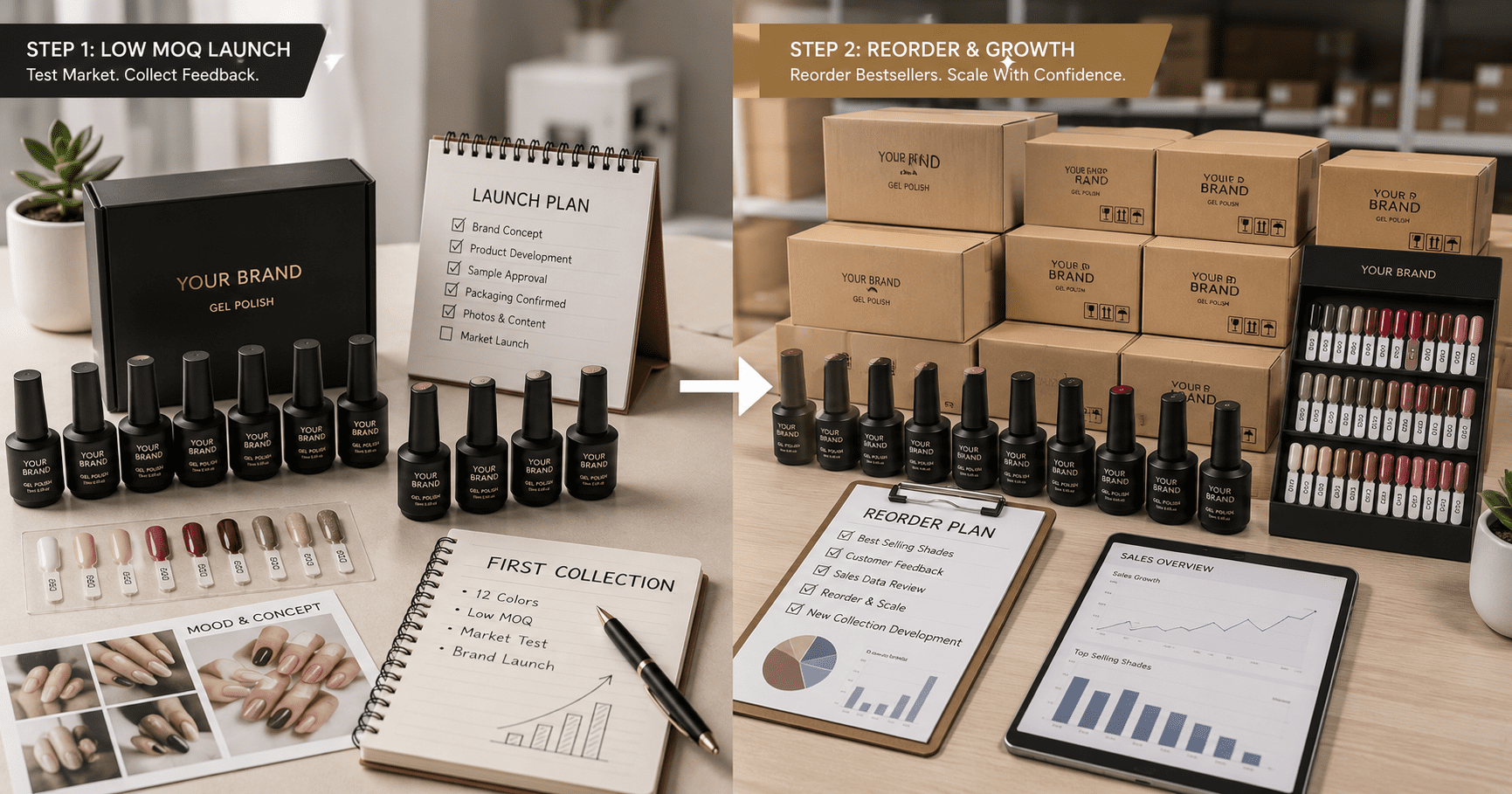
Low MOQ is a starting point, not a limitation. The goal of a first low MOQ private label gel polish order is to learn.
Buyers should consider scaling when they have clear evidence such as:
- Certain colors sell faster than others
- Customers request reorders
- Product reviews are positive
- Salon clients repeat the same shades
- Social media content performs well
- Wholesale buyers ask for larger quantity
- The brand understands its best-selling category
- Packaging feedback is stable
- The buyer can forecast inventory more confidently
Scaling too early can create overstock. Scaling too late can cause stockouts. A professional buyer should monitor sales speed, reorder timing, and customer feedback from the first launch.
9. Common Startup Budget Mistakes to Avoid
Budget mistakes in private label gel polish are not always obvious. Many buyers do not lose money because the product is bad. They lose money because the first order was planned without a clear launch strategy.
Mistake 1: Choosing Too Many Colors Too Early
A large color range looks impressive, but it can create inventory pressure for a new brand. Every additional color increases product cost, label work, product photography, SKU management, and reorder complexity.
For a startup, 6–12 focused colors are often more effective than 48 random shades. A smaller collection is easier to explain, easier to photograph, and easier to test.
A strong first collection may include:
- Core nude shades
- Milky white or soft pink
- Classic red
- Seasonal accent color
- One or two trend shades
- A functional gel if suitable
The goal is not to show everything. The goal is to launch a collection customers can understand.
Mistake 2: Only Comparing Unit Price
Many buyers compare suppliers only by unit price. This can be risky.
A lower unit price may not include the same bottle quality, label quality, pigment level, packaging protection, sample support, or quality control. A slightly cheaper bottle can become expensive if the product leaks, cures poorly, looks inconsistent, or receives customer complaints.
A better comparison should include:
- Formula performance
- Bottle quality
- Brush control
- Label durability
- Packaging protection
- Sample approval process
- Batch consistency
- Communication clarity
- Reorder support
Unit price matters, but it should not be the only decision factor.
Mistake 3: Ignoring Packaging MOQ
Packaging MOQ can be different from product MOQ. A buyer may be able to order a low quantity of gel polish, but custom boxes, trays, printed cartons, or special packaging materials may require higher minimum quantities.
Before confirming a packaging direction, buyers should ask:
- What is the MOQ for this box?
- Is the box standard or custom size?
- Does the packaging supplier require a minimum print quantity?
- Can the same box be used for future colors?
- Is there a simpler packaging option for the first order?
Ignoring packaging MOQ can cause budget surprises.
Mistake 4: Skipping Sample Testing
Skipping samples may save time at the beginning, but it increases risk later.
Gel polish should be tested before production because buyers need to check more than color. They should test curing, viscosity, pigmentation, brush feel, gloss, leveling, application comfort, and final appearance.
Sample testing is especially important for:
- Cat eye gel
- Glitter gel
- Jelly gel
- Builder gel
- Rubber base gel
- Functional gels
- New formula directions
- Custom color projects
A sample cost is not a waste. It is a risk-control tool.
Mistake 5: Spending Too Much on Packaging Before Product Validation
Luxury packaging can make a product look premium, but it does not guarantee sales. If a startup spends too much on packaging before testing customer demand, the brand may have less budget left for product photos, advertising, influencer samples, or reorders.
A better approach is to start with clean, professional packaging and upgrade after sales validation.
For example:
- First launch: logo label + simple box
- Second launch: improved label material + refined box design
- Growth stage: set box, display box, or premium packaging
- Established stage: custom mold, luxury gift box, advanced printing
This keeps the brand flexible.
Mistake 6: Not Preparing Complete Label Information
Label delays are common in private label projects. Buyers may have a logo but not the full product information.
Before artwork confirmation, prepare:
- Product name
- Brand logo
- Net content
- Color number
- Curing time
- Usage direction
- Warning text
- Ingredient information if required
- Distributor or company information if needed
- Barcode if needed
- Batch information if needed
Incomplete label information can delay sampling, packaging preparation, and production.
Mistake 7: Choosing Colors Only by Personal Taste
Personal taste matters, but it should not be the only basis for a commercial collection.
A buyer may love unusual colors, but customers may prefer wearable shades, salon classics, seasonal tones, or trend-driven colors. A startup budget should be used to create a sellable collection, not only a personal favorite collection.
Better color planning considers:
- Target market
- Skin tone compatibility
- Seasonal demand
- Salon usage
- Social media visual impact
- Reorder potential
- Category positioning
- Competitor gaps
A balanced first collection usually combines core shades and trend shades.
Mistake 8: Forgetting Product Photos and Launch Content
A private label order is not ready to sell without visual content.
Many buyers spend their entire budget on products and packaging, then realize they still need:
- White background product photos
- Lifestyle photos
- Swatch images
- Application videos
- Short video clips
- Website images
- Amazon listing images
- Social media posts
- Product descriptions
- Shade charts
For online sales, photos and videos are not optional. They are part of the startup budget.
Mistake 9: Not Planning Reorder Timing
If a color sells well, the buyer needs to reorder before stock runs out. Reorder planning should begin before launch, not after the last bottle is sold.
Buyers should track:
- Sales speed by shade
- Most requested colors
- Slow-moving colors
- Customer reviews
- Seasonal changes
- Production lead time
- Shipping time
- Packaging availability
A successful low MOQ launch can quickly become a problem if the buyer cannot restock popular colors in time.
10. Private Label Gel Polish Startup Budget Checklist
Before placing your first order, use this checklist to review whether your budget is realistic and complete.
| Budget Planning Area | Key Question | Ready? |
|---|---|---|
| Target Market | Do you know who will buy your gel polish? | |
| Sales Channel | Will you sell through salons, Shopify, Amazon, TikTok, wholesale, or academy kits? | |
| Product Category | Have you chosen color gel, cat eye, jelly, builder, base/top, or another category? | |
| Collection Size | Have you decided whether to start with 6, 12, 24, or more colors? | |
| Color Strategy | Are you using ready colors, custom colors, or a mix? | |
| MOQ Planning | Do you understand the MOQ by color, bottle, label, and packaging? | |
| Bottle Choice | Have you selected a practical bottle size and style? | |
| Label Design | Is your logo and label information complete? | |
| Packaging Level | Does your packaging match your sales channel? | |
| Sample Budget | Have you reserved budget for sample testing and possible revisions? | |
| Quality Testing | Will you test curing, viscosity, color, gloss, and application feel? | |
| Product Photos | Have you planned product images, swatches, and videos? | |
| Shipping Budget | Have you considered shipping method and landed cost? | |
| Documents | Have you confirmed whether documents are required for your market? | |
| Launch Content | Do you have product descriptions, listings, and social content planned? | |
| Reorder Plan | Do you know when and how you will reorder bestsellers? |
Startup Budget Priority Table
| Priority Level | What to Spend On | Why It Matters |
|---|---|---|
| Must-Have | Product, bottle, label, samples, shipping | Required to create and receive sellable goods |
| High Priority | Product photos, swatches, clear packaging | Helps customers understand and trust the product |
| Medium Priority | Simple box, collection naming, better label material | Improves brand presentation |
| Optional at First | Luxury box, advanced printing, custom colors | Useful after validation |
| Better Later | Custom mold, exclusive formula, large full-range launch | Best for established brands with sales data |
This table helps buyers avoid spending too much on low-impact upgrades while forgetting essential launch costs.
11. How a Professional OEM Manufacturer Can Support Your Budget Planning
A professional gel polish OEM/ODM manufacturer does more than produce bottles. For startup buyers, the right manufacturer can help turn a limited budget into a more organized launch plan.
As a gel polish OEM/ODM manufacturer, YICHUN / GELOEM can support suitable low MOQ private label projects starting from 60 bottles per color with 15ml net content, while also helping buyers plan colors, packaging, samples, quality control, and future reorders. Final MOQ may depend on product type, packaging method, printing process, formula requirements, customization level, and production schedule.
Professional OEM support may include:
- Ready color chart selection
- Low MOQ private label options
- 15ml bottle recommendations
- Logo label support
- Color number label planning
- Sample kit preparation
- Product category suggestions
- Formula and texture guidance
- Packaging option comparison
- Bottle silk-screen printing guidance when suitable
- Filling and labeling support
- Batch QC inspection
- Packaging inspection
- Export document support when required
- Reorder planning
- Scaling from small batch to larger production
For a startup, this guidance can help prevent over-customization, reduce sampling confusion, and keep the first launch commercially realistic.
The most useful OEM conversation is not only about price. Buyers should discuss:
- Target market
- Product category
- First collection size
- Sales channel
- Packaging level
- Label requirements
- Sample testing plan
- Launch timeline
- Reorder expectations
The clearer the buyer’s plan, the easier it is for the manufacturer to recommend a suitable low MOQ structure.
12. FAQ: Private Label Gel Polish Startup Budget
1. What should a private label gel polish startup budget include?
A private label gel polish startup budget should include product cost, bottle, label, packaging, samples, artwork, shipping, product photos, launch content, and reorder planning. Depending on the market and sales channel, it may also include documentation, barcode labels, box packaging, or additional testing requirements.
2. Can I start a gel polish brand with low MOQ?
Yes, low MOQ private label gel polish is a practical way for new nail brands, salons, Shopify sellers, Amazon sellers, and influencer brands to start with lower inventory risk. For suitable projects, YICHUN / GELOEM can support low MOQ private label gel polish orders starting from 60 bottles per color with 15ml net content, depending on product type, packaging method, customization level, and production schedule.
3. Is 60 bottles per color enough for a first launch?
For many startup projects, 60 bottles per color can be suitable for market testing, sample sales, salon trials, influencer launches, or small e-commerce launches. However, the right quantity depends on your sales channel, launch plan, number of colors, and expected demand.
4. Does low MOQ mean lower quality?
No. Low MOQ does not automatically mean lower quality. Quality depends on the formula, raw materials, production control, filling process, packaging, and QC inspection. A low MOQ project can still use professional gel polish formulas and proper quality control when planned correctly.
5. Should I start with ready colors or custom colors?
Most startups should begin with ready colors because they are more low-MOQ friendly, easier to sample, and faster to approve. Custom colors can be added later when the brand has sales data, customer feedback, and a clearer market direction.
6. How many gel polish colors should I launch first?
Many new brands start with 6–12 colors. This is usually enough to create a real collection while keeping inventory risk manageable. A 24-color or 60-color collection may be better for growing brands, distributors, or salon chains with clearer demand.
7. What packaging should I choose for a first private label order?
For most startups, a standard 15ml bottle with a clean logo label is a practical first choice. Depending on the sales channel, you may add a simple folding box, set box, or barcode-ready packaging. Luxury boxes and custom molds are usually better after market validation.
8. Do I need my own formula to start a gel polish brand?
No. Many private label gel polish brands start with existing proven formulas and ready colors. This helps reduce development cost and launch risk. Custom formula development is possible, but it usually requires more time, testing, and higher budget.
9. What hidden costs should I prepare for?
Hidden costs may include sample revisions, label changes, packaging MOQ, barcode labels, special box structures, product photos, shipping protection, export documents, and reorder timing. Buyers should avoid using the entire budget only for production.
10. When should I upgrade from low MOQ to bulk production?
You should consider scaling when you have clear sales data, positive customer feedback, repeat orders, bestseller colors, and stable packaging direction. Low MOQ helps you test the market first; bulk production is more suitable after demand becomes predictable.
13. Final Thoughts
A private label gel polish startup budget should be planned as a complete launch system, not just a product purchase.
For new nail brands, low MOQ is valuable because it allows buyers to test the market with less inventory pressure. But low MOQ still needs professional planning. Buyers should understand the cost of products, bottles, labels, packaging, samples, shipping, product photos, launch content, and reorders before placing the first order.
The most practical first launch is usually focused, not oversized. Start with a clear target market, a manageable color collection, reliable samples, professional private label presentation, and a realistic reorder plan. Once customer feedback and sales data become clearer, the brand can upgrade packaging, develop custom colors, expand product categories, or move into larger production.
Low MOQ Private Label Gel Polish should be seen as a strategic starting point. It gives new brands room to learn, test, improve, and grow without taking unnecessary early-stage risk.
If you are preparing your first private label gel polish order, start by defining your target market, first collection size, preferred packaging level, and sample testing needs. A professional OEM manufacturer can then help you build a more realistic budget and a more scalable launch plan.