

1. Introduction: Why This Product Topic Matters
For many nail brands, HEMA-Free gel polish is no longer just a simple “free-from” phrase printed on a label. It has become a product development question, a sourcing question, and a brand trust question.
Buyers want to know what actually happens when HEMA is removed from a gel polish formula. Does another ingredient directly replace it? Does the product still adhere well? Will the gel polish cure properly? Can it last as long as traditional gel? Will the texture, gloss, soak-off behavior, and color stability remain professional enough for salons and private label retail lines?
These are practical questions, especially for nail brands, salon chains, distributors, Amazon sellers, Shopify sellers, and beauty startups planning a safer-positioned gel polish collection. A product claim may attract attention, but the formula still needs to perform in real use.
The biggest misunderstanding is that HEMA-Free means one ingredient is simply removed and swapped with another single ingredient. In reality, modern gel polish formulas are more complex. HEMA often plays several functional roles, so removing it usually requires the whole formula structure to be balanced differently.
A professional HEMA-Free formula may involve adjustments in adhesion strategy, resin structure, flexibility, viscosity, curing response, pigment loading, and film formation. The goal is not only to remove HEMA, but also to maintain a stable, usable, salon-worthy gel polish system.
This article explains what replaces HEMA in modern gel polish formulas from a buyer-friendly product education perspective. It does not disclose proprietary formulation ratios or confidential chemistry. Instead, it helps buyers understand the logic behind HEMA-Free gel polish, how performance is supported, and what to evaluate before launching a private label or OEM product line.
2. What Is This Product Concept?
What Does HEMA-Free Gel Polish Mean?
HEMA-Free gel polish means the formula is designed without intentionally using HEMA as an ingredient.
HEMA stands for hydroxyethyl methacrylate. In traditional gel nail systems, HEMA has commonly been discussed because of its role in adhesion, wetting, and film formation. It can help the product bond to the nail surface and support wear performance when used correctly within a balanced formula.
However, due to rising buyer awareness around ingredient exposure and sensitivity concerns, many nail brands now want HEMA-Free alternatives. This does not mean that every traditional formula is poor, and it does not mean that every HEMA-Free product automatically performs better. It simply means the product is developed without HEMA and uses a different formula strategy to support performance.
What HEMA-Free Does Not Mean
HEMA-Free is an ingredient exclusion claim. It should be understood carefully.
HEMA-Free does not automatically mean:
| Claim Confusion | Correct Understanding |
|---|---|
| Allergy-free | HEMA-Free does not mean allergy-free. Skin sensitivity can still be affected by other ingredients, application, curing, and individual reactions. |
| 15-Free | HEMA-Free focuses on HEMA only, while 15-Free usually refers to a broader ingredient exclusion list. |
| Odor-free | Odor depends on the full monomer system, solvents, photoinitiators, fragrance, and raw material quality. |
| Stronger or weaker by default | Performance depends on the total formula balance and application system. |
| No professional use needed | Proper nail prep, curing, and usage instructions still matter. |
| Suitable for every user | Individual skin sensitivity and professional guidance remain important. |
For B2B buyers, this distinction matters because product claims must be accurate. If a brand markets HEMA-Free gel polish as “allergy-proof” or “100% safe for everyone,” it may create unrealistic expectations and potential customer complaints.
A better communication style is:
“Designed without HEMA and developed for brands seeking a safer-positioned professional gel polish system. Proper application, curing, and professional use are still important.”
This wording is more responsible, more realistic, and more suitable for long-term brand trust.

3. How It Works in a Gel Polish Formula
HEMA Is Not Usually Replaced by One Single Ingredient
When buyers ask, “What replaces HEMA?” the most accurate answer is:
In modern HEMA-Free gel polish formulas, HEMA is usually not replaced by one single ingredient. Its functions are supported by a combination of alternative adhesion ingredients, resin systems, oligomers, film-forming components, curing design, and texture-balancing materials.
A gel polish formula works as a system. Each part contributes to the final product experience:
| Formula Component | Main Function in Gel Polish | Role in HEMA-Free Formula Design |
|---|---|---|
| Adhesion-related monomers or resins | Help the product bond to the nail surface | Support adhesion without relying on HEMA |
| Oligomers and resin matrix | Build the main cured film structure | Provide strength, flexibility, and wear resistance |
| Reactive diluents | Adjust flow, viscosity, and application feel | Help control brushability and curing behavior |
| Photoinitiators | Help the gel cure under LED/UV light | Must match the formula, pigment load, and target lamp system |
| Pigments and colorants | Create color appearance | Must be balanced to avoid curing problems or color instability |
| Leveling agents | Improve smooth application | Help the gel self-level without flooding |
| Flexibility modifiers | Reduce brittleness and support movement | Important for wear performance and comfort |
| Gloss and surface agents | Support shine and finish | Especially important for color gel and top coat systems |
This is why two HEMA-Free gel polishes can perform very differently. One formula may feel smooth, flexible, and easy to cure, while another may feel thick, brittle, weak, or unstable. The difference is not only whether HEMA is absent. The difference is how well the entire formula has been designed.
The Main Formula Logic Behind HEMA-Free Gel Polish
A professional HEMA-Free formula usually needs to solve several questions at the same time:
- How will the product adhere without HEMA?
- How will the cured film remain flexible enough for natural nail movement?
- How will the gel maintain good viscosity and self-leveling?
- How will the formula cure under common professional lamp systems?
- How will pigments affect curing depth and color stability?
- How will the product soak off or remove according to its intended use?
- How will the system work with base coat, top coat, builder gel, or functional gels?
If the formula only removes HEMA but does not rebuild performance logic, the product may have problems such as lifting, poor leveling, weak wear time, incomplete curing, excessive heat sensation, color inconsistency, or unstable viscosity.
A good HEMA-Free formula is not simply “HEMA removed.” It is a redesigned performance system.
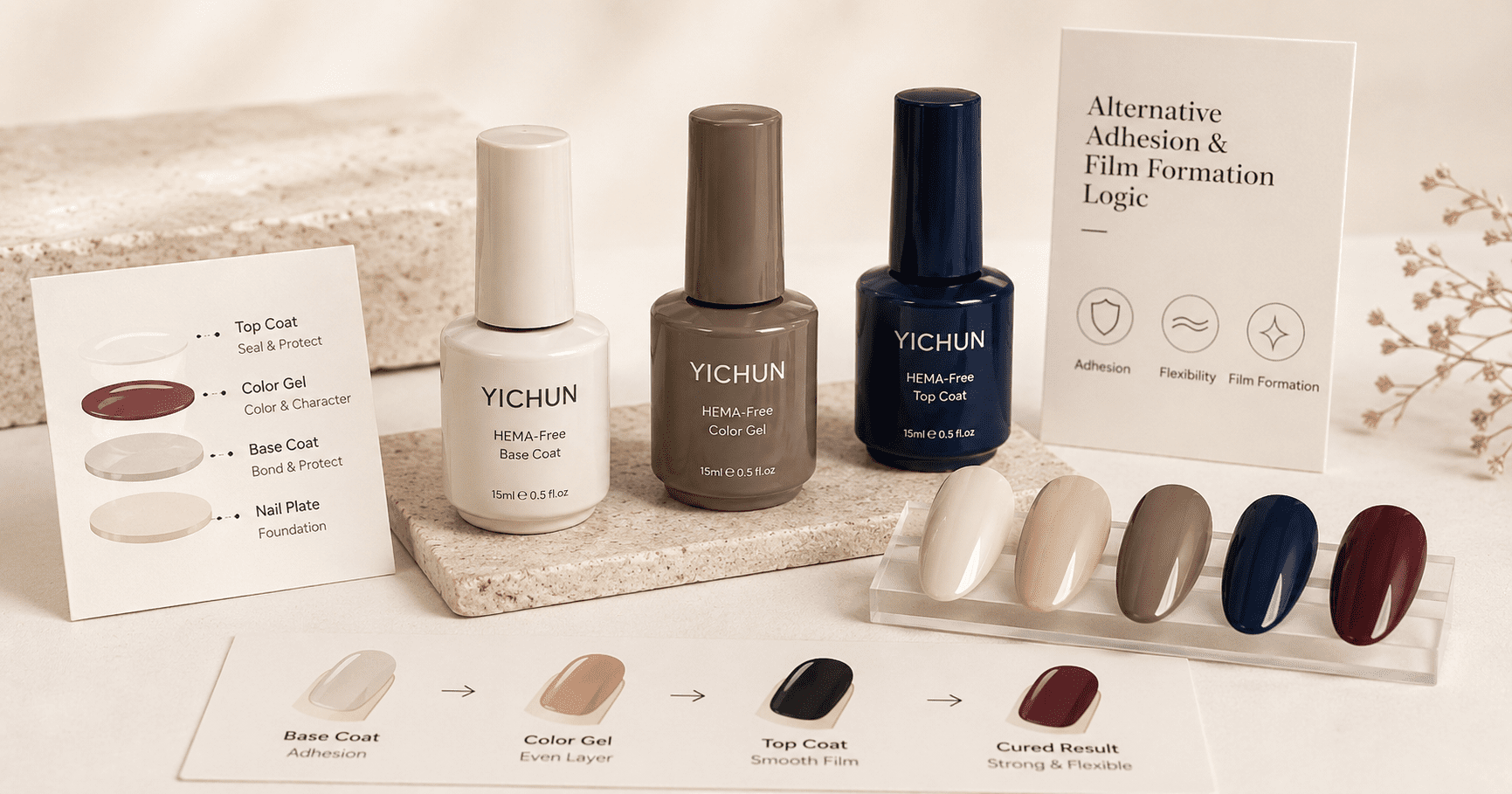
Alternative Adhesion Strategy
In traditional gel polish formulas, HEMA may help with adhesion and wetting because of its small molecular structure and ability to interact with the nail surface. When HEMA is removed, the formula may rely on alternative adhesion strategies.
These may include:
- different adhesion-related monomers or resins
- modified resin systems
- improved base coat compatibility
- better wetting behavior
- flexibility balance
- primer or base coat system support
- optimized curing response
For buyers, the key point is not to ask only, “What ingredient replaces HEMA?” A better question is:
“How does the formula support adhesion and wear performance without HEMA?”
This question leads to a more useful sourcing conversation because it focuses on product behavior, not just ingredient names.
Resin and Oligomer Balance
The resin and oligomer structure affects the final cured film. It influences hardness, flexibility, gloss, durability, and removal behavior.
In HEMA-Free gel polish, the resin matrix becomes especially important because it must help compensate for the performance role that HEMA may have supported in traditional systems. If the resin system is too hard, the gel may become brittle. If it is too soft, wear resistance may suffer. If it is poorly balanced, the product may not maintain stable adhesion or surface finish.
A buyer does not need to know the exact confidential formula. However, a buyer should understand that resin balance is one of the main reasons why some HEMA-Free formulas feel more professional than others.
Curing System Design
HEMA-Free gel polish still requires correct curing. Removing HEMA does not mean the product cures automatically under every lamp.
Curing depends on:
- lamp wavelength
- lamp power
- curing time
- application thickness
- pigment density
- bottle storage conditions
- photoinitiator system
- formula opacity
- nail technician technique
A highly pigmented black, white, nude, cat eye, or jelly shade may require different testing attention than a lighter sheer color. A builder gel or rubber base may also behave differently from a thin color gel.
For private label buyers, curing tests should be done under the lamps commonly used by the target customer group. A salon-focused product line may need different evaluation standards from a home-use retail line.
4. Core Roles in a Professional Nail System
HEMA-Free Performance Depends on the Full System
A common mistake is judging HEMA-Free gel polish as a single bottle only. In real nail application, gel polish works as part of a full system.
A professional nail system may include:
- nail prep
- dehydrator or cleanser
- primer if needed
- base coat
- color gel
- builder gel or rubber base if used
- top coat
- LED/UV lamp
- correct curing time
- proper sealing technique
HEMA-Free color gel alone cannot determine the full wear result. Even a well-developed formula may fail if the nail surface is oily, the base coat is incompatible, the gel is applied too thickly, or the lamp does not match the curing requirements.
Base Coat Compatibility
For many HEMA-Free systems, base coat selection is especially important. The base coat often carries much of the adhesion responsibility. If a brand sells a HEMA-Free color gel but pairs it with a poorly matched base coat, customers may experience lifting or poor wear.
Buyers should evaluate:
- whether the HEMA-Free color gel works with the recommended base coat
- whether the base coat is also HEMA-Free if the brand wants a full HEMA-Free system
- whether adhesion remains stable across different nail types
- whether soak-off behavior is acceptable
- whether the base coat supports flexible wear without becoming too rubbery or too brittle
For a stronger product line, buyers may consider developing a complete HEMA-Free system rather than only launching HEMA-Free color gels.
Color Gel Function
HEMA-Free color gel must deliver more than ingredient positioning. It still needs:
- smooth brushing
- good pigment dispersion
- even coverage
- stable curing
- proper viscosity
- gloss compatibility with top coat
- no excessive shrinkage
- good layer control
- color stability after curing
If the formula becomes difficult to apply, too thick, too runny, or unstable in color, customers may not care that it is HEMA-Free. Product positioning attracts interest, but product experience creates repeat orders.
Top Coat and Final Wear
The top coat affects gloss, scratch resistance, stain resistance, and final surface protection. In a HEMA-Free product system, the top coat should be tested together with the base and color formula.
A buyer should not assume that any top coat will produce the same result. Some top coats may improve gloss but feel too rigid. Others may offer flexibility but lower scratch resistance. A professional product system needs balance.
System Compatibility Table
| System Element | Why It Matters in HEMA-Free Gel Polish | Buyer Evaluation Point |
|---|---|---|
| Nail prep | Affects bonding and lifting risk | Check whether instructions are clear and realistic |
| Base coat | Supports adhesion and flexibility | Test with HEMA-Free color gel under target conditions |
| Color gel | Provides shade, coverage, texture, and curing behavior | Test opacity, leveling, curing, and color stability |
| Top coat | Protects gloss and wear surface | Test shine, scratch resistance, and staining behavior |
| LED/UV lamp | Determines curing effectiveness | Test with target customer lamp types |
| Application thickness | Affects curing depth and wear | Provide clear usage guidance |
| Removal method | Affects customer experience | Test soak-off or removal behavior according to product type |
The main takeaway is simple: HEMA-Free is a formula claim, but professional performance is a system result.
5. Product Types, Variations, and Use Cases
Modern HEMA-Free development is no longer limited to one basic color gel. Many brands now want to build full HEMA-Free product families for different market segments.
HEMA-Free Color Gel
HEMA-Free color gel is the most common product type for private label brands. It allows brands to offer seasonal collections, nude systems, jelly shades, cat eye colors, reflective gels, glitter gels, and salon core colors with a safer-positioned formula direction.
Key evaluation areas include:
- color coverage
- curing response
- viscosity
- pigment stability
- brush control
- compatibility with base and top coat
- wear performance
This is often the first product category buyers request when developing a HEMA-Free gel polish line.
HEMA-Free Base Coat
A HEMA-Free base coat is important for brands that want a complete HEMA-Free system. Since the base coat directly contacts the nail plate, buyers often pay close attention to this product.
The challenge is to support adhesion while avoiding overpromising safety. A base coat must balance bonding, flexibility, curing, and removal behavior. If it is too weak, lifting may occur. If it is too aggressive, removal or user comfort may become a concern.
HEMA-Free Rubber Base
Rubber base formulas are popular because they can provide flexibility and support for natural nails. A HEMA-Free rubber base may be attractive for salons and private label brands targeting customers who want comfort, flexibility, and a more premium nail system.
Buyers should test:
- самовыравнивающийся
- flexibility
- heat sensation during curing
- adhesion
- thickness control
- soak-off behavior
- compatibility with color gel
HEMA-Free Builder Gel
HEMA-Free builder gel or BIAB-style products may require more technical development because they need structure, strength, and application control. The formula must be stable enough to build shape while still curing properly.
Important evaluation areas include:
- viscosity
- self-leveling speed
- strength after curing
- flexibility
- heat sensation
- filing behavior
- removal method
- wear time under professional use
HEMA-Free Top Coat
A HEMA-Free top coat supports the finishing layer of the system. It should provide gloss, surface protection, and good curing response. Buyers may request no-wipe top coat, wipe top coat, matte top coat, glitter top coat, or specialty finish top coat.
Key evaluation areas include:
- shine
- yellowing resistance
- scratch resistance
- stain resistance
- curing surface
- compatibility with color gels
- long-term gloss retention
HEMA-Free Effect Gels
HEMA-Free formulas can also be developed for effect gel categories, depending on the product direction and technical feasibility.
Examples include:
- HEMA-Free cat eye gel
- HEMA-Free jelly gel
- HEMA-Free glitter gel
- HEMA-Free reflective gel
- HEMA-Free milky gel
- HEMA-Free nude gel
- HEMA-Free magnetic effect gel
Effect gels require extra testing because pigments, glitter particles, magnetic powders, and reflective materials can affect curing behavior, viscosity, and final appearance.
Product Type Table
| Тип продукта | Main Role | Buyer Use Case | Key Evaluation Point |
|---|---|---|---|
| HEMA-Free color gel | Provides color and finish | Seasonal collections, salon colors, retail shades | Coverage, curing, viscosity, color stability |
| HEMA-Free base coat | Supports adhesion | Full HEMA-Free system development | Bonding, flexibility, soak-off behavior |
| HEMA-Free rubber base | Adds flexible support | Natural nail overlay, salon premium lines | Self-leveling, flexibility, heat sensation |
| HEMA-Free builder gel | Provides structure | BIAB-style lines, strengthening systems | Strength, viscosity, curing depth |
| HEMA-Free top coat | Protects final surface | Gloss, matte, no-wipe, specialty finish lines | Shine, scratch resistance, stain resistance |
| HEMA-Free cat eye gel | Creates magnetic effect | Trend collections, salon effect lines | Magnetic response, pigment balance, curing |
| HEMA-Free jelly gel | Creates translucent color | Soft color systems, layered looks | Transparency, leveling, layer control |
| Full HEMA-Free system | Complete product family | Professional private label launch | Compatibility across base, color, and top |
For brands working with an OEM partner such as YICHUN gel factory, the practical decision is whether to launch only HEMA-Free color gels or build a complete HEMA-Free product system. A complete system often gives buyers stronger control over performance, instructions, positioning, and repeat purchasing.

6. Comparison: HEMA-Free Formulation Logic vs Traditional Gel Polish
Traditional Gel Polish Formula Logic
Traditional gel polish formulas may use HEMA because it can support adhesion and product performance within the formula. When properly formulated and used professionally, traditional systems can deliver strong wear, good curing, and stable application.
However, because buyer awareness around ingredient exposure has increased, many brands now want alternatives that reduce reliance on HEMA. This is especially common among brands targeting premium salons, safety-conscious customers, professional education, or markets where ingredient communication is important.
HEMA-Free Formula Logic
HEMA-Free gel polish changes the formulation strategy. Instead of relying on HEMA to support certain performance functions, the formula uses a broader structure to achieve adhesion, flexibility, film formation, and curing performance.
This may involve:
- alternative adhesion systems
- adjusted resin matrix
- controlled viscosity
- balanced flexibility
- optimized photoinitiator response
- improved compatibility between base, color, and top
- more detailed sample testing
A strong HEMA-Free formula is not just a weaker version of traditional gel. It is a different design direction.
Comparison Table
| Comparison Point | HEMA-Free Gel Polish | Traditional Gel Polish | Buyer Takeaway |
|---|---|---|---|
| Ingredient claim | Designed without intentionally using HEMA | May contain HEMA depending on formula | HEMA-Free is a specific ingredient exclusion claim |
| Adhesion strategy | Uses alternative formula balance | May use HEMA as part of adhesion support | Ask how adhesion is supported without HEMA |
| Performance | Can perform well when properly developed | Can perform well when properly developed | Performance depends on formula and application system |
| Safety positioning | Supports safer-positioned product strategy | May be less suitable for brands focused on HEMA-Free claims | Do not confuse safer-positioned with allergy-free |
| Curing | Depends on formula, pigment, lamp, and thickness | Also depends on formula, pigment, lamp, and thickness | Both require proper curing tests |
| Odor | Not automatically low odor | Not automatically high odor | Odor depends on full formula design |
| Brand communication | Useful for ingredient-aware customers | Useful for traditional professional systems | Messaging must be accurate and responsible |
| Product development | Requires careful balancing | Established formula logic may be easier to control | HEMA-Free development should be tested carefully |
| Customer education | Needs clear explanation | Usually more familiar to technicians | Brands should explain what HEMA-Free does and does not mean |
Is HEMA-Free Always Better?
Not automatically.
HEMA-Free may be better for a brand’s positioning if the brand wants to reduce exposure to HEMA and communicate a more safety-conscious formula direction. However, product quality still depends on the whole formulation.
A poorly developed HEMA-Free gel polish may perform worse than a well-developed traditional gel. A well-developed HEMA-Free gel polish may perform strongly when paired with the correct base coat, curing system, and application method.
The buyer’s goal should not be to choose a claim only. The goal should be to choose a formula system that supports the claim, performs consistently, and can be communicated responsibly.
Is Traditional Gel Always Stronger?
Also not automatically.
Some buyers assume traditional gel always has better adhesion because HEMA may support bonding. This is too simple. Adhesion depends on many factors, including resin structure, base coat design, nail prep, curing, product thickness, and nail condition.
Modern HEMA-Free formulas can be developed to provide professional wear performance, but they need proper testing. Buyers should compare actual sample performance instead of assuming that one claim always means stronger or weaker.
HEMA-Free vs 15-Free
Another common confusion is mixing HEMA-Free with 15-Free.
HEMA-Free means the product is designed without HEMA.
15-Free usually refers to a broader marketing claim that excludes a list of selected ingredients. However, the exact list may vary by brand or supplier, so buyers should always confirm what the claim includes.
| Claim Type | What It Means | What It Does Not Mean | Buyer Caution |
|---|---|---|---|
| HEMA-Free | Formula does not intentionally use HEMA | Does not mean allergy-free or 15-Free | Confirm claim wording and formula direction |
| 15-Free | Excludes a broader list of selected ingredients | Does not automatically explain performance | Ask for the exact ingredient exclusion list |
| Low-odor | Designed to reduce or control odor profile | Does not mean safer by itself | Odor and safety claims should not be confused |
| Sensitive-positioned | Marketed toward customers seeking gentler-positioned products | Does not mean suitable for every sensitive user | Avoid medical or absolute claims |
For B2B sourcing, clear claim boundaries are important. A product label should not make claims that the formula, documentation, or supplier communication cannot support.
7. Application Logic and Performance Variables
A HEMA-Free gel polish formula can be well designed, but its final performance still depends on how the product is applied, cured, and combined with the rest of the nail system.
This is especially important for buyers who plan to sell HEMA-Free gel polish to salons, distributors, online customers, or private label retail channels. A product may pass sample testing in the factory, but if the final customer applies it too thickly, uses an unsuitable lamp, skips nail prep, or mixes incompatible base and top coats, the result may not match expectations.
For this reason, professional brands should treat application guidance as part of product quality.
Nail Preparation
Nail preparation affects adhesion more than many buyers realize. Even a strong HEMA-Free formula may lift early if the nail plate is oily, dusty, uneven, or improperly cleaned.
Important nail prep factors include:
- gently removing surface shine
- cleaning nail dust thoroughly
- removing excess oil or moisture
- avoiding contact with skin or cuticle area
- applying base coat evenly
- sealing the free edge properly
When HEMA is removed, the formula may rely more heavily on system balance and correct application. This does not mean HEMA-Free gel polish is weak. It means the product should be used as a professional system, not as a casual one-step coating.
Product Thickness
Application thickness is one of the most common causes of curing and wear issues.
If a HEMA-Free color gel is applied too thickly, several problems may appear:
- incomplete curing
- wrinkling
- heat sensation
- soft or rubbery inner layer
- poor adhesion between layers
- surface dullness
- shortened wear time
This is especially important for dark colors, highly pigmented shades, white gel, black gel, nude gel, cat eye gel, glitter gel, and builder-type products.
A professional instruction should usually recommend thin, even layers rather than one heavy layer. Brands should also test each product type according to its real customer use case.
Base Coat Selection
The base coat is critical in a HEMA-Free gel polish system. In many cases, the base coat contributes more to adhesion than the color gel itself.
Buyers should test:
| Base Coat Factor | Why It Matters |
|---|---|
| Adhesion strength | Helps reduce lifting when used correctly |
| Flexibility | Supports natural nail movement |
| Curing response | Prevents soft or unstable base layers |
| Compatibility | Ensures color gel bonds properly to the base layer |
| Soak-off behavior | Affects removal experience and customer satisfaction |
| Formula claim alignment | Important if the brand wants a full HEMA-Free system |
If a brand sells HEMA-Free color gels but uses a traditional base coat containing HEMA, the product line may create customer confusion. This does not mean the product is unusable, but the brand must communicate claims accurately.
For stronger positioning, many buyers prefer a complete HEMA-Free base, color, and top system.
Curing Lamp Variables
HEMA-Free gel polish does not automatically require a completely different lamp. However, curing must be tested carefully.
Curing depends on:
- lamp wavelength
- lamp power
- curing time
- distance between nail and light source
- gel thickness
- pigment level
- formula opacity
- photoinitiator system
- lamp age and condition
A formula that cures well under one LED lamp may behave differently under another. This is why buyers should not rely only on general curing assumptions. They should test samples under the lamp types used by their target customers.
For example, a professional salon line may be tested with higher-quality salon lamps. A retail product sold to home users may need clearer curing instructions because home-use lamps can vary widely.
Pigment and Color Effects
Pigment can strongly affect curing behavior. Some colors block or absorb light more than others.
High-risk shades for curing evaluation include:
- black gel
- white gel
- dark red
- deep brown
- navy blue
- highly pigmented nude
- cat eye gel
- glitter gel
- reflective gel
- neon gel
- milky or opaque pastel gel
This does not mean these shades cannot be made HEMA-Free. It means they require careful testing.
A good HEMA-Free formula should maintain color beauty while still curing properly under recommended conditions. Buyers should evaluate not only how the color looks in the bottle, but also how it cures on nail tips and real nails.
Layering and System Compatibility
Layering affects both appearance and durability. A HEMA-Free gel polish may be designed for two thin color coats, but customers may apply one thick coat to save time. This can cause curing issues or uneven wear.
Buyers should decide how the product should be positioned:
- salon professional use
- retail home-use line
- beginner-friendly product
- premium private label collection
- training academy product
- distributor salon supply product
Each use case may require different texture, opacity, instructions, and system recommendations.
A salon-use formula can be slightly more technical if technicians understand proper layering. A retail formula may need more forgiving viscosity and clearer instructions.
Top Coat Sealing
Top coat sealing affects gloss, stain resistance, scratch resistance, and edge protection. Even if the HEMA-Free color gel performs well, poor top coat compatibility can reduce the final result.
Common issues include:
- dull gloss
- color staining
- peeling at the free edge
- cracking
- surface scratches
- uneven finish
- poor compatibility with effect gels
Brands should test top coat compatibility with multiple shade types, including dark colors, light colors, cat eye gel, glitter gel, and jelly gel.
Storage Conditions
Storage also affects gel polish stability. HEMA-Free gel polish should still be protected from excessive heat, direct sunlight, and improper storage.
Poor storage may cause:
- viscosity change
- pigment separation
- thickening
- curing instability
- bottle leakage
- odor change
- reduced shelf performance
For distributors and online sellers, storage and shipping conditions should be considered during product planning. Packaging should help protect the formula, and product instructions should advise customers to keep bottles tightly closed and away from direct light.
Performance Variable Checklist
| Performance Variable | What Buyers Should Test | Why It Matters |
|---|---|---|
| Nail prep | Adhesion on different nail types | Helps evaluate real salon wear |
| Layer thickness | Thin vs thick application | Affects curing and durability |
| Base coat | Compatibility with HEMA-Free color gel | Supports full system performance |
| LED lamp | Target lamp curing response | Reduces customer curing complaints |
| Pigmentation | Dark, white, nude, glitter, cat eye shades | High pigment can affect curing depth |
| Viscosity | Brush feel and leveling | Affects user experience |
| Top coat | Gloss and surface protection | Determines final finish |
| Storage | Heat and light stability | Supports shelf performance |
| Removal | Soak-off or filing behavior | Affects customer satisfaction |
The key takeaway is that HEMA-Free performance should be evaluated as a full product system, not only as an ingredient claim.
8. Suitable and Unsuitable Scenarios
HEMA-Free gel polish can be an excellent product direction for many nail brands, but it is not suitable for every business strategy or every marketing message. Buyers should understand where it fits well and where extra caution is needed.
Suitable Scenario 1: Brands Building a Safer-Positioned Product Line
HEMA-Free gel polish is suitable for brands that want to reduce exposure to HEMA and build a more safety-conscious formula direction.
This positioning is especially useful for:
- premium nail brands
- salon professional product lines
- private label beauty brands
- ingredient-aware consumers
- distributors serving professional salons
- training academies teaching product awareness
The brand message should stay responsible. Instead of saying “allergy-proof gel polish,” a better message would be:
“HEMA-Free gel polish designed for brands seeking a safer-positioned professional nail system.”
This communicates the benefit without making unsafe medical claims.
Suitable Scenario 2: Salons Wanting More Ingredient-Aware Options
Many salons want to offer clients more choices. A HEMA-Free product line can help salons communicate that they are paying attention to formula trends and customer concerns.
However, salons should still educate clients properly. HEMA-Free does not mean every sensitive user will have no reaction. Professional application, curing, and skin contact prevention remain important.
For salon-focused buyers, the product should have:
- stable adhesion
- smooth application
- strong gloss
- reliable curing
- clear usage instructions
- professional packaging
- responsible claim wording
Suitable Scenario 3: Distributors Targeting Premium Buyers
Distributors can use HEMA-Free gel polish as a differentiated product category. It can help them serve salons and retailers looking for modern formula claims.
For distributors, the most important factors are:
- product consistency
- clear product documentation
- stable reorder quality
- packaging flexibility
- claim accuracy
- good sample performance
- supplier communication
A distributor should not only ask whether the product is HEMA-Free. They should also ask whether the supplier can support long-term product planning and stable batch production.
Suitable Scenario 4: Private Label Brands Launching a Modern Gel Polish Collection
HEMA-Free gel polish is highly suitable for private label brands that want a modern, cleaner-positioned product line.
Possible collection directions include:
- HEMA-Free nude gel collection
- HEMA-Free jelly gel collection
- HEMA-Free salon core color system
- HEMA-Free cat eye gel collection
- HEMA-Free rubber base system
- HEMA-Free builder gel collection
- HEMA-Free beginner salon kit
- HEMA-Free premium private label line
For private label buyers, it is usually better to think in product systems instead of single shades. A complete HEMA-Free system can support stronger brand storytelling and better repeat sales.
Suitable Scenario 5: Training Academies and Professional Education
HEMA-Free gel polish can also be suitable for nail training academies. It gives educators a chance to teach students about ingredient claims, curing logic, application technique, and responsible product communication.
Training academies should focus on:
- proper nail prep
- thin layer application
- skin contact prevention
- curing discipline
- product claim education
- client consultation language
- safe and professional removal
This creates a stronger link between product education and real nail service quality.
Unsuitable or Caution Scenario 1: Buyers Expecting Allergy-Proof Products
HEMA-Free gel polish should not be positioned as allergy-proof.
This is one of the most important warnings for buyers. Even without HEMA, a gel polish formula may still contain other reactive ingredients. Skin sensitivity can also be affected by under-curing, repeated skin contact, improper application, and individual reactions.
A responsible brand should avoid claims such as:
- allergy-free
- no allergic reaction
- 100% safe for sensitive skin
- safe for everyone
- eliminates all irritation
Better wording includes:
- designed without HEMA
- supports a safer-positioned formula strategy
- suitable for professional use with proper curing and application
- developed for brands seeking reduced HEMA exposure
Unsuitable or Caution Scenario 2: Brands Without Clear Usage Instructions
HEMA-Free gel polish still needs clear instructions. If a brand sells the product without proper curing guidance, layer instructions, or safety reminders, customer complaints may increase.
Important instructions may include:
- avoid skin contact
- apply thin layers
- cure according to manufacturer guidance
- use compatible base and top coats
- keep bottle away from direct light
- discontinue use if discomfort occurs
- use only as directed
A strong product label and instruction card can reduce misuse and improve customer trust.
Unsuitable or Caution Scenario 3: Buyers Who Only Want a Marketing Claim
Some buyers request HEMA-Free gel polish only because the claim looks attractive. They may not care about texture, curing, color stability, or system compatibility.
This is risky.
If the product performs poorly, the claim will not save the brand. Customers will judge the product by real use: how it applies, how it cures, how long it lasts, how it looks, and how it removes.
HEMA-Free should be part of a complete product strategy, not only a label phrase.
Unsuitable or Caution Scenario 4: Unsupported Medical or Regulatory Claims
HEMA-Free is a product formulation claim. It should not be turned into a medical promise.
Brands should be cautious with claims related to allergy, skin health, medical safety, or universal suitability. Markets may also have different expectations for labeling, ingredient disclosure, and product documentation.
For this reason, buyers should work with suppliers who understand claim wording and can provide appropriate product information when required.
Suitable and Caution Scenario Table
| Scenario | Suitability | Buyer Guidance |
|---|---|---|
| Premium nail brand | Suitable | Use HEMA-Free as part of a professional formula story |
| Salon chain | Suitable | Provide staff training and proper instructions |
| Distributor | Suitable | Focus on consistency, documentation, and reorder stability |
| Retail beginner brand | Suitable with caution | Make instructions very clear and avoid overclaims |
| Training academy | Suitable | Use product education to teach professional use |
| Allergy-proof marketing | Not suitable | Avoid absolute safety claims |
| No curing guidance | Not suitable | Clear lamp and application instructions are necessary |
| Claim-only product planning | Risky | Performance testing must support the claim |
| Markets with strict labeling expectations | Needs review | Confirm claim wording and documentation needs |
9. Common Misunderstandings
HEMA-Free gel polish is widely searched, but it is also widely misunderstood. Correcting these misunderstandings helps brands communicate more professionally and avoid unrealistic customer expectations.
Misunderstanding 1: HEMA-Free Means Allergy-Free
This is the most common and most dangerous misunderstanding.
HEMA-Free means the formula is designed without intentionally using HEMA. It does not mean the product is allergy-free. Gel polish still contains reactive materials that need proper curing and professional application.
Skin sensitivity may be affected by:
- other ingredients
- repeated skin contact
- under-curing
- incorrect product use
- individual sensitivity
- damaged skin or nails
- poor removal habits
A responsible brand should explain HEMA-Free as a reduced HEMA exposure direction, not a medical guarantee.
Misunderstanding 2: HEMA-Free Means 15-Free
HEMA-Free and 15-Free are different claims.
HEMA-Free focuses on the absence of HEMA. 15-Free usually refers to a broader list of excluded ingredients, but the exact list can vary between brands.
A product can be HEMA-Free but not 15-Free. A product can also be marketed as 15-Free while still needing careful review of what that claim actually includes.
Buyers should always confirm the exact claim scope before printing packaging or launching product pages.
Misunderstanding 3: HEMA-Free Always Has Weaker Adhesion
Some buyers worry that HEMA-Free gel polish must have poor adhesion. This is not always true.
Adhesion depends on the full formula design, base coat compatibility, nail prep, curing, and application technique. Modern HEMA-Free systems can be developed with alternative adhesion strategies.
However, buyers should still test carefully. Do not assume HEMA-Free is weak, but do not assume it performs perfectly without testing either.
Misunderstanding 4: HEMA-Free Always Smells Better
HEMA-Free does not automatically mean low odor.
Odor can be affected by:
- monomer system
- solvent content
- raw material purity
- fragrance
- photoinitiator system
- packaging seal quality
- storage conditions
A HEMA-Free formula can still have noticeable odor. A traditional formula can also be designed with odor control. Buyers should evaluate odor as a separate product characteristic.
Misunderstanding 5: HEMA-Free Needs a Completely Different Lamp
Most HEMA-Free gel polishes are still designed for LED/UV curing systems, but curing performance depends on the specific formula and lamp.
The product may not need a completely different lamp, but it does need proper testing under target lamp conditions.
Buyers should check:
- recommended curing time
- lamp wavelength compatibility
- performance with dark colors
- performance with thick layers
- curing result under common salon lamps
- curing result under target retail lamps if sold to consumers
Misunderstanding 6: HEMA-Free Is Only a Marketing Term
HEMA-Free is a real formulation direction when the product is genuinely developed without HEMA.
However, the claim alone does not prove product quality. A serious HEMA-Free product should combine claim accuracy with strong performance testing, stable production, responsible labeling, and suitable product instructions.
In other words, HEMA-Free is meaningful when supported by real formulation and product evaluation.
Misunderstanding 7: All HEMA-Free Formulas Perform the Same
Not all HEMA-Free gel polish formulas are equal.
Different manufacturers may use different resin systems, adhesion strategies, photoinitiator systems, pigment dispersion methods, and viscosity designs.
This means buyers should not choose only based on price or label claim. They should compare samples, test performance, review texture, and evaluate supplier communication.
Misunderstanding 8: More Free-From Claims Always Mean Better Products
More claims do not automatically mean better products.
A product with many “free-from” claims still needs to perform well. If the formula becomes unstable, hard to cure, weak in adhesion, or unpleasant to apply, customers may not reorder.
The best product strategy is balanced: responsible ingredient positioning plus professional product performance.
Misunderstanding 9: HEMA-Free Products Do Not Need Testing
HEMA-Free products still need testing. In fact, they may need more careful evaluation because the formula uses a different performance structure from traditional systems.
Buyers should test:
- adhesion
- curing
- gloss
- viscosity
- color coverage
- pigmentation stability
- wear time
- soak-off behavior
- odor profile
- packaging compatibility
- batch consistency
A claim is not a substitute for sample testing.
Misunderstanding 10: HEMA-Free Can Be Sold Without Professional Education
HEMA-Free gel polish still needs responsible customer education.
Brands should provide clear guidance for:
- professional use
- proper curing
- avoiding skin contact
- correct storage
- compatible product systems
- removal method
- customer expectations
This is especially important for retail and e-commerce brands, where the end user may not have professional salon training.

10. Professional Buyer Judgment: How to Evaluate This Product
For B2B buyers, the most important question is not simply, “Is this HEMA-Free?”
The better question is:
“Is this HEMA-Free gel polish formula suitable for my brand position, target customer, application system, performance expectations, packaging claim, and sales channel?”
A buyer should evaluate the product from multiple angles before placing a larger OEM or private label order.
1. Confirm the Exact Claim
The first step is to confirm what the HEMA-Free claim actually means.
Buyers should ask:
- Is HEMA intentionally excluded from the formula?
- Is the claim limited to color gel only, or the full system?
- Are the base coat and top coat also HEMA-Free?
- Can the supplier support proper claim wording?
- Are there other free-from claims involved, such as 15-Free?
This prevents packaging mistakes and customer confusion.
2. Evaluate Adhesion Behavior
Adhesion should be tested on different nail types and under realistic application conditions.
Buyers should observe:
- whether the gel lifts at the cuticle area
- whether the free edge chips
- whether adhesion changes after several days
- whether oily or thin nails show different results
- whether the base coat improves performance
- whether the product works better as a full system
Adhesion testing should not be limited to one perfect nail tip in a controlled environment. Real salon conditions are more complex.
3. Test Curing Response
Curing is one of the most important performance areas for HEMA-Free gel polish.
Buyers should test:
- light colors
- dark colors
- white and black
- thick and thin application
- glitter or cat eye shades
- different LED lamps
- recommended curing time
- surface and inner layer hardness
Incomplete curing can affect wear, comfort, gloss, and customer satisfaction. It can also increase the risk of product misuse.
4. Review Viscosity and Application Feel
Application feel strongly affects customer experience. Nail technicians and consumers often judge a gel polish within the first few brush strokes.
A professional HEMA-Free gel polish should feel controlled, smooth, and stable.
Buyers should check:
- brush control
- self-leveling speed
- flooding risk
- streaking
- shrinkage
- thickness
- pigment settlement
- bottle consistency after storage
A formula that looks good on paper but feels difficult to apply may not succeed in the market.
5. Check Color Stability
Color stability is important for both salon and retail products.
Buyers should evaluate:
- color before curing
- color after curing
- color after top coat
- yellowing risk
- fading risk
- pigment separation
- consistency between batches
- color accuracy against swatches
This is especially important for nude collections, milky shades, jelly colors, cat eye gels, and seasonal color launches.
6. Evaluate Gloss and Finish
A HEMA-Free gel polish system should still deliver a professional finish. Gloss is not only a visual detail; it affects perceived product quality.
Buyers should test:
- initial gloss
- gloss after curing
- gloss after cleaning if needed
- gloss after several days of wear
- stain resistance
- scratch resistance
- compatibility with top coat
For premium brands, surface finish can strongly influence customer perception.
7. Review Soak-Off or Removal Behavior
Removal behavior should match the product type.
A color gel may be expected to soak off more easily than a builder gel. A rubber base may require different removal guidance. A hard gel may not be soak-off at all.
Buyers should clarify:
- whether the product is soak-off
- expected removal time
- whether filing is needed
- whether the base coat affects removal
- how the product behaves after long wear
- whether removal instructions are clear
Poor removal experience can create customer dissatisfaction even if the product wears well.
8. Evaluate Odor Profile Separately
Because HEMA-Free does not automatically mean low odor, buyers should evaluate odor as a separate product characteristic.
They should check:
- bottle odor
- odor during application
- odor after curing
- odor difference between shades
- packaging seal quality
- storage influence
For salon brands, odor control may be part of the customer experience. For retail brands, it may affect product reviews.
9. Review Packaging and Label Accuracy
Packaging should communicate the claim clearly without overpromising.
Good label wording may include:
- HEMA-Free Gel Polish
- Professional Use Recommended
- Cure Under LED/UV Lamp
- Avoid Skin Contact
- Use With Compatible Base and Top Coat
- Store Away From Heat and Light
Risky wording may include:
- allergy-free
- non-allergenic
- completely safe
- no reaction
- suitable for everyone
- medical-grade
Professional packaging should support trust, not create legal or customer expectation problems.
10. Test Supplier Communication
A good HEMA-Free gel polish supplier should be able to explain product direction clearly.
Buyers should pay attention to whether the supplier can discuss:
- formula positioning
- product type differences
- curing guidance
- sample testing
- color matching
- packaging options
- claim wording
- batch consistency
- reorder support
If a supplier only says “yes, HEMA-Free” but cannot explain performance logic, buyers should be cautious.
Buyer Evaluation Table
| Evaluation Area | What Buyers Should Check | Why It Matters |
|---|---|---|
| Claim accuracy | Whether HEMA is intentionally excluded | Prevents misleading product communication |
| Full system | Base, color, and top coat compatibility | Improves wear and customer satisfaction |
| Adhesion | Lifting, chipping, wear on different nails | Determines professional performance |
| Curing | Lamp response, shade depth, layer thickness | Reduces under-curing issues |
| Viscosity | Brush control, leveling, shrinkage | Affects user experience |
| Color stability | Pigment behavior and batch consistency | Supports brand quality |
| Gloss | Shine, stain resistance, top coat match | Affects premium appearance |
| Removal | Soak-off or filing behavior | Influences repeat purchase |
| Odor | Formula and packaging odor profile | Impacts salon and retail experience |
| Label wording | Responsible claim communication | Builds trust and reduces risk |
| Supplier support | Testing, packaging, documentation, communication | Supports long-term private label growth |
A professional buyer should not select HEMA-Free gel polish based on one sample photo or one claim. The product should be tested as a complete commercial system.
11. Product Development and OEM Considerations
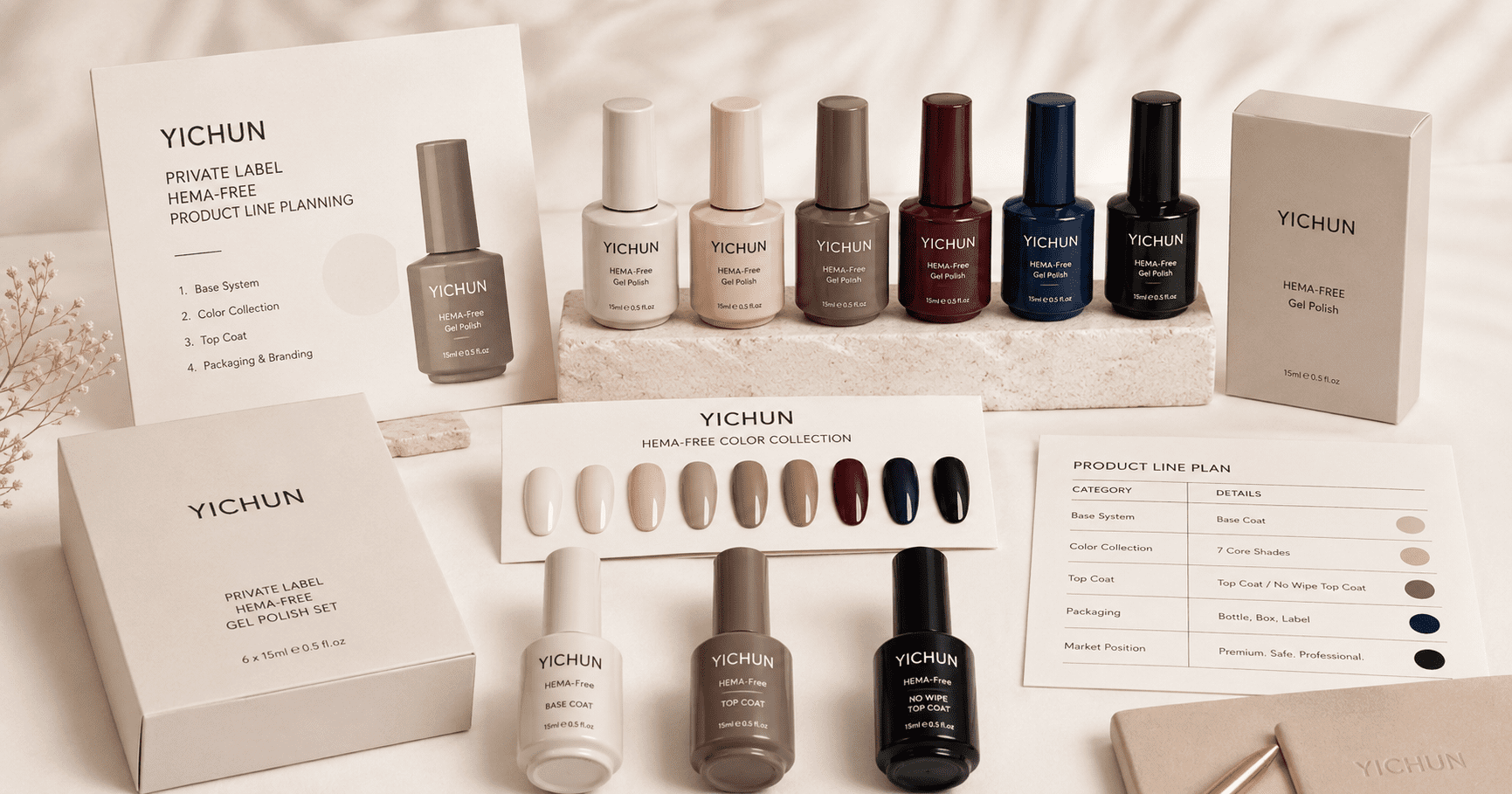
For buyers planning a HEMA-Free gel polish line, the most important product development decision is not only which ingredient is removed. The real decision is how the full formula system should perform after HEMA is removed.
A professional OEM/ODM development process should connect formula direction, product performance, packaging claims, and market positioning.
Start With the Product Positioning
Before selecting a HEMA-Free formula, buyers should define the product goal clearly.
Important questions include:
- Is the line for professional salons or retail customers?
- Will the product be sold as color gel only or as a full system?
- Does the buyer need HEMA-Free base coat, color gel, and top coat?
- Is the focus safer-positioned formula, low odor, premium salon performance, or beginner-friendly use?
- Will the line include effect gels such as cat eye, jelly, glitter, or builder products?
- What claim wording will appear on the bottle, box, website, and product page?
Clear positioning helps the manufacturer recommend a more suitable formula direction.
For example, a salon professional line may prioritize adhesion, gloss, and long wear. A retail line may prioritize easy application, clear curing instructions, and stable texture. A premium private label line may require stronger packaging design, color system planning, and more refined product education.
Ready Formula vs Custom Formula
Buyers usually have two main options when developing HEMA-Free gel polish.
| Development Option | Best For | Main Advantage | Buyer Caution |
|---|---|---|---|
| Ready HEMA-Free formula | Faster launch, smaller starting orders, private label testing | Shorter development time and lower launch complexity | Buyers should still test adhesion, curing, and packaging claim wording |
| Custom HEMA-Free formula | Established brands, differentiated texture, special performance goals | More control over viscosity, color, finish, and system positioning | Requires more sampling, testing, and development time |
A ready formula can be suitable for new brands, distributors, or sellers who want to test the market quickly. A custom formula may be better for brands that already understand their customer base and want a more differentiated product system.
Color Matching and Shade Development
HEMA-Free gel polish still needs professional color development. Removing HEMA does not remove the normal challenges of gel polish color matching.
Buyers should consider:
- pigment concentration
- opacity level
- curing depth
- color after curing
- color after top coat
- nude shade balance
- white and black gel curing
- glitter and cat eye particle behavior
- batch-to-batch color consistency
For brands launching a full collection, shade planning should be connected to market use cases. A strong HEMA-Free line may include salon basics, nude shades, seasonal colors, trending effect gels, and functional supporting products.
Sample Testing and Approval
Sample testing should be treated as a required step, not a formality.
A buyer should not approve a HEMA-Free gel polish only by checking bottle design or swatch photos. The product should be tested in real use.
Recommended sample testing includes:
- brush application test
- two-coat coverage test
- curing test under target lamps
- adhesion test with recommended base coat
- gloss test with recommended top coat
- wear test under normal salon conditions
- soak-off or removal test
- odor evaluation
- storage stability observation
- color consistency review
If the buyer plans to sell internationally, testing should reflect the target customer’s actual application habits and lamp systems.
Packaging and Label Wording
Packaging is especially important for HEMA-Free gel polish because the claim must be communicated clearly and responsibly.
Good packaging should explain the product without exaggeration.
Suitable wording may include:
- HEMA-Free Gel Polish
- Professional Gel Polish
- LED/UV Curable
- Use With Base Coat and Top Coat
- Avoid Skin Contact
- For Professional Use or Professional Guidance
- Cure According to Instructions
Buyers should avoid claim language that sounds medical, absolute, or unsupported.
Risky wording includes:
- allergy-free
- non-allergenic
- safe for everyone
- prevents allergies
- no skin reaction
- completely harmless
- medical-grade safety
As a gel polish OEM/ODM manufacturer, YICHUN gel factory can support buyers with HEMA-Free product direction, formula sample testing, private label packaging, bottle and box planning, color matching, and long-term product line development. The best OEM support should help buyers build both a claim and a reliable product experience.
Batch Consistency and Reorder Planning
A HEMA-Free gel polish line should be planned for repeat sales, not only first launch.
Buyers should ask suppliers about:
- color consistency between batches
- viscosity stability
- raw material control
- packaging consistency
- lead time for reorders
- sample confirmation process
- batch production records
- label and box repeat accuracy
For distributors and private label brands, reorder stability is critical. A beautiful first batch is not enough if the second batch has color differences, texture changes, or packaging inconsistency.
OEM Development Workflow
| Development Step | What Happens | Buyer Benefit |
|---|---|---|
| Product positioning | Define market, claim, product type, and sales channel | Prevents wrong formula selection |
| Formula selection | Choose ready or custom HEMA-Free formula direction | Matches launch speed and performance needs |
| Color development | Confirm shades, opacity, effect, and pigment behavior | Builds a market-ready collection |
| Sample testing | Test adhesion, curing, gloss, viscosity, and removal | Reduces launch risk |
| Packaging planning | Design bottle, label, box, and product system | Supports brand identity |
| Claim wording review | Keep HEMA-Free communication accurate | Reduces customer misunderstanding |
| Pre-production approval | Confirm final sample, color, packaging, and instructions | Protects order quality |
| Bulk production | Manufacture according to approved standard | Supports commercial launch |
| Reorder support | Maintain consistency for future batches | Supports long-term brand growth |
12. HEMA-Free Formula Replacement Buyer Checklist
The question “What replaces HEMA?” should lead buyers into a deeper evaluation process. A professional buyer should not only ask for an ingredient name. They should check whether the replacement formula strategy works in real product performance.
Buyer Checklist
| Evaluation Area | What Buyers Should Ask | Why It Matters |
|---|---|---|
| Claim definition | Does HEMA-Free mean HEMA is intentionally excluded from the formula? | Ensures accurate product communication |
| Formula strategy | How does the formula support adhesion without HEMA? | Helps buyers understand performance logic |
| Base coat compatibility | Is there a recommended HEMA-Free base coat? | Supports better wear and clearer product positioning |
| Color gel performance | Does the gel apply smoothly and cure evenly? | Determines user satisfaction |
| Alternative adhesion support | What system supports bonding and wear? | Prevents judging the product by ingredient claim only |
| Resin balance | Is the cured film flexible and durable enough? | Affects lifting, cracking, and comfort |
| Curing response | Has the formula been tested under target LED/UV lamps? | Reduces under-curing complaints |
| Pigment behavior | Do dark, white, nude, glitter, and cat eye shades cure well? | Important for complete color collections |
| Odor profile | Is odor evaluated separately from the HEMA-Free claim? | Prevents false low-odor assumptions |
| Top coat compatibility | Does the top coat maintain gloss and wear? | Affects final appearance |
| Removal behavior | Is the product soak-off or file-off according to type? | Impacts customer experience |
| Label wording | Does the packaging avoid allergy-free or medical claims? | Supports responsible brand trust |
| Sample testing | Has the buyer tested real application conditions? | Confirms product-market fit |
| OEM support | Can the supplier support color, packaging, claims, and reorder consistency? | Supports long-term private label growth |
Simple Buyer Decision Rule
A strong HEMA-Free gel polish project should meet three conditions:
- The claim is clear.
The product is designed without HEMA, but does not overpromise allergy-free performance. - The formula performs.
Adhesion, curing, viscosity, gloss, color, and removal are tested as a complete system. - The brand communication is responsible.
Product labels, website copy, salon education, and customer instructions explain HEMA-Free correctly.
If one of these three areas is weak, the product launch may face problems even if the formula is technically HEMA-Free.
13. FAQ
1. What replaces HEMA in modern gel polish formulas?
HEMA is usually not replaced by one single ingredient. In modern HEMA-Free gel polish formulas, its functional role may be supported by a combination of alternative adhesion systems, resin structures, oligomers, flexibility modifiers, viscosity control, and curing system design.
2. Does HEMA-Free gel polish mean the formula has no adhesion?
No. HEMA-Free gel polish can still have professional adhesion when the formula is properly balanced. Adhesion depends on alternative formula design, base coat compatibility, nail preparation, curing, and application technique.
3. Is HEMA-Free gel polish allergy-free?
No. HEMA-Free does not mean allergy-free. It means the formula is designed without HEMA, but skin sensitivity can still depend on other ingredients, curing, application, skin contact, and individual reactions.
4. Is HEMA-Free gel polish the same as 15-Free gel polish?
No. HEMA-Free focuses on the absence of HEMA. 15-Free usually refers to a broader ingredient exclusion claim, but the exact list may vary by brand or supplier. Buyers should confirm the exact claim scope before printing packaging or launching product pages.
5. Can HEMA-Free gel polish last as long as traditional gel?
It can perform well when properly developed and used as part of a compatible nail system. Wear time depends on formula balance, base coat, nail prep, curing, layer thickness, top coat, and user technique. Buyers should test samples before making performance claims.
6. Does HEMA-Free gel polish need a different LED lamp?
Not necessarily. Many HEMA-Free gel polishes are designed for common LED/UV curing systems. However, curing depends on lamp wavelength, lamp power, curing time, pigment level, product thickness, and formula design. Buyers should test products under their target lamp systems.
7. Does HEMA-Free gel polish smell better?
Not automatically. Odor depends on the full formula, including monomer system, raw material quality, solvent content, fragrance, photoinitiators, packaging, and storage. HEMA-Free and low-odor are different product characteristics.
8. Can HEMA-Free formulas be used for cat eye, jelly, glitter, or builder gels?
Yes, HEMA-Free development can be applied to different gel categories, including color gel, cat eye gel, jelly gel, glitter gel, rubber base, builder gel, and top coat. However, each type requires separate testing because pigment, particles, viscosity, and curing behavior may differ.
9. What should nail brands test before ordering HEMA-Free gel polish?
Brands should test adhesion, curing response, viscosity, color coverage, gloss, soak-off behavior, odor profile, compatibility with base and top coats, storage stability, and real wear performance. Testing should reflect the target customer’s actual use conditions.
10. Can I make a private label HEMA-Free gel polish line with YICHUN gel factory?
Yes. YICHUN gel factory can support private label HEMA-Free gel polish development, including formula direction, color matching, sample testing, bottle and box packaging, product line planning, and OEM/ODM production support. Buyers should confirm product positioning, claim wording, and performance targets before production.
14. Final Thoughts
The question “What replaces HEMA in modern gel polish formulas?” does not have a simple one-ingredient answer.
In professional HEMA-Free gel polish development, HEMA is usually replaced by a broader formula strategy. Alternative adhesion systems, resin balance, oligomers, curing design, pigment control, viscosity adjustment, and system compatibility all work together to support product performance.
For nail brands and private label buyers, the main lesson is clear: HEMA-Free should not be treated as only a label claim. It should be developed, tested, and communicated as a complete product system.
A strong HEMA-Free gel polish line should offer responsible ingredient positioning, stable application, reliable curing, good wear performance, clear customer education, and professional packaging. Buyers should avoid unsupported medical claims and focus on accurate, trustworthy product communication.
For brands planning to launch or upgrade a HEMA-Free gel polish collection, working with an experienced OEM/ODM manufacturer can make the process more structured. From formula selection and sample testing to private label packaging and reorder consistency, the right manufacturing partner can help turn a product claim into a reliable commercial system.
If you are developing a HEMA-Free gel polish line for salons, distributors, e-commerce, or private label retail, YICHUN gel factory can help you evaluate formula direction, product performance, packaging design, and OEM production planning.