
Introduction: Why Sourcing Strategy Matters in Gel Polish OEM
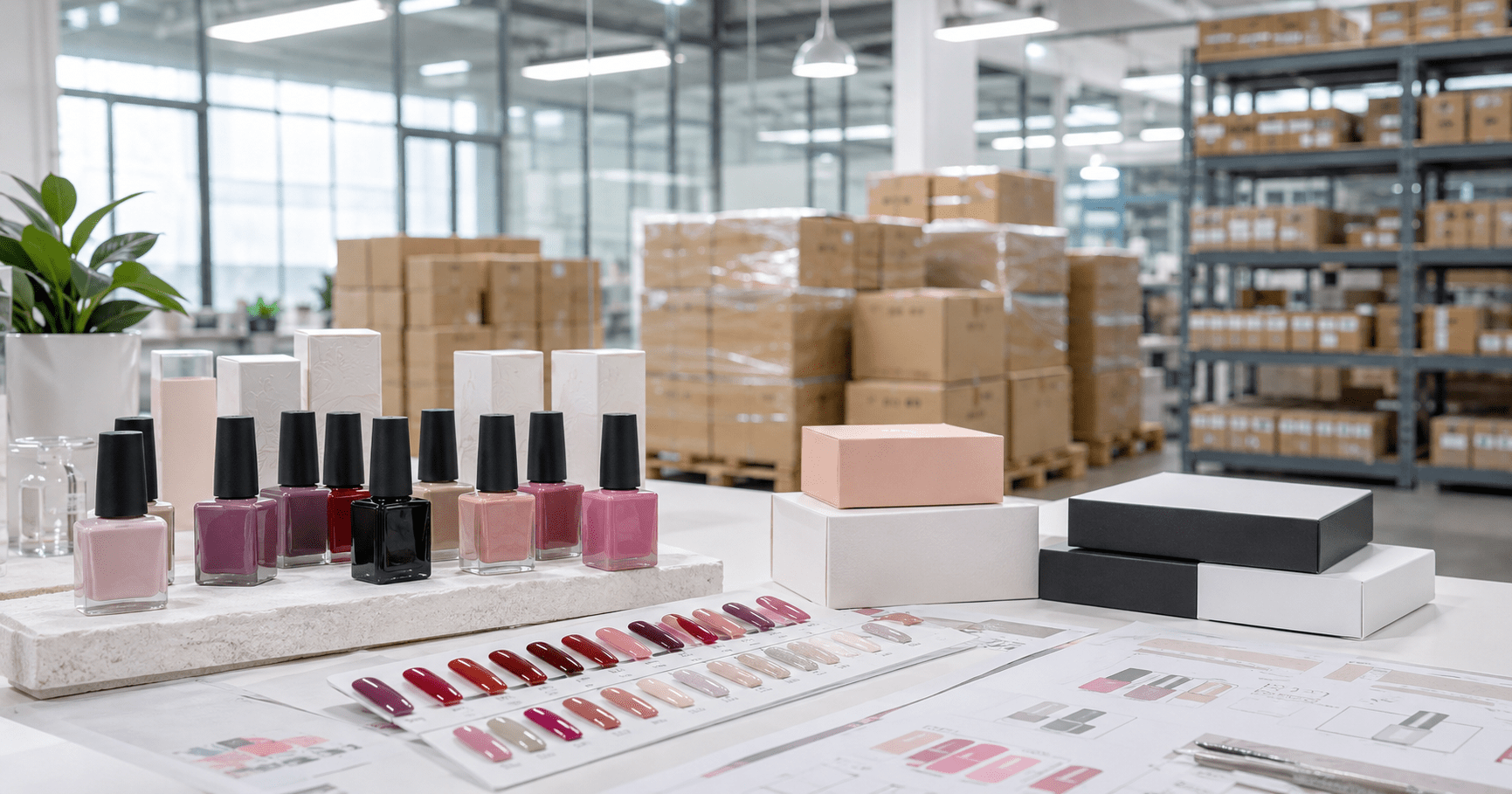
For many nail brands, searching for a nail gel factory China is not only about finding a lower price. It is about finding a supply chain that can support product development, packaging customization, stable production, quality control, export coordination, and long-term reorder growth.
Gel polish is a product category where sourcing decisions directly affect brand reputation. A bottle of gel polish may look simple from the outside, but behind it are many production variables: formula stability, pigment consistency, curing response, texture control, bottle compatibility, brush quality, label accuracy, box packaging, carton protection, documentation, and shipping preparation.
For overseas buyers, especially private label nail brands, distributors, salon chains, Amazon sellers, Shopify sellers, and beauty wholesalers, sourcing from China can offer strong advantages. China has a mature beauty manufacturing ecosystem, a wide packaging supply chain, flexible OEM/ODM capability, and experienced export-oriented factories. However, the advantage does not come automatically from “China” as a location. It comes from choosing the right factory, asking the right questions, and understanding how the supply chain actually works.
A strong gel polish supply chain should help buyers answer several important questions:
- Can this factory support my brand’s product direction?
- Can they manage both formula and packaging?
- Can they help me develop colors, textures, and functional gels?
- Can they keep future batches consistent?
- Can they support low MOQ testing and later larger orders?
- Can they help with export documents and logistics preparation?
- Can they communicate clearly when problems or changes happen?
This article explains why China remains one of the most important sourcing destinations for gel polish and nail gel products, what supply chain advantages matter most to nail brands, and how buyers can evaluate whether a Chinese gel polish supplier is suitable for long-term OEM/ODM cooperation.
The goal is not to say every supplier in China is the same. The real goal is to help buyers understand what a professional China-based nail gel supply chain can offer, and how to use those advantages wisely.
What a Professional Nail Gel Factory in China Actually Does
A professional gel polish factory in China is not just a company that fills liquid into bottles. A real OEM/ODM factory should manage the connection between product performance, packaging execution, production control, quality inspection, and export readiness.
For nail brands, this matters because the finished product is only the final stage. Before the product reaches the buyer’s warehouse or online store, many factory-side decisions have already shaped the final quality.
A professional nail gel factory may support:
- Product category planning
- Formula selection or development
- Color matching
- Texture and viscosity adjustment
- Special effect development
- Raw material preparation
- Sample production
- Bottle and cap selection
- Brush compatibility review
- Label and box packaging coordination
- Filling, capping, labeling, and packing
- Quality control inspection
- Batch record management
- Document support where applicable
- Export packing and logistics communication
- Reorder planning
This full-chain capability is one reason buyers look for a nail gel factory China instead of only buying ready products from a catalog supplier.
A catalog supplier may provide many product options, but an OEM/ODM factory should help buyers build a product system. For example, a private label brand may need a core color gel polish line, a seasonal cat eye collection, a builder gel system, rubber base gels, top coats, primers, and nail art gels. These products should not be selected randomly. They need to fit the brand’s target market, customer skill level, retail price range, packaging style, and reorder strategy.
A factory with real manufacturing experience can help buyers understand what is practical at the sample stage, what requires higher MOQ, what packaging choices affect cost, and what product types need more testing before launch.
China as a Complete Nail Gel Supply Chain Ecosystem
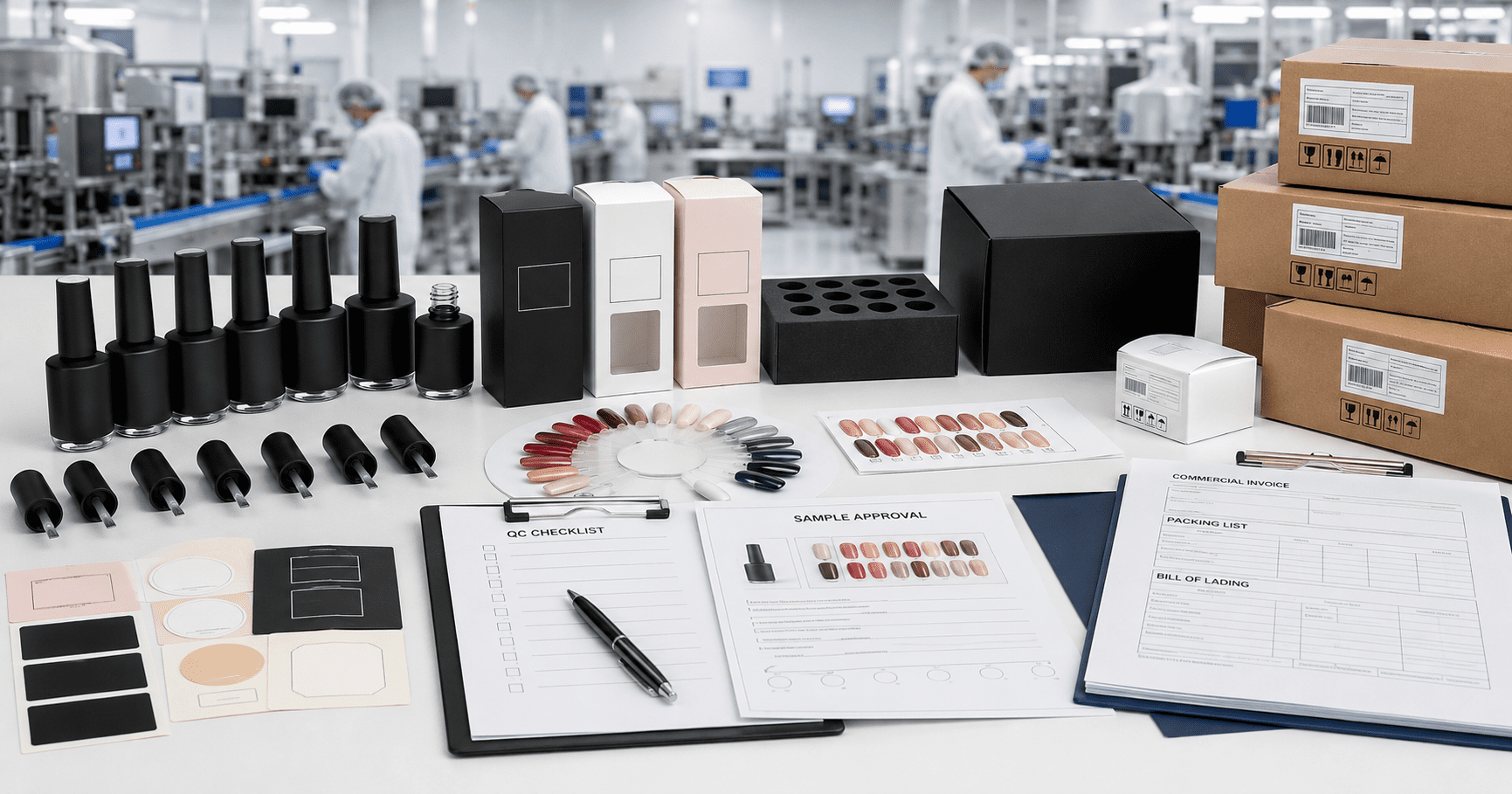
One of the biggest advantages of sourcing gel polish from China is that buyers can access a complete supply chain ecosystem.
Gel polish manufacturing does not depend on formula alone. It also requires packaging, printing, production equipment, color development, testing, export packing, and logistics coordination. China’s advantage is that many of these supply chain links are concentrated and connected.
A complete gel polish supply chain may include:
- Gel polish formulation and production
- Pigment and effect material sourcing
- Bottle and cap suppliers
- Brush suppliers
- Label printing suppliers
- Silk-screen printing suppliers
- Color box suppliers
- Set box and rigid box suppliers
- Inner tray suppliers
- Carton suppliers
- QC and inspection support
- Export document coordination
- Freight forwarder communication
For overseas buyers, this connected ecosystem can reduce project friction. Instead of managing every component separately, buyers may work with a professional factory that coordinates the key steps.
This is especially useful for private label and OEM projects, because the buyer often needs more than one component at the same time. A new product launch may require gel formula, shade selection, bottle, cap, label, box, barcode area, warning text, carton packing, and shipping preparation. When these elements are disconnected, the risk of mistakes increases.
For example, a label design may look good digitally but may not fit the bottle curve. A box may look premium but may not protect the bottle during international shipping. A brush may not match the viscosity of a builder gel. A bottle may not be suitable for UV-sensitive gel if the material or opacity is wrong.
A factory that understands both nail gel production and packaging coordination can help buyers avoid these problems earlier.
Factory, Trading Company, Packaging Supplier, and Brand Agency: Why the Difference Matters
When sourcing from China, buyers may meet several types of suppliers. Each type may have value, but they do not offer the same level of control.
Understanding the difference helps buyers choose the right cooperation model.
Nail Gel Factory
A nail gel factory is directly involved in product manufacturing. It may control formula preparation, color production, filling, capping, labeling, packing, QC inspection, and batch records. Depending on its capability, it may also support R&D, custom colors, private label packaging, and export coordination.
For buyers who need long-term product consistency, factory-direct communication can be valuable.
Trading Company
A trading company focuses on sourcing and coordination. It may work with one or several factories behind the scenes. Trading companies can be useful when buyers need a broad range of products from different categories, but they may not directly control production details.
For gel polish OEM projects, buyers should clarify whether the trading company can access production records, sample adjustment, QC details, and reorder references.
Packaging Supplier
A packaging supplier provides bottles, caps, labels, boxes, trays, and cartons. They may have strong packaging expertise, but they are not necessarily responsible for gel formula production or QC testing.
Packaging suppliers are important, but they are only one part of the gel polish supply chain.
Brand Agency or Product Broker
A brand agency may help with market positioning, visual identity, product planning, or packaging design. This can be useful for brand building, but buyers still need manufacturing support from a real factory.
OEM Manufacturer
An OEM manufacturer produces products under the buyer’s brand requirements. This may include private label packaging, ready formulas, existing colors, custom colors, or buyer-approved product specifications.
OEM is suitable for buyers who already have a brand direction and need production execution.
ODM Manufacturer
An ODM manufacturer provides more development support. This may include formula direction, texture suggestions, new color collections, trend-based product concepts, and sample iteration.
ODM is useful for brands that need product differentiation, not just logo placement.
Why Nail Brands Source Gel Polish from China
China’s gel polish supply chain advantage is not based on one factor. It is built through a combination of manufacturing experience, packaging access, production flexibility, product variety, export familiarity, and cost structure.
For nail brands, these advantages can support different stages of business growth.
- A new brand may need low MOQ private label products to test the market.
- An established brand may need more advanced color development and packaging upgrades.
- A distributor may need stable bulk supply and carton-ready export packing.
- An Amazon seller may need product consistency, packaging protection, and clear documentation.
- A salon chain may need professional product performance and reliable reorders.
- A beauty wholesaler may need a wide product category system and seasonal launches.
China-based factories can be especially useful when buyers need product variety and packaging flexibility at the same time.
For example, a buyer may want to develop:
- 60-color gel polish collection
- Cat eye gel collection
- Jelly nude series
- Builder gel system
- Rubber base gel line
- Top coat and base coat system
- Seasonal glitter gel collection
- Gift box sets
- Private label bottle series
- Salon-ready color cards
A mature supply chain can help combine these product and packaging needs into a more manageable OEM project.
Key Supply Chain Advantages of Sourcing Gel Polish from China
1. Mature Gel Polish Manufacturing Experience
China has developed strong manufacturing experience in nail gel products, especially for private label and OEM/ODM supply. Many Chinese factories are familiar with producing for overseas buyers, which means they often understand requirements around sampling, packaging, SKU planning, export packing, and repeat orders.
This experience matters because gel polish production requires category-specific understanding.
A professional nail gel factory should understand products such as:
- Color Gel Polish
- Kedi Gözü Jeli
- Jelly Gel
- Parıltılı Jel
- Reflective Gel
- İnşaatçı Jeli
- Rubber Base Gel
- Baz Kat
- Üst Kat
- Matte Top Coat
- Steel Top Coat
- Primer
- Dehydrator
- Blooming Gel
- Nail Art Gel
- Fonksiyonel Jel
Each product category has different performance expectations. Builder gel needs strength and self-leveling. Cat eye gel needs magnetic movement and visual depth. Jelly gel needs controlled transparency. Top coat needs surface finish and gloss. Rubber base gel needs flexibility and base-layer performance.
A supplier that understands these differences can support better product planning than one that only offers generic catalog items.
2. Strong Packaging Supply Chain
Packaging is one of the biggest reasons nail brands source from China.
Gel polish brands often need more than a standard bottle. They may need a complete packaging system that includes:
- Bottle shape
- Bottle color
- Cap design
- Brush type
- Label material
- Silk-screen printing
- Hot stamping
- Color box
- Set box
- Rigid box
- Drawer box
- Inner tray
- Barcode area
- Carton packing
- Shipping protection
China’s packaging ecosystem gives buyers access to many options. This is useful for brands at different stages.
A startup brand may choose standard bottles with custom labels to reduce MOQ and launch faster. An established brand may choose silk-screen printing, special cap finishes, custom boxes, or full set packaging. A premium salon brand may develop a more unified visual identity with bottle, box, color card, and display set.
However, packaging flexibility also requires professional control. More options mean more decisions, and more decisions create more risk if they are not confirmed carefully.
Alıcılar sormalı:
- Is this bottle suitable for gel polish?
- Does the label fit the bottle curve?
- Will the cap and brush match the product texture?
- Is the box strong enough for shipping?
- Does the packaging allow enough space for required label information?
- Can the same packaging be used for future reorders?
- What is the MOQ for this packaging process?
A good factory should not only show packaging options. It should help buyers choose packaging that is practical for production and shipment.
3. Flexible OEM and Private Label Options
Many nail brands choose China because of flexible OEM and private label options.
Depending on the factory and project type, buyers may be able to choose from:
- Ready formulas
- Existing color collections
- Custom color matching
- Custom shade numbering
- Private label bottles
- Custom labels
- Custom color boxes
- Set packaging
- Functional gel systems
- Seasonal collections
- ODM development support
This flexibility is useful because not every buyer is at the same business stage.
A new brand may not need a custom formula immediately. It may start with ready formulas, selected colors, and private label packaging. This allows the brand to test product-market fit before investing in more complex customization.
An established brand may need deeper differentiation. It may request exclusive color direction, custom textures, special effects, or upgraded packaging.
A distributor may need a balance: reliable ready products with enough branding flexibility for local market needs.
For suitable low MOQ private label projects, YICHUN / GELOEM can support projects starting from 60 bottles per color with 15ml net content, depending on product type, packaging method, customization level, and production schedule.
This kind of low MOQ support can help buyers test early collections, but buyers should remember that custom formulas, custom packaging, special printing, or custom boxes may require higher MOQ and longer preparation.
4. Fast Product Development for Trend-Driven Nail Markets
Nail trends move quickly. Cat eye effects, jelly nudes, milky shades, reflective glitter, builder gels, rubber bases, seasonal colors, and functional gel systems can rise quickly across social media, salons, and e-commerce platforms.
For nail brands, speed matters — but only when combined with quality control.
China’s nail gel supply chain can support trend-driven development because many factories are familiar with:
- Seasonal color planning
- Special effect gels
- Texture variation
- Color card development
- Sample iteration
- Packaging refreshes
- Small batch testing
- Scaling successful products
A brand may begin with a trend idea and then work with a factory to turn it into a finished product line.
For example:
- A TikTok beauty brand may want a reflective glitter gel set.
- A salon chain may want a builder gel nude system.
- A distributor may want seasonal cat eye colors.
- A Shopify brand may want a jelly pink private label collection.
- An Amazon seller may want a complete base coat and top coat bundle.
A factory with strong sampling and packaging coordination can help shorten the path from concept to product approval.
However, buyers should not confuse speed with skipping testing. Fast development should still include sample review, curing tests, packaging confirmation, and QC planning.
5. Cost Structure Advantages Without Depending Only on Low Price
Many buyers source from China because of cost advantages. This is a real factor, but it should be understood correctly.
A professional sourcing strategy should not focus only on the lowest unit price. In gel polish OEM, cost is affected by many variables:
- Formula type
- Raw material selection
- Pigment and effect materials
- Bottle size
- Cap and brush
- Label material
- Printing process
- Box packaging
- Number of colors
- Quantity per color
- Order quantity
- Inspection requirements
- Export document needs
- Shipping method
China can offer cost efficiency because of supply chain concentration, packaging availability, manufacturing experience, and production organization. But a reliable factory will still price based on real product and packaging requirements.
Buyers should be careful when a supplier offers a price that seems too low for the requested customization level. Extremely low pricing may indicate hidden trade-offs in formula quality, packaging material, inspection process, communication support, or reorder stability.
A better approach is to compare total value:
- What formula is included?
- What packaging is included?
- What sample process is included?
- What QC checks are included?
- What documents can be supported?
- What happens if there is a problem?
- Can the supplier support reorders consistently?
Factory-direct sourcing may help buyers reduce communication layers and improve project control, but the goal should be sustainable margin, not the cheapest possible product.
6. Wide Product Category Support
Another important advantage of China’s nail gel supply chain is wide product category support.
Many brands do not want to work with a separate supplier for every product. They want a more integrated supply system.
A professional factory may help buyers develop a complete nail gel product map, such as:
| Product Line | Brand Use Case | Buyer Benefit |
|---|---|---|
| Color Gel Polish | Core retail or salon color range | Builds the main product foundation |
| Kedi Gözü Jeli | Trend and visual effect collection | Adds high-impact selling points |
| Jelly Gel | Soft translucent color trend | Supports modern salon and social media styles |
| İnşaatçı Jeli | Professional nail structure system | Appeals to salon and training customers |
| Rubber Base Gel | Flexible base layer and nail strengthening | Expands functional product offering |
| Baz Kat | Essential system product | Supports complete nail application routine |
| Üst Kat | Gloss, matte, steel, or no-wipe finish | Creates system completeness |
| Primer / Dehydrator | Nail prep support | Helps brands offer professional-use systems |
| Blooming Gel | Nail art effect product | Adds creative salon value |
| Glitter / Reflective Gel | Seasonal and promotional collections | Supports marketing campaigns |
This category support helps brands build a stronger product structure. Instead of launching random colors, buyers can create a complete system that supports salon use, retail sales, tutorials, bundles, and reorders.
7. Production Scalability for Growing Nail Brands
One of the strongest reasons nail brands source from China is scalability.
A brand may start with a small private label test order, then gradually expand into a larger product line. This growth path is common for Shopify sellers, Amazon sellers, salon brands, nail distributors, and social media-driven beauty brands.
A professional nail gel factory China should be able to support different stages of growth:
| Brand Stage | Typical Need | Supply Chain Requirement |
|---|---|---|
| Startup brand | Low MOQ private label launch | Ready formulas, selected colors, simple packaging |
| Early growth brand | More colors and better packaging | Stable samples, label control, reorder consistency |
| Established brand | Wider product system | More SKUs, packaging upgrades, QC planning |
| Distributor | Bulk supply and category depth | Larger production planning, carton packing, shipment coordination |
| Salon chain | Professional product system | Stable formula performance and long-term reorder support |
| Premium brand | Differentiated products | ODM development, custom color direction, packaging control |
This scalability is important because a buyer’s needs change over time.
At the beginning, the buyer may only need 12 colors, 24 colors, or a small functional gel set. Later, the same buyer may need a 60-color collection, a seasonal cat eye series, a builder gel system, a base and top coat system, retail boxes, salon display materials, or bulk reorder planning.
A mature Chinese gel polish factory can often help buyers move from product testing to structured product expansion. However, buyers should not assume scalability automatically. They should evaluate whether the factory can manage production scheduling, packaging material preparation, color consistency, QC checkpoints, and export packing as order volume increases.
Scaling is not only about making more bottles. It is about keeping the same product standard while the order becomes more complex.
8. Strong Color and Effect Development Capability
Gel polish is a highly visual product. Color, texture, shine, transparency, glitter, and special effects directly influence buyer decisions and consumer response.
China’s nail gel supply chain has become especially strong in color and effect development because the market requires constant product updates. Many professional factories are familiar with trend-driven categories such as:
- Cat eye gel
- Jelly gel
- Milky nude gel
- Reflective glitter gel
- Magnetic gel
- Chameleon gel
- Glitter gel
- Syrup gel
- Builder gel nude shades
- Rubber base color systems
- Seasonal gel polish collections
- Nail art effect gels
For nail brands, this can be a major advantage. Instead of developing each new collection from zero, buyers can work with a factory that already understands color families, popular effects, salon application needs, and packaging presentation.
However, color development should still be controlled carefully.
A professional factory should help buyers confirm:
- Color direction
- Opacity level
- Transparency level
- Texture and viscosity
- Glitter or particle density
- Magnetic effect strength
- Layering result
- Curing response
- Color difference under different lighting
- Approved sample references
- Shade numbering system
- Reorder consistency
This is especially important for colors that appear different under various lighting conditions. A nude shade may look warmer in daylight and cooler under studio lighting. A cat eye gel may show different depth depending on the magnet, base color, and viewing angle. A glitter gel may look dense in a bottle but different when applied in thin layers.
Buyers should approve physical samples before bulk production, especially for custom colors or special effect gels.
9. Packaging Flexibility for Private Label Brands
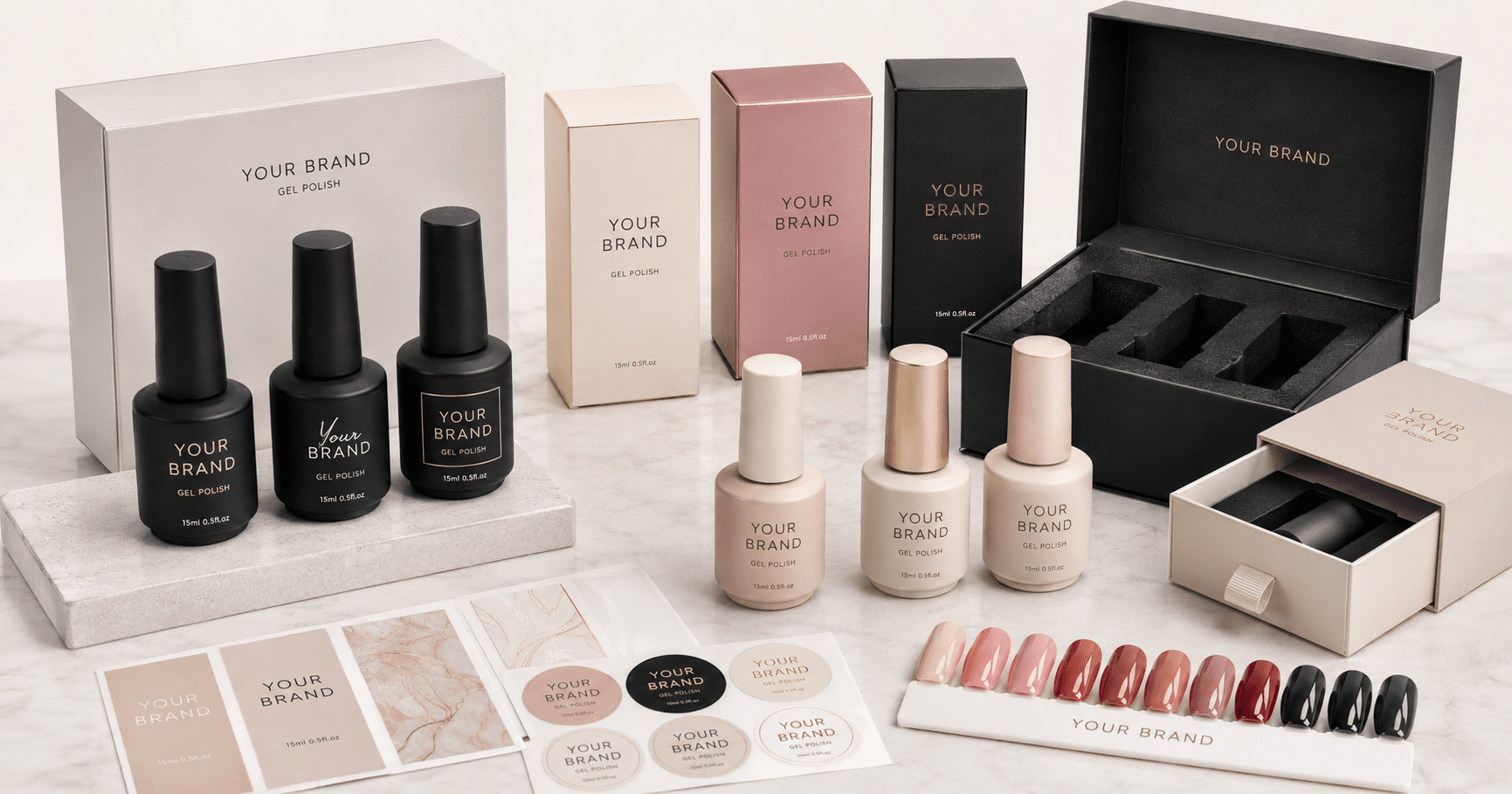
Packaging is one of the biggest practical advantages of sourcing gel polish from China.
A nail brand does not only need a good formula. It also needs packaging that supports brand positioning, retail display, shipping protection, and customer trust.
China’s packaging supply chain can support many private label options, such as:
- Standard gel polish bottles
- Matte black bottles
- White bottles
- Colored bottles
- Custom labels
- Waterproof labels
- Metallic labels
- Silk-screen printed bottles
- Hot stamping
- Color boxes
- Rigid boxes
- Drawer boxes
- Magnetic boxes
- Set boxes
- Inner trays
- Carton packing
- Color cards
- Display-ready packaging
This gives buyers flexibility at different budget levels.
A startup brand may begin with standard bottles and custom labels. A growing brand may upgrade to printed bottles and color boxes. A premium brand may develop set boxes, salon kits, or more refined packaging systems.
But packaging flexibility also requires careful decision-making. More customization usually means more variables.
Buyers should confirm:
| Packaging Item | Why It Matters | Buyer Risk if Ignored |
|---|---|---|
| Bottle size | Affects net content, label size, shipping weight | Wrong positioning or higher cost |
| Bottle opacity | Gel products need suitable light protection | Product stability risk |
| Cap and brush | Affects application experience | Poor user experience |
| Label material | Affects appearance and durability | Peeling or poor brand presentation |
| Label size | Must fit bottle curve | Wrinkled or misaligned label |
| Box structure | Affects retail look and protection | Damage during shipping |
| Inner tray | Protects bottles in sets | Broken or moving bottles |
| Carton packing | Affects international shipping safety | Leakage, damage, or claims |
| Batch code area | Supports traceability | Poor reorder and QC control |
A professional factory should help buyers choose packaging that is realistic for production, not only attractive in a mockup.
10. Integrated Product and Packaging Coordination
One important advantage of working with a real factory is that product and packaging decisions can be coordinated together.
This matters because gel polish packaging must match the product type.
For example:
- A high-viscosity builder gel may need a suitable brush, bottle, or jar format.
- A UV-sensitive gel formula needs packaging that protects it from light exposure.
- A glitter gel may need proper suspension and bottle compatibility.
- A thick rubber base gel may require a brush that applies evenly.
- A premium salon line may need consistent bottle, label, and box design across multiple product categories.
- A large color collection needs clear shade numbers, color labels, and carton organization.
If product development and packaging sourcing are handled separately, mistakes are more likely. The packaging may look good but fail during filling, labeling, packing, or shipping.
A professional nail gel factory should consider:
- Product viscosity and brush compatibility
- Bottle shape and filling process
- Label material and bottle surface
- Box size and bottle protection
- Shade number and label system
- Carton packing and SKU separation
- Reorder packaging consistency
This integrated approach is especially valuable for private label buyers who are building a brand, not just buying inventory.
11. OEM/ODM Flexibility: From Ready Products to Custom Development
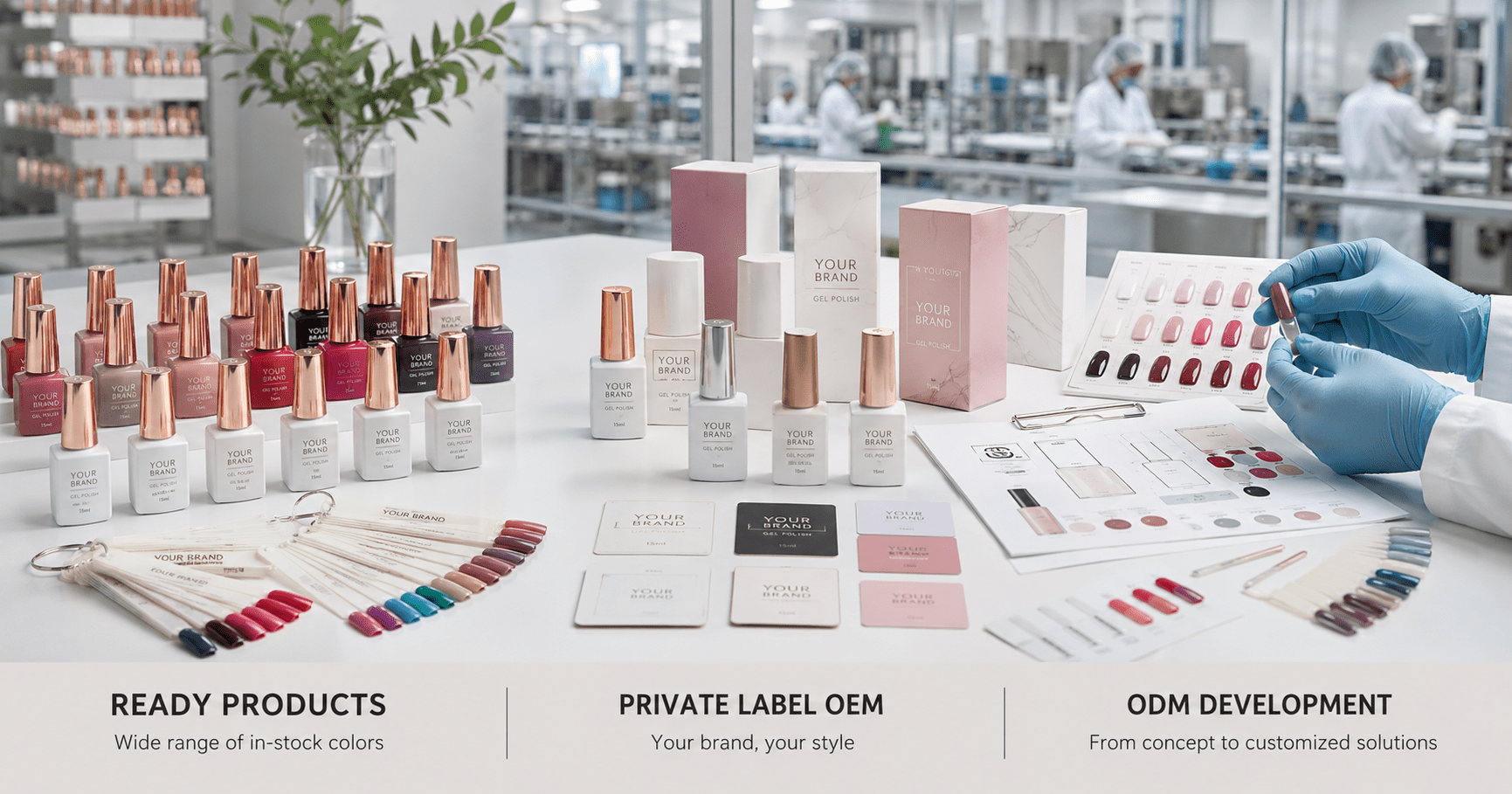
Another reason buyers source from China is the flexibility between ready products, OEM customization, and ODM development.
Not every buyer needs the same level of customization.
Ready Product Selection
Ready products are suitable for buyers who want to launch quickly. The buyer may select existing colors or formulas, then customize labels or packaging.
This can be practical for:
- Startup brands
- Market testing
- Seasonal promotion
- Influencer product launches
- Low MOQ private label projects
- Salon trial lines
OEM Customization
OEM customization is suitable for buyers who have a clearer brand plan. The buyer may choose product categories, colors, bottle style, label design, box packaging, and product specifications.
This is often used by:
- Private label nail brands
- Distributors
- Beauty wholesalers
- Amazon sellers
- Shopify brands
- Salon product companies
ODM Development
ODM development goes deeper. The factory may help with product concept, color direction, texture suggestions, sample iteration, special effects, and product system planning.
ODM may be suitable for buyers who want:
- Custom seasonal collections
- New gel textures
- Special effect gels
- Builder gel systems
- HEMA-free or TPO-free direction where applicable
- Premium salon product lines
- Differentiated product concepts
ODM does not mean a factory should disclose confidential formulas or exact formulation ratios. It means the factory supports development logic, sample creation, testing, and product refinement.
A good Chinese nail gel factory should help buyers choose the right development path based on budget, MOQ, timeline, target market, and brand positioning.
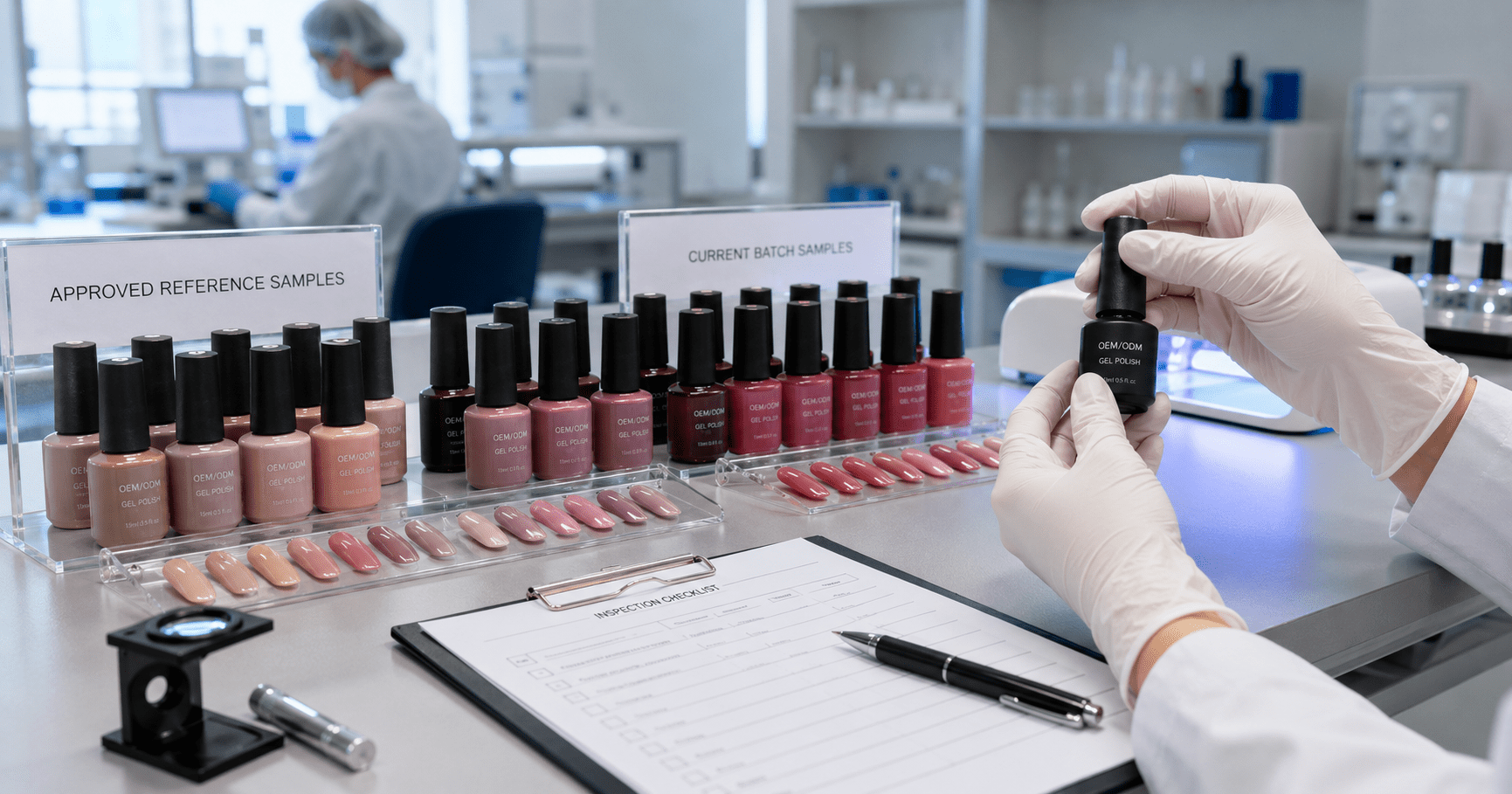
12. Quality Control and Batch Consistency Support
Supply chain advantage is not only about producing more products. It is about producing products consistently.
For gel polish, consistency matters in several areas:
- Color
- Texture
- Viscosity
- Curing response
- Gloss
- Opacity
- Magnetic effect
- Glitter density
- Filling volume
- Bottle sealing
- Label alignment
- Box packing
- Carton count
- Batch identification
A professional factory should have a structured QC process before shipment. This may include:
| QC Area | What the Factory May Check | Why Buyers Should Care |
|---|---|---|
| Raw material review | Material condition and batch use | Supports formula stability |
| Color check | Sample vs bulk shade comparison | Reduces color complaints |
| Viscosity check | Texture and application feel | Supports professional usability |
| Curing test | UV/LED curing response | Protects product performance |
| Gloss or finish review | Surface appearance after curing | Supports customer satisfaction |
| Filling volume check | Bottle fill level | Reduces quantity disputes |
| Bottle sealing check | Leakage risk | Important for international shipping |
| Cap tightness check | Closure consistency | Prevents leakage and damage |
| Label alignment | Brand presentation | Protects retail appearance |
| Box packing check | Packaging condition | Reduces shipping damage |
| Carton inspection | Carton strength and count | Supports export readiness |
For buyers, the key question is not simply “Do you have QC?” The better question is:
“What QC checks will you perform for this exact order?”
Different product types require different checks. A cat eye gel needs magnetic effect review. A top coat needs finish review. A builder gel needs viscosity and self-leveling attention. A glitter gel needs particle distribution observation.
Batch consistency should also be discussed before reorders. Buyers should ask whether the factory keeps approved samples, production notes, color references, packaging files, and batch information where applicable.
13. Export Experience and Logistics Coordination
Many overseas buyers choose China because Chinese factories are often experienced in export preparation. This does not mean a factory can guarantee customs clearance or solve every import requirement. However, an export-oriented factory should understand the basic workflow of preparing goods for international shipment.
Export support may include:
- Packing list preparation
- Commercial invoice coordination
- Carton marks
- SKU separation
- Carton count confirmation
- Gross weight and net weight information
- Product label information support
- Shipping document coordination
- Communication with freight forwarders
- Export carton packing
- Warehouse-ready shipment preparation
For nail gel products, shipping may require additional attention because product type, formula, destination, shipping method, and carrier requirements can affect document needs and shipping route.
Buyers should confirm logistics needs early, especially if they are shipping to:
- Amazon warehouse
- Third-party warehouse
- Distributor warehouse
- Salon chain warehouse
- Retail distribution center
- Cross-border e-commerce fulfillment center
Each destination may have different packing, labeling, carton marking, and document expectations.
A professional factory should help buyers prepare goods in a more organized way, but buyers should also confirm import and platform requirements in their own market.
14. Documentation Awareness for International Buyers
Documentation is an important part of sourcing gel polish from China.
Depending on product type, country, ingredient claims, and sales channel, buyers may ask whether the factory can support:
- MSDS
- COA
- Ingredient list
- Product label information
- Packing list
- Commercial invoice
- Shipping documents
- Testing reports where required
- Factory documents where available and applicable
Compliance requirements vary by country, product category, label claims, ingredients, and distribution channel. A product sold through a salon distributor may have different documentation needs from a product sold through Amazon, TikTok Shop, Shopify, retail stores, or professional training academies.
A responsible factory should not promise that one document makes a product suitable for every market. Instead, it should help buyers understand which documents may be prepared where applicable and encourage buyers to confirm market-specific requirements before bulk production.
Buyers should prepare these questions early:
- What market will the product be sold in?
- What product category is it?
- Are there specific ingredient claims?
- Are there platform requirements?
- Does the importer need special documents?
- Is local registration required?
- What label information must appear on packaging?
- Are there restrictions on certain ingredients?
- Is third-party testing needed?
This type of planning helps avoid delays after production is complete.
15. MOQ, Cost, Timeline, and Supply Chain Variables
China’s supply chain can be flexible, but buyers should understand that MOQ, cost, and timeline depend on project details.
A professional factory will not treat every inquiry the same. A 12-color private label collection with standard labels is different from a 60-color collection with custom boxes. A ready color project is different from a new ODM texture. A simple bottle label is different from hot stamping or custom packaging.
MOQ Variables
MOQ may depend on:
- Product type
- Formula availability
- Number of colors
- Quantity per color
- Bottle size
- Bottle inventory
- Label printing method
- Box printing requirement
- Custom packaging
- Special effect materials
- Production scheduling
Low MOQ can be useful for market testing, but buyers should understand that deeper customization usually requires higher MOQ.
Cost Variables
Cost may depend on:
- Formula type
- Raw material selection
- Pigment and effect materials
- Bottle and cap
- Brush system
- Label material
- Printing process
- Box packaging
- Number of SKUs
- Order quantity
- QC requirements
- Document needs
- Shipping method
A lower price is not always better if it reduces product stability, packaging quality, or QC support.
Timeline Variables
Timeline may depend on:
- Requirement confirmation
- Sample preparation
- Buyer feedback
- Formula or color adjustment
- Artwork confirmation
- Packaging material production
- Bulk production scheduling
- QC inspection
- Final packing
- Logistics booking
- Document preparation
Buyers should not expect accurate lead time until samples, packaging, quantity, and documents are clear.
16. China Supply Chain Advantage Table for Nail Brands
| Supply Chain Advantage | What It Means for Buyers | Best-Fit Buyer Type |
|---|---|---|
| Mature gel polish production | Access to factories familiar with nail gel categories | Nail brands, distributors, salon chains |
| Wide packaging ecosystem | More options for bottles, labels, boxes, and sets | Private label brands, premium brands |
| OEM flexibility | Custom labels, packaging, color selection, product systems | Startup and growing brands |
| ODM development | Product concepts, sample iteration, color and texture direction | Established brands, product development teams |
| Low MOQ options | Easier market testing before scaling | New brands, Shopify sellers, influencers |
| Large-order planning | Better support for repeat and bulk orders | Distributors, wholesalers, importers |
| Category depth | Color gels, cat eye, builder, rubber base, top coats, nail art gels | Brands building full product lines |
| QC and batch control | Supports consistency and reorder confidence | Professional buyers and salon channels |
| Export experience | Better packing, documents, and logistics communication | Importers, Amazon sellers, distributors |
| Cost structure efficiency | Competitive sourcing when specifications are clear | Buyers balancing margin and quality |
This table shows why China is attractive for nail gel sourcing, but it also shows an important point: the buyer must match the supplier to the project type. Not every factory is suitable for every brand stage.
17. Professional Judgment: How Buyers Should Evaluate a China-Based Nail Gel Factory
Sourcing from China can offer strong advantages, but buyers still need to evaluate suppliers carefully.
A strong supply chain does not replace supplier verification. Buyers should check whether the specific factory can support the project professionally.
Buyers Should Ask
- What gel product categories do you manufacture?
- Do you support ready colors, custom colors, or ODM development?
- How do you prepare and revise samples?
- What packaging options can you support?
- How do you control color consistency?
- What QC checks are performed before shipment?
- Can you support private label bottles and boxes?
- What documents can you provide where applicable?
- How do you manage repeat orders?
- Can you support both low MOQ testing and larger future orders?
- What factors affect MOQ, price, and timeline?
- Can you explain limitations before production begins?
Positive Signals
A professional China-based gel polish factory often shows:
- Clear product category knowledge
- Real sample process
- Packaging coordination ability
- QC explanation
- Export document awareness
- Structured communication
- Practical MOQ explanation
- Ability to discuss formula and texture direction without revealing confidential ratios
- Reorder planning
- Honest limitation setting
Warning Signs
Buyers should be cautious if a supplier:
- Only sends catalog photos
- Cannot explain product differences
- Cannot discuss sample testing
- Avoids QC questions
- Gives unclear MOQ logic
- Promises every customization at very low MOQ
- Does not confirm packaging details
- Ignores document requirements
- Cannot explain reorder consistency
- Pushes payment before requirements are clear
The best sourcing approach is to start with clear requirements, test samples, confirm packaging, review QC process, and scale gradually.
18. Common Mistakes to Avoid When Sourcing Gel Polish from China
Mistake 1: Choosing China Only for Low Price
China can offer cost advantages, but sourcing only for the lowest price can create product and packaging risks. Buyers should evaluate formula stability, QC, packaging, communication, and reorder support.
Mistake 2: Not Verifying Factory Capability
A supplier may present itself as a factory, but buyers should verify production evidence, sample process, QC workflow, and packaging control before placing bulk orders.
Mistake 3: Ignoring Packaging Complexity
Packaging is often where OEM projects fail. Buyers should confirm bottle, cap, brush, label, box, inner tray, carton packing, and batch coding before production.
Mistake 4: Skipping Physical Sample Approval
Digital photos are not enough for gel polish. Buyers should review physical samples for color, texture, curing, application, and packaging appearance.
Mistake 5: Launching Too Many SKUs Too Early
A wide color range can look attractive, but too many SKUs increase production complexity, inventory risk, and reorder management difficulty. New brands may benefit from starting with a focused launch.
Mistake 6: Assuming All Factories Can Do ODM
ODM development requires sample development, color understanding, texture adjustment, and product testing. Not every supplier can support deeper development.
Mistake 7: Not Discussing Reorder Consistency
The first order is only the beginning. Buyers should ask how the factory manages approved samples, color references, packaging files, and batch records.
Mistake 8: Confirming Price Before Confirming Specifications
Price depends on formula, packaging, quantity, printing, QC, and shipping needs. Buyers should avoid comparing quotations that are based on different assumptions.
Mistake 9: Forgetting Market and Platform Requirements
Different markets and platforms may require different documents, labels, and product claims. Buyers should confirm these requirements before production.
Mistake 10: Treating the Factory as Only a Bottle Filler
A good OEM/ODM factory can support product planning, sampling, packaging, QC, documents, and reorders. Buyers who only focus on filling may miss the real value of factory cooperation.
How a Professional Chinese Nail Gel OEM/ODM Factory Can Support Buyers
After understanding the supply chain advantages of sourcing gel polish from China, buyers need to ask a more practical question:
How should a professional nail gel factory China actually support my brand?
A strong factory relationship is not only about buying finished bottles. It should help buyers manage the full product journey: category planning, sample development, packaging confirmation, production control, QC inspection, export preparation, and long-term reorder planning.
For overseas nail brands, this support can reduce mistakes, shorten communication loops, and make future product launches more organized.
1. Product Category Planning
Many buyers start with a simple idea: “I want to launch a gel polish line.”
A professional factory should help turn that idea into a clear product structure. Instead of selecting random colors or products, buyers should build a line that matches their market, customer type, sales channel, and brand positioning.
For example, a startup private label brand may begin with:
- 12–24 core gel polish colors
- Base coat and top coat
- A small cat eye gel collection
- Simple private label bottles
- Basic color box packaging
A salon-focused brand may need:
- Nude builder gels
- Rubber base gels
- Base coat and top coat systems
- Professional color gels
- Functional gels for nail prep
- Salon-friendly packaging
A distributor may need:
- Wider color ranges
- Seasonal collections
- Category depth
- Carton-ready packing
- Reorder planning
- Clear SKU organization
A professional factory should help buyers avoid launching too many unrelated SKUs at once. A better product structure makes inventory easier to manage and reorders more predictable.
2. Formula, Texture, and Color Direction Support
A real OEM/ODM factory should help buyers translate product ideas into practical gel products.
This may include:
- Ready formula selection
- Custom color matching
- Texture direction
- Viscosity adjustment
- Opacity or transparency planning
- Glitter or magnetic effect development
- Builder gel and rubber base gel texture suggestions
- Top coat finish selection
- Sample revision after buyer testing
For example, “jelly nude gel polish” is not only a color request. It requires decisions around transparency, layering effect, color warmth, curing response, and final nail appearance.
“Cat eye gel” is not only about adding magnetic particles. It needs magnetic movement, depth, light reflection, background color, and application control.
“Builder gel” requires attention to viscosity, self-leveling, strength, curing thickness, and application feel.
A professional factory should guide buyers through these decisions without revealing confidential formulation ratios. The focus should be on performance goals, sample approval, and production feasibility.
3. Sample Preparation and Buyer Approval
Sample development is one of the most important steps in gel polish OEM.
Before bulk production, buyers should test:
- Color accuracy
- Texture
- Viscosity
- Curing result
- Gloss or finish
- Application feel
- Cat eye or glitter effect if applicable
- Bottle and brush quality
- Label appearance
- Box packaging
- Overall brand presentation
A professional factory can support different sample types:
| Sample Type | Amaç | Buyer Decision |
|---|---|---|
| Product sample | Test formula, color, texture, curing | Approve or request adjustment |
| Nail tip swatch | Review color and effect visually | Confirm shade direction |
| Bottle sample | Check bottle, cap, brush, and label fit | Confirm packaging practicality |
| Label sample | Review material, size, and printing | Confirm brand presentation |
| Box sample | Check structure and visual style | Confirm retail packaging |
| Final approval sample | Align product and packaging before bulk | Production reference |
Buyers should treat sample approval seriously. Once bulk production begins, changes become more difficult and more expensive.
4. Packaging Structure and Artwork Confirmation
China’s packaging supply chain is one of its major advantages, but packaging must be handled carefully.
A professional nail gel factory can help buyers coordinate:
- Bottle size
- Bottle shape
- Cap style
- Brush compatibility
- Label size
- Label material
- Bottle printing
- Silk-screen printing
- Hot stamping
- Color box
- Rigid box
- Drawer box
- Set box
- Inner tray
- Barcode area
- Warning text space
- Batch number position
- Export carton packing
The key is production-ready confirmation.
A beautiful design file is not enough. Buyers need to confirm whether the label fits the bottle, whether the box protects the product, whether the brush works with the formula, and whether the packaging can be repeated for future orders.
Packaging should support both brand image and manufacturing control.
5. Production Management
Once samples and packaging are approved, the factory must turn the confirmed details into bulk production.
A professional factory should manage:
- Raw material preparation
- Pigment and effect material preparation
- Bottle and cap readiness
- Label and box preparation
- Production scheduling
- Filling
- Capping
- Labeling
- Boxing
- Carton packing
- In-process inspection
- Final quality review
- Shipment preparation
Production management becomes more important when the order contains many colors or many SKUs.
For example, a 60-color collection requires careful shade organization, label matching, carton separation, and count checking. A set box project requires product, tray, box, and outer carton coordination. A distributor order may require SKU separation for warehouse receiving.
A professional factory should help buyers reduce confusion by confirming details before production starts.
6. Quality Control and Batch Consistency
Quality control is the foundation of long-term sourcing.
A professional Chinese nail gel factory should support QC checks such as:
- Raw material condition review
- Formula preparation control
- Color consistency check
- Viscosity check
- Curing test
- Gloss or finish review
- Application appearance review
- Filling volume check
- Bottle sealing check
- Cap tightness check
- Label alignment check
- Box packing check
- Carton strength check
- Batch identification
- Sample retention where applicable
Batch consistency matters especially for reorders. A buyer may approve the first shipment, but the real test is whether future batches remain consistent.
Alıcılar sormalı:
- Will approved samples be kept as references?
- How are colors identified for future reorders?
- How are packaging files managed?
- What happens if a bottle, cap, label, or box material changes?
- Can samples be reconfirmed before a large reorder?
A reliable factory relationship is built through repeatable control, not only the first successful shipment.
7. Export Coordination and Shipment Preparation
Export-oriented factories in China often support buyers with shipment preparation, but buyers should still confirm details early.
A professional factory may help coordinate:
- Packing list
- Commercial invoice support
- Carton marks
- Product count per carton
- Gross weight and net weight information
- Carton dimensions
- SKU separation
- Shipping document communication
- Freight forwarder coordination
- Warehouse-ready carton packing
For buyers shipping to Amazon warehouses, distributor warehouses, salon chain warehouses, or third-party logistics centers, packing details can matter as much as product quality.
Buyers should confirm:
- How products are packed
- Whether cartons are strong enough
- Whether SKUs are separated clearly
- Whether carton marks match warehouse needs
- Whether documents match shipment information
- Whether the freight forwarder has special requirements
A factory cannot guarantee customs clearance for every market, but it should understand export preparation and communicate clearly with the buyer or freight partner.
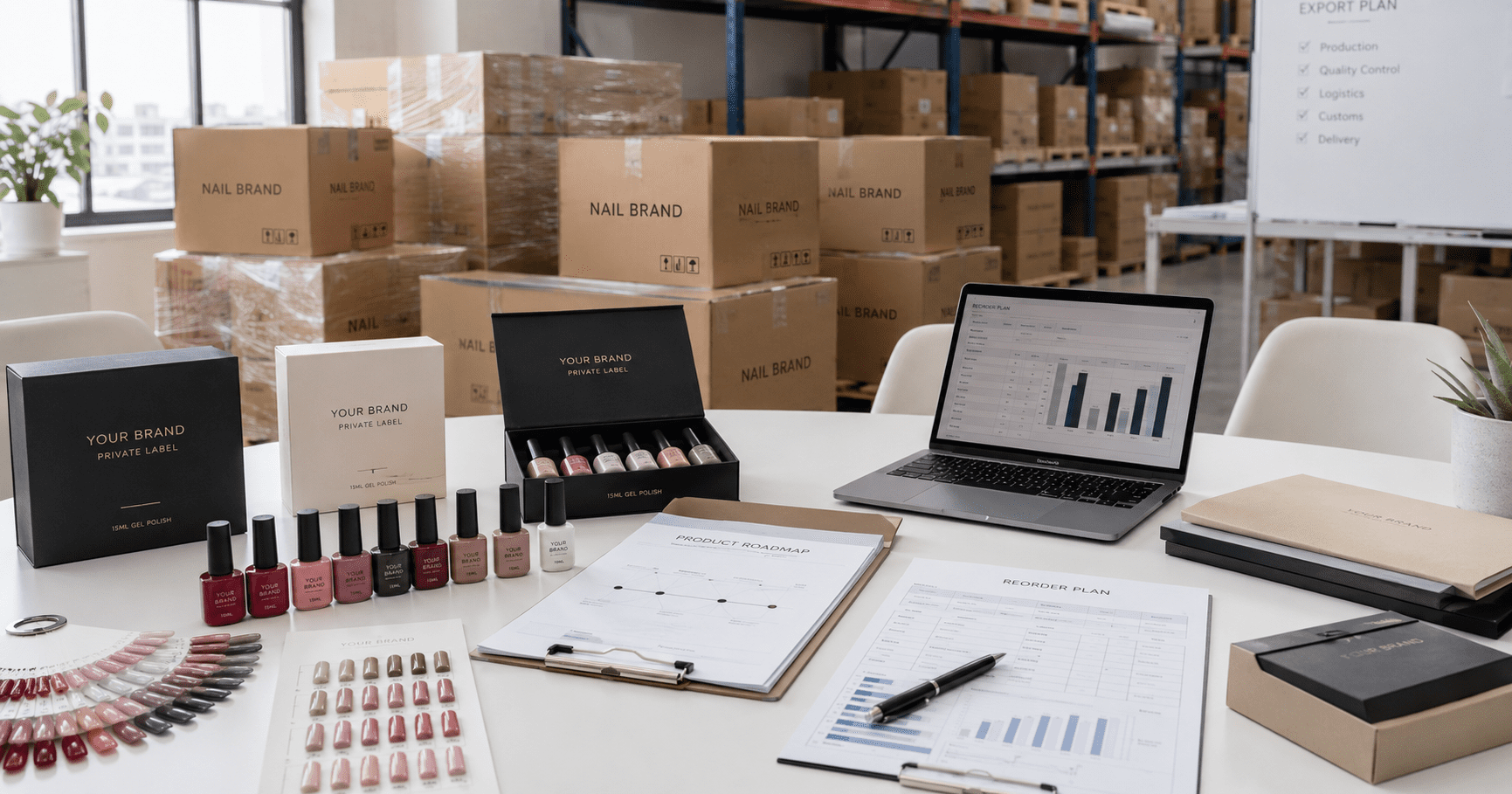
8. Long-Term Reorder and Product Roadmap Support
The strongest value of a professional nail gel factory China is not only the first order. It is the ability to support long-term product development.
A strong factory relationship can help buyers plan:
- Reorder cycles
- Seasonal color launches
- Best-selling shade expansion
- Packaging upgrades
- Functional gel systems
- New texture development
- Larger order planning
- SKU rationalization
- Market feedback adjustments
- Product line refreshes
For example, a buyer may start with 24 colors and later expand into:
- 60 core colors
- 12 cat eye shades
- 6 builder gel nudes
- 4 top coat finishes
- Holiday glitter sets
- Salon kit packaging
- Distributor carton packs
A factory that understands the buyer’s roadmap can help plan sampling, packaging, MOQ, and production scheduling more efficiently.
This is one of the biggest differences between transactional sourcing and long-term OEM cooperation.
Final Buyer Checklist: Is China the Right Gel Polish Supply Chain for Your Brand?
| Evaluation Question | Why It Matters | Buyer Action |
|---|---|---|
| Do you need flexible product categories? | China offers wide gel polish category support | Map your first product structure clearly |
| Do you need private label packaging? | Packaging is a major China supply chain strength | Confirm bottle, label, box, and carton details |
| Do you need low MOQ testing? | Some factories support small trial orders | Start focused, then scale based on feedback |
| Do you need custom colors or effects? | China factories often support trend-driven sampling | Approve physical samples before production |
| Do you need long-term reorders? | Batch consistency affects brand trust | Discuss reference samples and batch records |
| Do you need export support? | International shipping needs organized packing and documents | Confirm documents and logistics requirements early |
| Do you need cost efficiency? | China can offer strong value when specs are clear | Compare total value, not only unit price |
| Do you need ODM development? | Not every supplier has real development capability | Verify R&D and sample revision ability |
| Do you need packaging upgrades later? | China’s packaging ecosystem supports scaling | Plan packaging roadmap with MOQ awareness |
| Do you need a long-term factory partner? | Product growth requires stable communication | Choose a factory that explains limitations clearly |
Final Thoughts: China Sourcing Works Best When Buyers Choose the Right Factory
Sourcing gel polish from China can give nail brands real supply chain advantages: mature manufacturing experience, wide product category support, packaging flexibility, OEM/ODM development, cost efficiency, export preparation, and production scalability.
But these advantages are not automatic. They depend on choosing a professional factory, confirming requirements clearly, approving samples carefully, checking packaging details, understanding MOQ and timeline variables, and planning for batch consistency.
For nail brands, China is not only a place to buy gel polish. It can be a complete supply chain base for product development, private label packaging, seasonal launches, reorder planning, and long-term brand growth.
A good sourcing strategy should not begin with the lowest price. It should begin with clear product goals:
What product line do you want to build?
Who is your target customer?
What packaging level do you need?
What market will you sell in?
What documents may be required?
How will you test samples?
How will you manage reorders?
As a gel polish OEM/ODM manufacturer, YICHUN / GELOEM can support buyers with product category planning, sample development, private label packaging, production coordination, QC inspection, export support, and long-term reorder planning. For buyers preparing to source gel polish from China, the best first step is to organize product requirements, target market, packaging expectations, sample needs, and estimated order scale before starting factory discussions.
SSS
1. Why do nail brands source gel polish from China?
Nail brands source gel polish from China because China offers mature gel polish manufacturing, wide packaging options, flexible OEM/ODM support, product category depth, cost efficiency, export experience, and scalability for growing brands.
2. What are the supply chain advantages of a nail gel factory China?
A professional nail gel factory China can support formula selection, color development, sample preparation, bottle and packaging coordination, filling, labeling, QC inspection, export packing, document support where applicable, and long-term reorder planning.
3. Is sourcing gel polish from China only about lower cost?
No. Cost efficiency is one advantage, but serious buyers should also evaluate formula stability, packaging quality, QC workflow, communication, document awareness, and reorder consistency. The lowest price is not always the best long-term sourcing choice.
4. Can Chinese gel polish factories support private label brands?
Yes. Many Chinese gel polish factories support private label projects, including ready formulas, existing colors, custom labels, bottle options, color boxes, and packaging coordination. The exact level of customization depends on product type, MOQ, printing method, and production schedule.
5. Can a factory in China help with custom gel polish colors?
A professional factory may support custom color matching, seasonal shade development, special effect gels, cat eye gels, jelly gels, glitter gels, and builder gel color systems. Buyers should approve physical samples before bulk production.
6. What packaging options can Chinese gel polish factories support?
Depending on the factory and project, packaging options may include standard bottles, custom labels, silk-screen printing, hot stamping, color boxes, set boxes, rigid boxes, drawer boxes, inner trays, color cards, and export cartons.
7. What should buyers check before sourcing gel polish from China?
Buyers should check product category capability, sample process, packaging control, MOQ logic, QC workflow, document support, communication quality, export experience, and reorder consistency before placing a bulk order.
8. Can a China nail gel factory support low MOQ orders?
Some factories can support suitable low MOQ private label projects, depending on product type, bottle size, packaging method, customization level, and production schedule. For example, suitable projects may start from 60 bottles per color with 15ml net content, depending on specific requirements.
9. What affects the cost of OEM gel polish from China?
Cost may be affected by formula type, raw material selection, pigment or effect materials, bottle size, cap and brush, label material, printing process, box packaging, number of colors, order quantity, QC requirements, documents, and shipping method.
10. How can buyers reduce sourcing risk when working with a Chinese gel polish factory?
Buyers can reduce risk by preparing clear specifications, testing physical samples, confirming packaging in writing, reviewing QC checkpoints, discussing document needs early, verifying factory capability, and scaling gradually from trial orders to larger production.