

This pigment density gel polish buyers guide is written to help professional buyers understand how coverage, curing behavior, and color payoff are engineered in modern gel systems.
Opening Context: Why Pigment Density Is the Most Misunderstood Factor in Gel Polish Performance
In the professional nail market, pigment is often discussed in visual terms—brightness, opacity, richness, saturation. But behind every color impression sits a technical variable that quietly determines whether a gel polish becomes a reliable product line or a long-term liability: pigment density.
Many gel polish buying decisions are still made by comparing swatches, shade charts, or Instagram results. Brands focus on whether a color “looks strong,” “covers in one coat,” or “matches the trend.” Yet months later, those same brands face curing complaints, shrinkage issues, uneven batches, or salons reporting inconsistent performance.
The root problem is rarely “the color.”
It is almost always pigment density.
Pigment density governs how a gel polish covers, how it levels, how it cures, how it ages, and how consistently it can be reproduced at scale. It is not merely a formulation detail—it is a system-level decision that affects product architecture, quality control, regulatory safety, and long-term brand credibility.
This buyer’s guide is written to clarify what pigment density truly means in gel polish, how it influences professional performance, and how brands and professional buyers should evaluate it beyond surface-level color payoff.
1. What Pigment Density Actually Means in Gel Polish
Pigment density refers to the proportion, dispersion, and optical behavior of color particles within a gel polish system. It is not simply “how much pigment is added.” In professional formulation, pigment density emerges from the interaction between three technical dimensions:
- Pigment loading ratio (how much solid pigment exists relative to resin and oligomers)
- Pigment particle properties (size, shape, surface treatment, light absorption)
- Dispersion quality (how evenly pigment is distributed throughout the gel matrix)
Two gels can contain the same percentage of pigment yet behave completely differently on the nail. One may appear rich but cure poorly. Another may appear soft but deliver high color payoff in thin layers.
This is why pigment density should not be understood as a single number. It is a system behavior.
From a buyer’s perspective, pigment density controls not only visual strength but also:
- Film thickness requirements
- Brushability and flow
- Layer build behavior
- UV/LED curing penetration
- Batch-to-batch consistency
- Long-term stability and settling
In OEM manufacturing, pigment density is rarely fixed. It is designed according to market positioning, product category, and risk tolerance. A professional salon line, a training system, a retail consumer product, and a nail art gel will all use fundamentally different pigment density architectures—even if the colors appear similar.

2. How Pigment Density Controls Coverage and Application Behavior
Coverage is the most visible expression of pigment density, but it is also the most misunderstood.
High coverage is often assumed to mean “high pigment.” In reality, perceived coverage depends on how efficiently pigment particles block light, not simply how many particles are present. Well-dispersed, optically efficient pigments can deliver strong coverage at moderate density. Poorly dispersed systems require excessive loading, which creates application and curing problems.
From a practical standpoint, pigment density directly influences how a gel behaves under the brush:
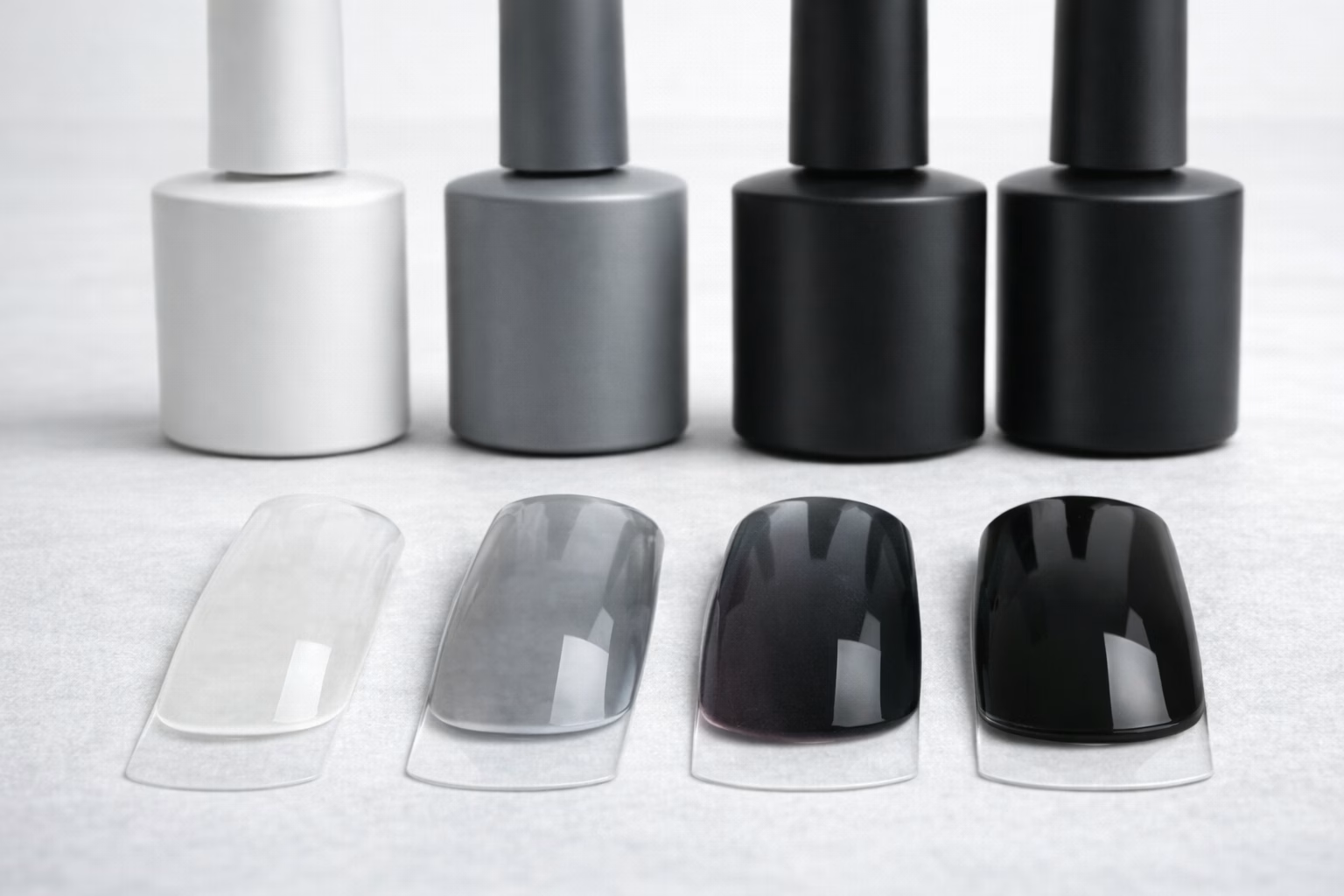
- Low-density systems appear translucent or jelly-like. They flow easily, self-level well, and are forgiving in application.
- Medium-density systems create buildable coverage. They allow layering, gradient effects, and controlled opacity.
- High-density systems produce immediate visual payoff but increase viscosity, resistance, and film thickness sensitivity.
As pigment density rises, several application effects emerge:
- Flow slows.
- Leveling windows narrow.
- Brush strokes become more visible.
- Overworking increases streaking risk.
- Layer thickness becomes critical.
This is why professional buyers must evaluate coverage not only by visual opacity but by how the gel behaves in motion: how it releases from the brush, how it settles before curing, and how it responds to repeated strokes.
Pigment density determines whether a gel feels effortless or demanding. And that feeling strongly predicts salon adoption, service speed, and error rates.
3. Pigment Density vs Curing Performance
Curing is where pigment density becomes a structural risk factor.
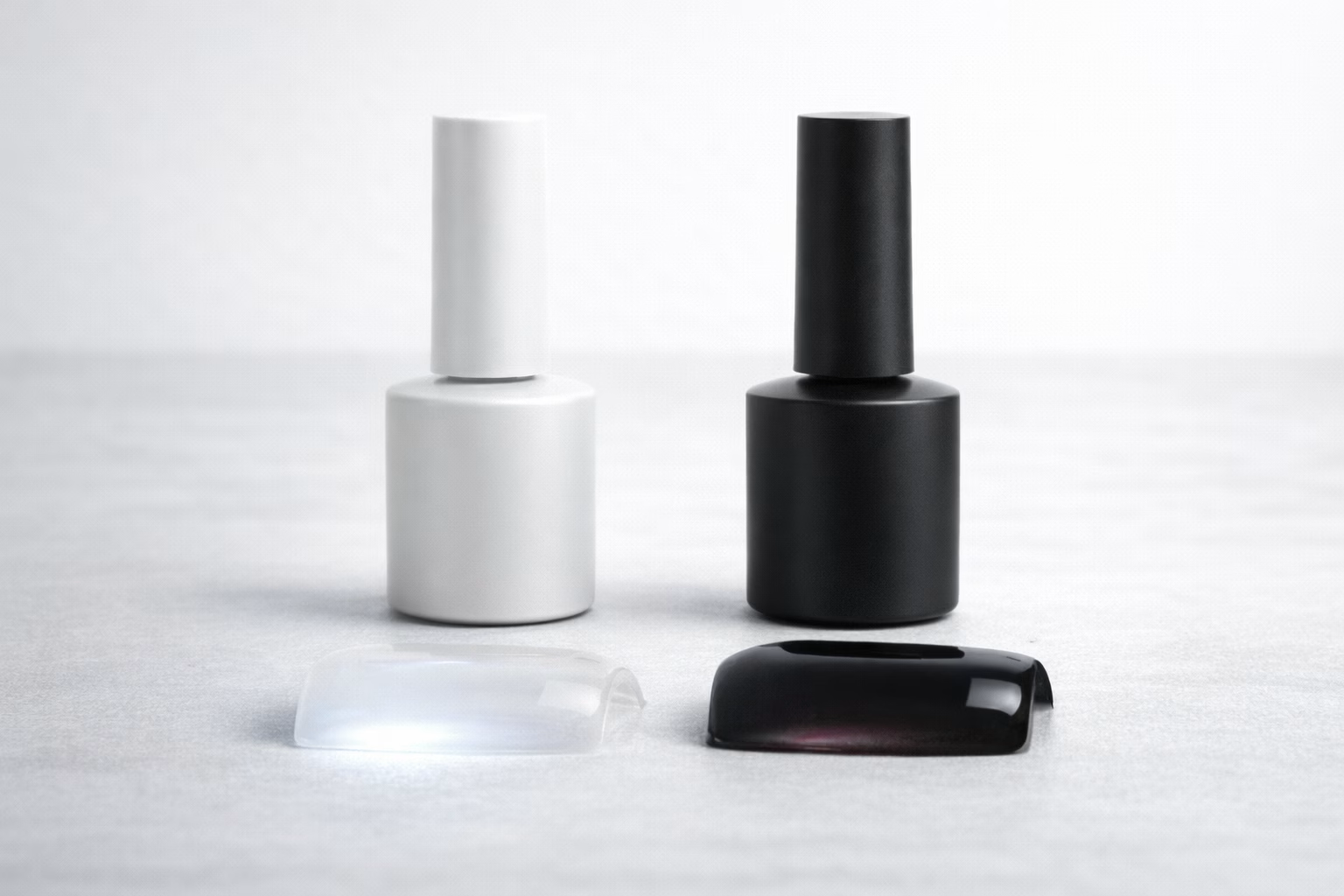
UV and LED curing relies on light penetration. Pigments absorb, scatter, and block light. As density increases, curing energy struggles to reach deeper layers. This is why deeply pigmented colors—particularly blacks, navies, purples, and intense reds—are statistically more likely to exhibit under-curing.
When pigment density exceeds the transmission capacity of a system, several problems appear:
- Surface curing with internal softness
- Post-service wrinkling or shrinking
- Adhesion instability
- Staining during removal
- Elevated sensitivity risk
These failures rarely show in the first week. They surface in client wear, refill stages, or removal processes—making them far more damaging to professional trust.
From a buyer’s standpoint, pigment density should always be evaluated alongside curing depth, not color strength alone. A professional system is not “fully cured” when it feels dry. It is cured when polymerization has completed throughout the entire film thickness.
OEM manufacturers design pigment density around curing windows. That window defines:
- Maximum safe layer thickness
- Required lamp output
- Exposure time tolerance
- Color-specific limitations
When brands push for higher density without adjusting system architecture, curing reliability collapses. Buyers should therefore treat pigment density as a curing design parameter, not a cosmetic preference.
4. Color Payoff: Why Some Gels Look Richer Even at Lower Opacity
Color payoff is not the same as opacity.
Color payoff describes how vividly a color appears in thin layers. Two gels may both be semi-transparent, yet one looks deep and luminous while the other appears washed out. This difference lies in pigment efficiency, not density.
High color payoff systems rely on:
- Optimized pigment surface treatment
- Narrow particle size distributions
- Stable dispersion networks
- Resin refractive index matching
When pigment is well-dispersed and optically integrated into the gel matrix, light interacts with color particles more efficiently. This allows thinner films to generate stronger chromatic impressions.
This is why some professional gels feel “rich” even when they are not fully opaque. Their pigment density is engineered for visual efficiency rather than mass loading.
From a buyer’s perspective, strong color payoff at moderate density is a sign of advanced formulation. It indicates better long-term stability, easier curing, and greater flexibility in product positioning.
Brands that only chase opacity often sacrifice these advantages.
5. Pigment Density Types Buyers Should Understand
Professional buyers should recognize that pigment density exists in categories, not on a linear scale.
Low-Density Translucent Systems
These systems prioritize light transmission, smooth leveling, and color layering. They are commonly used in:
- Jelly gels
- Syrup colors
- Sheer builders
- Stain systems
Advantages include excellent curing reliability, smooth application, and creative versatility. Risks include low coverage expectations and color migration if poorly stabilized.
Medium-Density Buildable Systems
These are the backbone of most professional color collections. They allow:
- Controlled layering
- Adjustable opacity
- Consistent curing
- Broad service compatibility
Medium-density systems support the widest range of nail professionals because they balance visual impact with technical tolerance.
High-Density Full Coverage Systems
Designed for immediate color payoff, these systems deliver strong coverage in minimal coats. They are common in:
- White systems
- Black systems
- Salon speed lines
- Retail consumer products
They demand stricter curing control, formulation stability, and application discipline. Brands must manage them carefully to avoid long-term performance issues.
Ultra-Dense Art Systems
Used for painting gels, liners, and nail art, these systems intentionally maximize pigment concentration. They are not general-purpose coatings. They trade curing depth and flow for surface intensity and design precision.
Buyers should never evaluate ultra-dense systems using normal color standards. They are tools, not coatings.
6. Pigment Density and Market Positioning
Pigment density is inseparable from business strategy.
A salon-focused system prioritizes curing safety, service efficiency, and forgiveness. Its pigment density must accommodate varied lamps, varied technicians, and high turnover.
A retail system prioritizes visual impact, shelf appeal, and simplified application. Higher pigment density is often used to compensate for thinner consumer layers—but this increases formulation risk.
Training systems often favor lower to medium densities, enabling students to see layering behavior and curing feedback clearly.
Nail art systems intentionally push density to extremes for creative control.
OEM private label systems must integrate all these considerations while supporting scalability, compliance, and long-term batch consistency.
Pigment density therefore defines not just performance, but who your product is truly for.
7. Formulation Reality: What Brands Don’t See Behind Pigment Density
Behind every stable pigment system sits an industrial process most brands never witness.
Pigments do not dissolve. They are suspended solids. Maintaining stable density requires:
- Multi-stage dispersion
- Controlled shear processing
- Temperature management
- Long-term sedimentation testing
- Migration resistance engineering
As pigment density rises, formulation complexity increases exponentially. Problems such as floating, settling, shade drifting, and viscosity drift become more difficult to control.
This is why pigment density decisions directly affect:
- Shelf life
- Transportation stability
- Batch repeatability
- Regulatory documentation
- Complaint rates
From an OEM perspective, pigment density is not set in the lab. It is engineered across production, storage, and distribution environments.
Professional buyers evaluating pigment density should therefore inquire not only about color results, but about how those results are maintained over time and scale.
8. Common Buying Mistakes Around Pigment Density
The most common mistakes buyers make include:
- Judging pigment density solely from swatches
- Overvaluing one-coat coverage
- Ignoring curing depth data
- Testing only fresh samples
- Separating pigment performance from formulation systems
Another frequent mistake is treating pigment density as a color feature rather than a structural feature. When density decisions are made at the shade-selection stage rather than the system-design stage, inconsistency is inevitable.
Professional buying must begin before colors exist.
9. How Professional Buyers Evaluate Pigment Density Correctly
Professional evaluation of pigment density requires layered testing.
Buyers should assess:
- Thin layer application behavior
- Thick layer curing reliability
- Self-leveling window
- Edge pooling behavior
- Long-term sedimentation
- Batch-to-batch shade stability
Testing should include multiple lamps, varied layer thicknesses, delayed curing intervals, and post-cure flex assessments.
The question is not “does this color cover.”
The question is “does this pigment system behave predictably across professional conditions.”
Predictability, not intensity, defines professional quality.

10. OEM Perspective: Designing Pigment Density for Scalable Production
From an OEM manufacturing standpoint, pigment density design always balances three forces:
- Visual demand
- Technical safety
- Production stability
Sampling can support almost any pigment density. Scaling cannot.
As production volume increases, pigment dispersion, thermal stability, and batch reproducibility become dominant constraints. Systems that appear excellent in pilot runs may fail under manufacturing reality.
This is why OEM pigment density design includes:
- Equipment compatibility
- Process repeatability
- Supply chain stability
- Regulatory compliance
- Cost sustainability
Professional brands building long-term product lines must ensure that pigment density choices are compatible not only with visual goals, but with industrial reality.
Conclusion: Pigment Density Is a System Decision, Not a Color Choice
Pigment density determines how a gel polish behaves more than any shade card ever could.
It shapes application experience, curing safety, long-term reliability, and brand reputation. It defines who your product truly serves. It dictates whether your line scales smoothly or fractures under growth.
Professional buyers should therefore treat pigment density not as a cosmetic detail, but as a system architecture choice.
When pigment density is designed deliberately—aligned with curing logic, market positioning, and OEM capability—it becomes a competitive advantage. When it is chased visually, it becomes an invisible liability.
The most successful gel polish brands are not those with the boldest colors, but those whose pigment systems quietly support years of consistent professional performance.