
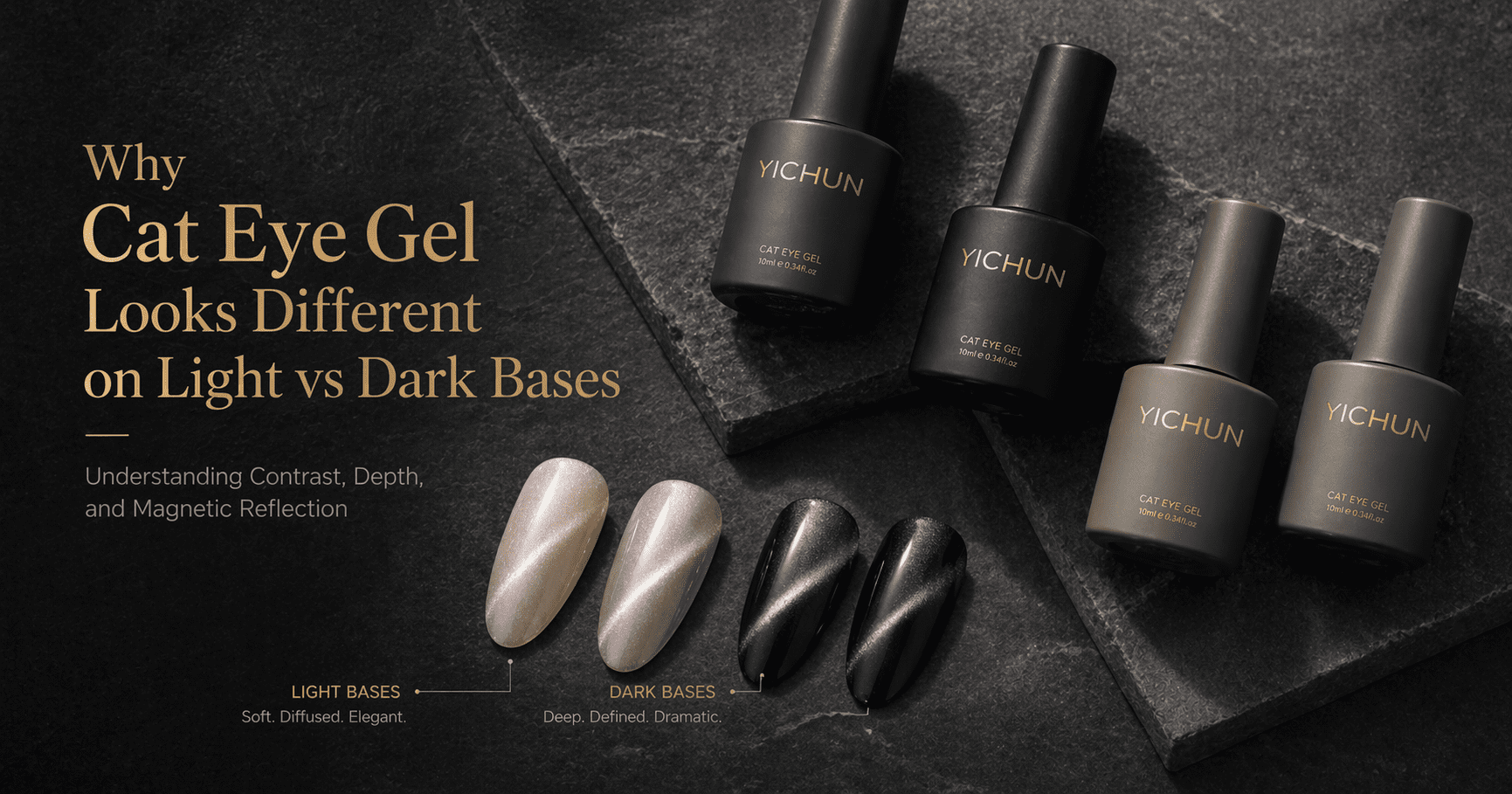
Cat eye gel is one of the clearest examples of how a nail product does not exist visually on its own. The same bottle can produce a soft, luminous, almost mist-like result over a pale base, then appear sharper, deeper, and far more dramatic over black or other dark shades. To inexperienced users, this can seem inconsistent. To professionals, it is simply how magnetic-effect systems work.
That difference matters for far more than aesthetics. It affects shade development, swatch accuracy, collection planning, salon training, social media presentation, and customer expectations. A brand that does not understand how base color changes cat eye performance may show one thing in marketing and deliver another in actual use. A technician who does not understand it may blame the gel, the magnet, or the lamp, when the real cause is visual contrast and system structure.
This is why the topic deserves a full product-guide treatment. The question is not only why a cat eye line appears brighter on black or softer on nude. The deeper question is how magnetic particles, translucency, contrast, reflection, and base tone work together to create the final effect the eye sees.
In practical terms, cat eye gel is never judged only by its bottle color. It is judged by:
- the visibility of the magnetic band
- the depth of the background tone
- the sharpness or softness of the reflected line
- the dimensional effect after top coat
- the consistency of the result across different service structures
That is why understanding light versus dark bases is not optional. It is one of the foundations of controlling cat eye gel professionally.
To build a stronger foundation before comparing base effects, read What Is Cat Eye Gel? How Magnetic Gel Polish Works for a complete explanation of how magnetic gel technology works in professional nail systems.
1. What Is “Why Cat Eye Gel Looks Different on Light vs Dark Bases”?
This topic refers to a specific visual phenomenon in magnetic gel systems: the same cat eye gel can produce significantly different results depending on whether it is applied over a light base or a dark base.
That statement sounds simple, but it contains several different layers of meaning. To understand it correctly, we need to define cat eye gel, define what “light base” and “dark base” actually mean in system terms, and define what kind of “difference” we are discussing.
What Is Cat Eye Gel?
Cat eye gel is a gel polish or effect gel that contains reflective magnetic particles suspended in a colored or semi-transparent gel base. When a magnet is placed near the uncured gel, those particles shift into a directional arrangement. After curing, the arrangement remains visible as a reflective line, glow, wave, velvet surface, halo, diagonal flash, or other controlled magnetic effect.
Its defining characteristics are:
- magnetic responsiveness
- directional reflection
- reflective depth
- dependence on particle behavior
- dependence on the surface below it
This immediately separates it from:
- ordinary shimmer gel, where particles reflect randomly
- glitter gel, where particles sparkle but do not align magnetically
- opaque cream color gels, where reflection is not the main visual engine
Cat eye gel is therefore not simply a color gel with sparkle. It is a magnetic optical-effect gel.
What Is a Light Base?
A light base is any underlying layer that is pale enough to reflect a high amount of light back through the cat eye gel. In salon practice, common light bases include:
- white
- milky white
- nude pink
- soft beige
- pale gray
- translucent natural-tone overlays
The important point is not just the label “light,” but the fact that the background beneath the cat eye layer is visually bright.
What Is a Dark Base?
A dark base is any underlying layer that absorbs more light and creates strong contrast with reflective particles. Common dark bases include:
- black
- deep brown
- charcoal gray
- deep navy
- dark forest green
- wine and burgundy tones
- saturated jewel-tone bases
Again, the issue is not only the color name. It is the fact that the background acts as a low-light, high-contrast field beneath the cat eye layer.
What Does “Looks Different” Actually Mean?
This phrase does not mean the product randomly changes formula. It means the final visual result changes in ways such as:
- the magnetic line looks sharper or softer
- the background appears deeper or flatter
- the particle flash appears brighter or more diffused
- the overall tone seems warmer, cooler, lighter, or darker
- the dimensional illusion appears stronger or weaker
- the cat eye effect becomes more dramatic or more subtle
So when professionals say cat eye gel looks different on light versus dark bases, they are not discussing only color. They are discussing contrast, visibility, optical depth, and reflective definition.
Why This Topic Is Important
This topic matters at multiple professional levels.
For technicians, it affects:
- base selection
- service consultation
- magnet technique
- final look prediction
For brands, it affects:
- swatch photography
- catalog presentation
- collection naming
- product education
- claims accuracy
For OEM and private-label buyers, it affects:
- sample evaluation
- line planning
- SKU positioning
- training materials
For distributors, it affects:
- how products are demonstrated
- how expectations are managed
- how complaints are reduced
The boundary of this topic is therefore quite broad. It is not just “Why is black stronger than white?” It is really about how base color changes magnetic effect performance inside a complete nail system.
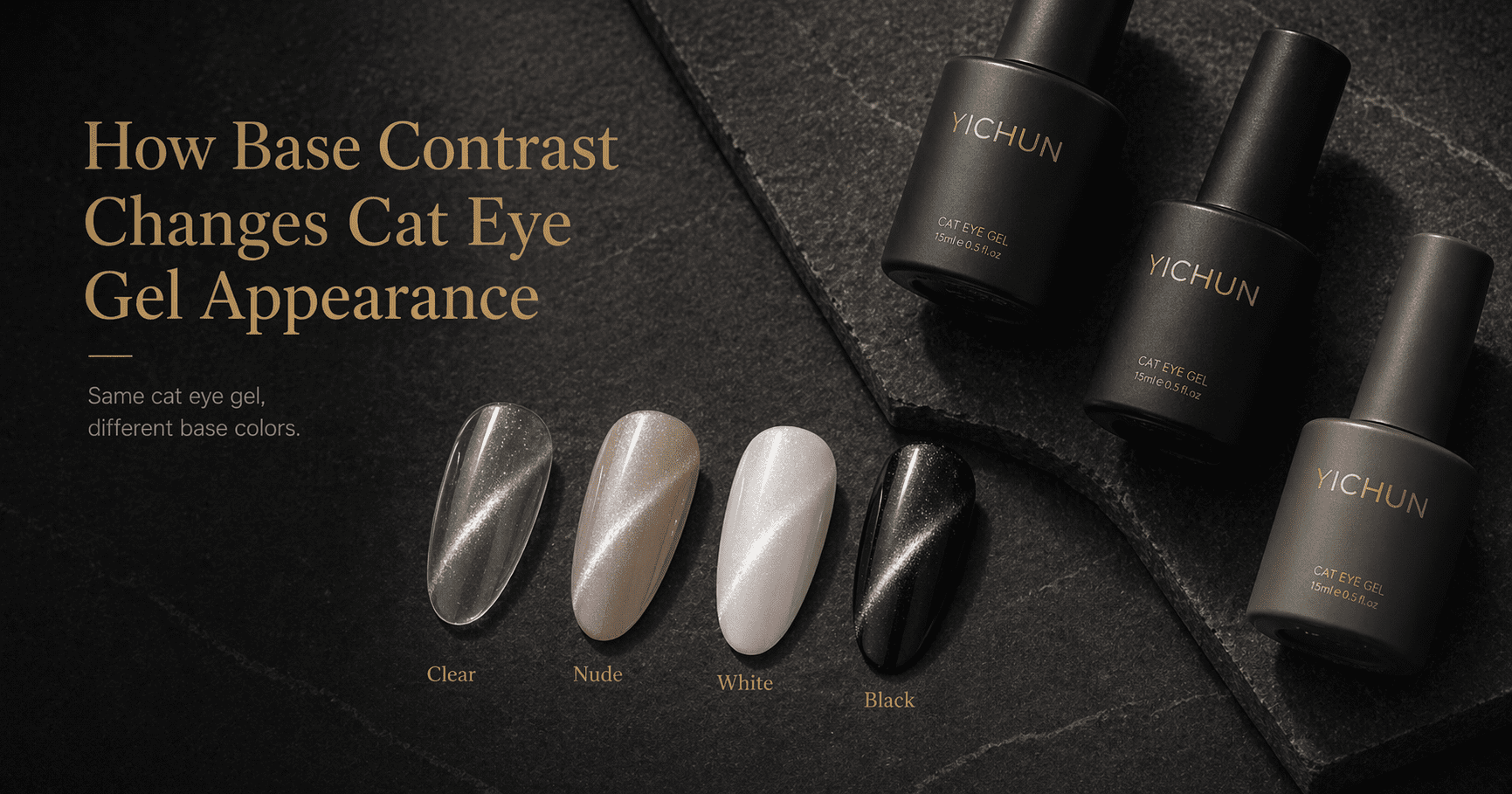
2. How It Works
To understand why cat eye gel looks different on light versus dark bases, we need to understand what the eye is actually seeing. The final result is not produced by one element alone. It is produced by an interaction between:
- the magnetic particles
- the gel body around them
- the base color below them
- the direction of light
- the position of the viewer
- the smoothing effect of the top layer
Cat eye gel is therefore a layered optical system.
A. Magnetic Particles Create Directional Reflection
The core visual effect of cat eye gel comes from magnetic particles that respond to a magnet before curing. When the magnet is applied, the particles move and cluster into a directional structure.
That structure changes how light reflects:
- non-aligned particles scatter more randomly
- aligned particles reflect more directionally
- directional reflection produces the visible “cat eye” effect
This means the brightest visible part of the design is usually not the whole gel surface. It is the zone where the particles are most effectively aligned.
B. The Gel Body Determines Background Transparency
Not all cat eye gels are equally opaque. Some have stronger color bodies, while others are more translucent or jelly-like. The more translucent the gel body, the more the base color underneath influences the final look.
This matters because the viewer does not only see the reflective particles. The viewer also sees:
- the colored gel body
- the base color below it
- the contrast between that base and the magnetic flash
So even before the magnet is considered, the formula already creates a variable visual field.
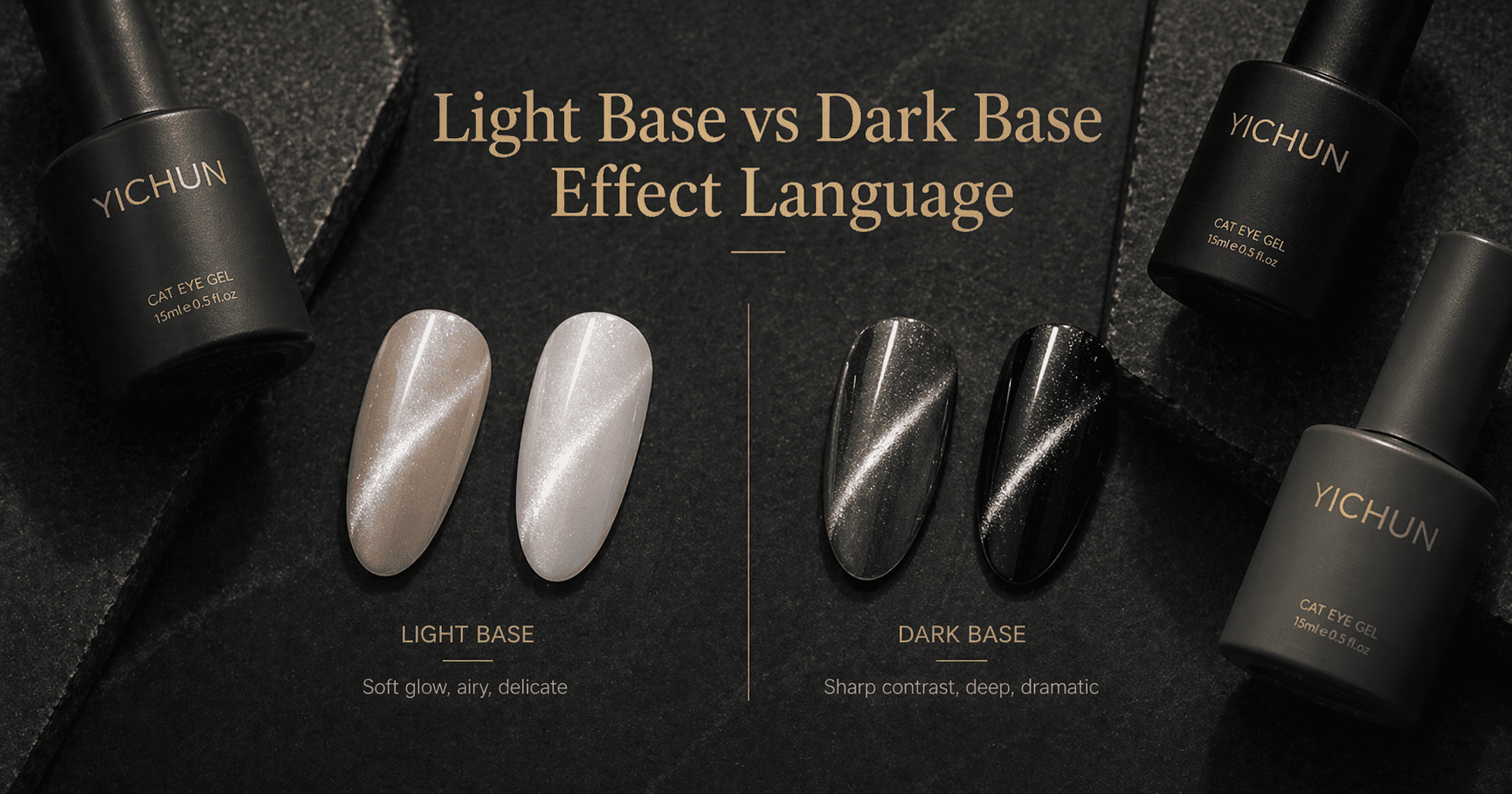
C. Dark Bases Increase Contrast
When cat eye gel is placed over a dark base, the reflective band or glow usually appears more dramatic. This happens because the dark background absorbs more ambient light and allows the reflective particles to stand out more clearly.
The visual result is often:
- stronger separation between background and magnetic line
- sharper-looking light band
- more intense “depth” illusion
- more luxurious, high-contrast finish
This is why black is so commonly used under cat eye gel. It does not make the particles stronger in a chemical sense. It makes the reflection more visible by contrast.
D. Light Bases Reduce Contrast but Expand Tone
When cat eye gel is placed over a light base, the magnetic effect often appears softer, more diffused, and more blended into the background. The base reflects more light overall, so the reflective line competes with an already bright surface.
The visual result is often:
- gentler magnetic band
- softer halo effect
- more airy or satin-like finish
- less aggressive contrast
- more visible interaction between gel tone and base tone
This does not mean the effect is weaker in quality. It means the optical relationship is different. The cat eye effect becomes less about a dramatic spotlight line and more about soft luminosity and layered movement.
E. Base Color Changes Perceived Tone
A cat eye gel is not just silver particles in a neutral medium. It usually has its own color body or tint. That tint interacts with the base beneath it.
For example:
- a rosy cat eye over black may look deeper and cooler
- the same rosy cat eye over nude may look warmer and creamier
- a champagne cat eye over white may look bright and elegant
- the same champagne cat eye over brown may look bronze and moodier
So base color does not only change the visibility of the magnetic line. It also changes the apparent shade identity of the product.
F. Surface Smoothness Affects Reflection Quality
Cat eye gel is extremely dependent on reflection quality. If the layer below is uneven, bulky, dented, or poorly leveled, the magnetic effect may appear distorted.
This happens because the reflected light is broken by surface inconsistency. Even if the magnetic particles aligned correctly, the visual result can still look messy if the structure beneath them is poor.
That is why cat eye gel performance depends on:
- smooth base color application
- clean builder structure if present
- proper leveling
- consistent top-coat finish
G. Top Coat Finalizes the Optical Field
Top coat is not only protection. In cat eye systems, it also finalizes the way light travels across the nail surface. A glossy, smooth top coat can:
- sharpen reflection
- deepen the visual finish
- make the magnetic line appear cleaner
- enhance the “glass” effect of the design
A matte top coat, on the other hand, may soften or mute the magnetic effect depending on the formula and desired style.
This means the question of light vs dark base is not fully answered until the entire visual stack is complete.
H. Light Conditions Influence Perception
Cat eye gel is highly environment-sensitive. Under direct light, the effect may appear sharp and dramatic. Under soft diffused indoor light, the same nails may appear subtler. Light bases especially can shift more visibly depending on environment, because their lower-contrast field is more sensitive to surrounding brightness.
This is one reason why:
- salon result
- customer photo
- ecommerce swatch
- social media video
may all show the same product slightly differently.
I. “Different” Is a System Outcome, Not a Product Failure
The most important conclusion of the mechanism is this:
cat eye gel looks different on light vs dark bases because the final effect is created by a layered optical system, not by the cat eye bottle alone.
This means difference should not be treated as inconsistency by default. In many cases, it is the normal and predictable outcome of:
- different base contrast
- different reflected light levels
- different tone interaction
- different surface geometry
That is the real mechanical explanation behind the phenomenon.
Because reflection clarity is also influenced by magnet control, see How Magnet Strength Affects Cat Eye Effects to understand how magnet force and positioning change the final visual result.
3. Core Roles in Nail Systems
Cat eye gel has several distinct roles inside a professional nail system. Understanding those roles helps explain why base color matters so much.
1. Reflective Effect Layer
Its primary role is to create a directional reflective effect. This is its most obvious function and the reason it belongs to the effect-gel family rather than plain color-only systems.
On dark bases, this role becomes bolder.
On light bases, this role becomes softer.
The role is the same, but the visual emphasis changes.
2. Contrast-Driven Design Layer
Cat eye gel is one of the few product types whose success depends strongly on contrast design. The effect is not only created by the gel. It is created by the relationship between gel and background.
That makes cat eye gel a design layer that depends on:
- what is beneath it
- what surrounds it
- what light hits it
In this sense, the base is not passive. It is part of the effect system.
3. Depth Builder
Even when the pattern is simple, cat eye gel builds perceived depth because the eye reads:
- the base color as background
- the reflective band as foreground light
- the gel body as an in-between visual space
This is why it can appear gemstone-like, velvet-like, satin-like, metallic, or even cosmic depending on the formula and base combination.
4. Collection Multiplier
From a product-line perspective, cat eye gel can create multiple visual directions from the same SKU. A single magnetic shade may behave as:
- soft luxury over nude
- dramatic glamour over black
- cool futuristic over charcoal
- moody elegance over deep navy
That makes cat eye gel a strong collection multiplier. Base selection becomes part of product positioning.
5. Content and Demonstration Product
Cat eye gel is highly demonstrable. It is often used in:
- short videos
- salon demo clips
- ecommerce swatch reels
- training content
Why? Because it visibly transforms. But to demonstrate it well, brands must understand how light and dark bases alter the result. Otherwise, demonstration material becomes misleading or incomplete.
6. Perceived Value Enhancer
Magnetic gels often occupy a higher-value space in the market because they appear more technical and more premium than flat color systems. This perceived value increases further when the effect is properly paired with the right base.
Dark bases tend to produce a luxury, jewel-like finish.
Light bases tend to produce a soft, refined, modern finish.
Both can feel premium, but in different ways.
7. Training-Sensitive Effect Product
Unlike simple single-color applications, cat eye gel requires skill in:
- base selection
- magnetic timing
- angle control
- light understanding
This means it plays an educational role in professional systems. A brand that sells cat eye well usually needs to teach it well.
4. Major Types / Variations
To understand how light and dark bases influence cat eye gel, it is important to know that not all cat eye gels behave the same way. Different formulations, particle sizes, transparency levels, and effect goals produce different base sensitivity.
A. Transparent or Jelly Cat Eye Gel
These formulas are highly base-dependent because the gel body itself is more translucent.
Characteristics:
- stronger visible influence from the underlying base
- more change in apparent tone
- softer or more dramatic result depending on background
- useful for layered luxury and trend-driven designs
On light bases, they may appear ethereal and soft.
On dark bases, they can become rich and gemstone-like.
B. Semi-Opaque Cat Eye Gel
These formulas carry more color body, so the base has less control over the final visible tone.
Characteristics:
- more stable color identity across bases
- still affected by contrast, but less dramatically
- often easier for standard commercial use
- useful when brands want stronger swatch consistency
The magnetic band still changes in clarity depending on base color, but the shade shift may be smaller than with transparent cat eye formulas.
C. Classic Silver-Particle Cat Eye
This is the traditional structure where reflective silver-toned magnetic particles create a bright line against the background.
Characteristics:
- strongest effect over black and deep colors
- high clarity of band
- ideal for classic magnetic line looks
On light bases, these may still work, but the effect often appears softer and less cinematic.
D. Colored Cat Eye
These formulas combine magnetic particles with a stronger internal color tone, such as red, purple, blue, green, champagne, bronze, or rose.
Characteristics:
- base influences both effect visibility and final shade identity
- often more versatile for collection building
- can shift dramatically between light and dark backgrounds
These are among the most commercially interesting because one bottle can produce multiple marketing looks depending on the base system.
E. Velvet or Satin Cat Eye
These formulas are designed less for a narrow line and more for an even, plush, velvet-like reflection.
Characteristics:
- broader reflection zone
- more diffused magnetic softness
- more elegant on medium and light bases
- still luxurious on dark bases, but in a less “laser-like” way
F. Multi-Dimensional or Galaxy Cat Eye
These formulas may use multiple particle sizes, color travel, or shifting reflective behavior.
Characteristics:
- highly responsive to base contrast
- often visually strongest on dark backgrounds
- capable of dramatic marketing imagery
- sensitive to both base and lighting
G. Fine-Particle vs Coarse-Particle Systems
Particle scale changes how base contrast is experienced.
Fine-particle systems tend to:
- blend more softly
- work elegantly on lighter bases
- create satin or mist-like movement
Coarse-particle systems tend to:
- pop harder against dark backgrounds
- emphasize sparkle and directional flash
- deliver stronger contrast drama
So when discussing light vs dark bases, one must always ask:
Which type of cat eye gel are we talking about?
Base sensitivity is not equal across all formulas.
Not all magnetic formulas behave the same across light and dark backgrounds, so explore Types of Cat Eye Gel: 5D, 9D, Velvet, Galaxy, and Micro to compare how different cat eye structures perform.
5. X vs Other Gels
Cat eye gel is often misunderstood because users compare it to other reflective or decorative systems that behave very differently.
Cat Eye Gel vs Glitter Gel
Glitter gel contains reflective pieces that sparkle, but they do not respond directionally to a magnet. Their visual result is more random and surface-driven.
Key difference:
- glitter gel = scattered sparkle
- cat eye gel = controlled magnetic reflection
A dark base may deepen both, but only cat eye creates a directional band or magnetic motion effect.
Cat Eye Gel vs Shimmer Gel
Shimmer gel creates a soft overall glow because fine reflective particles are distributed throughout the formula. However, the particles do not cluster into a pattern.
Key difference:
- shimmer = uniform glow
- cat eye = directed reflective pattern
On light bases, shimmer may appear gentle and elegant, but cat eye still has a more structured visual field.
Cat Eye Gel vs Chrome
Chrome is generally a surface effect created by rubbing powder over a cured layer. It sits more on the exterior surface, while cat eye lives within the gel layer itself.
Key difference:
- chrome = surface reflection
- cat eye = internal magnetic reflection
Base color affects both, but cat eye remains more dependent on contrast beneath the effect layer.
Cat Eye Gel vs Jelly Gel
Jelly gel changes visually because of transparency and base interaction, but it does not rely on magnetic alignment.
Key difference:
- jelly gel = transparency-led depth
- cat eye gel = magnetic reflection-led depth
Some modern formulas blend these two worlds, creating jelly cat eye effects that are extremely base-sensitive.
Cat Eye Gel vs Metallic Gel
Metallic gels can appear reflective or foil-like, but they usually produce a more static finish.
Key difference:
- metallic gel = overall reflective surface
- cat eye gel = selective reflective structure
This is why cat eye feels more dynamic and “alive” under movement.
Why This Comparison Matters
Users often say:
- “This cat eye is weak”
- “This one looks different from the swatch”
- “This base made it disappear”
- “This feels more like shimmer than cat eye”
These observations often come from comparing cat eye with the wrong category. Once cat eye is understood as a base-sensitive, contrast-driven, magnetic effect layer, these differences become easier to predict.
6. Application Logic & Variables
Understanding the mechanism is only the first step. In real nail work, the final result depends on how cat eye gel is applied, what it is applied over, and how consistently the effect is built from layer to layer. This is where many of the visible differences between light and dark bases become more practical than theoretical.
A professional result does not come from the cat eye bottle alone. It comes from the combined control of:
- base color
- base smoothness
- cat eye layer thickness
- magnet position and timing
- particle density
- curing sequence
- top-coat finish
- lighting environment during evaluation
Each of these variables changes how strongly the light band is perceived and how the overall nail reads visually.
Base Color Selection
Base selection is the most obvious and often the most important variable.
A black base is commonly chosen because it creates maximum contrast. It allows the reflective magnetic line to stand out clearly, which is why so many product swatches, promotional videos, and salon examples are demonstrated over black. It is the fastest way to make the effect look dramatic.
But a light base should not be viewed as a weak alternative. It simply changes the type of result being produced.
A nude base tends to:
- soften the overall look
- make the cat eye effect more wearable
- reduce harsh contrast
- create a luxury “soft-glow” finish
A white base tends to:
- brighten the visible effect
- make colors appear cleaner or cooler
- create more obvious tone shift in translucent cat eye formulas
- support pastel or modern high-light looks
A gray base often acts as a middle path:
- more contrast than nude
- less harshness than black
- elegant for refined collections
A colored base can also be used strategically. For example, a burgundy base under a rose cat eye may create greater richness, while a navy base under a silver-blue cat eye may create a colder, more futuristic effect.
This means base selection should be guided by the intended final look, not by habit alone.
Thickness of the Cat Eye Layer
Layer thickness strongly affects particle movement and visible contrast.
If the cat eye layer is too thin:
- magnetic particles may not have enough visual density
- the effect may appear weak or incomplete
- the background may dominate too strongly
If the cat eye layer is too thick:
- the particles may appear more crowded and less crisp
- the reflective line may blur
- the result may lose clarity, especially on lighter bases
This is especially important when comparing light and dark backgrounds. A dark base can sometimes tolerate a slightly heavier effect layer while still maintaining contrast. A light base often needs cleaner, more disciplined thickness control to avoid looking muddy or overfilled.
Magnet Strength and Distance
The magnet is one of the defining variables in cat eye performance. But it does not act independently from the base.
A strong, close magnet generally produces:
- tighter particle gathering
- sharper band formation
- stronger visible contrast
A weaker or more distant magnet generally produces:
- softer diffusion
- wider, less defined reflection
- lower pattern intensity
Over black, even a moderately sharp magnetic line may still look striking because the contrast field is already strong. Over a pale base, the same magnetic movement may look more blurred because the background is also reflecting light.
So when a user says the same gel looks “less strong” on white, the issue may not be particle weakness. It may be that the same magnetic arrangement is simply less visible in a brighter contrast environment.
Magnet Angle and Pattern Design
Different magnet positions produce different styles:
- straight line
- diagonal beam
- halo
- cat pupil
- velvet spread
- side glow
- starburst or galaxy field
The base underneath changes how readable each design becomes.
A narrow line pattern is often strongest over dark bases because the band remains visually isolated. On light bases, broader velvet or satin patterns may work better because they integrate more naturally with the brighter background.
In practice, this means pattern design itself should sometimes change with the base:
- dark base = sharper, high-contrast magnetic pattern
- light base = softer, more atmospheric magnetic pattern
Surface Smoothness
Cat eye gels are unforgiving when it comes to uneven surfaces. Any inconsistency in the layer below can break the reflection path and reduce the quality of the final magnetic effect.
Poor smoothness can cause:
- bent reflection lines
- broken cat eye bands
- patchy shine
- irregular optical depth
This is especially noticeable on light bases, where surface distortions may be perceived as muddiness rather than drama. On black, the eye may forgive small imperfections more easily because the reflective band still stands out strongly.
To control this, the underlying base and any structure layers must be:
- smooth
- even
- free from dents or brush marks
- properly cured
Number of Cat Eye Layers
Not every cat eye design is one-coat logic. Some looks may use:
- one coat of color base + one cat eye coat
- one coat of cat eye over dark gel
- two cat eye coats for stronger body
- cat eye over tinted jelly base for layered effects
More layers can increase richness, but they can also reduce sharpness if overdone. In general:
- one cat eye layer over dark base = more contrast, more clarity
- multiple effect layers over light base = softer dimensional depth, but greater risk of losing band definition
This is not a rule without exception, but it is a strong tendency.
Formula Transparency
As mentioned earlier, formula transparency determines how much the background can influence the final visual result.
A more transparent cat eye formula will:
- show greater difference between black and white bases
- be more versatile for layered design
- require stronger swatch education
A more opaque cat eye formula will:
- produce more predictable color identity
- still shift in contrast, but less in shade character
- be easier for broader commercial use
This is an important product-development point. Some brands want dramatic base sensitivity because it increases creative flexibility. Others want more controlled consistency because it reduces customer confusion.
Top Coat Choice
Top coat changes the finished optical field more than many users realize.
A high-gloss top coat usually:
- increases contrast
- deepens the visual field
- sharpens reflection
- enhances luxury appearance
A matte or velvet finish can:
- soften the magnetic band
- reduce line definition
- create a suede-like visual effect
On black bases, gloss often makes the cat eye look more jewel-like and premium. On light bases, gloss can make the effect feel airy and luminous. Matte top coat, meanwhile, can create very different style directions but will often reduce the “classic cat eye” visibility.
Lighting Conditions During Evaluation
The same nail set may look different in:
- direct sunlight
- cool salon LED light
- warm indoor light
- diffused studio light
- phone flash video
This is especially important when comparing light versus dark bases. Dark-base cat eye often performs better under many lighting conditions because strong contrast survives across environments. Light-base cat eye may appear more elegant in person but less dramatic on camera unless lighting is handled carefully.
For brands and salons, this affects:
- swatch photography
- ecommerce expectations
- training content
- client perception after service
Practical Summary of Variables
In real use, cat eye appearance on light versus dark bases is controlled by a combination of:
- contrast background
- effect-layer transparency
- magnet strength
- pattern choice
- smoothness below
- thickness above
- final gloss
That is why the topic should never be simplified to “black works, white doesn’t.” The reality is much more useful: different bases create different effect personalities, and the professional’s job is to control them deliberately.
7. Suitable & Unsuitable Scenarios
Once the variables are understood, the next question is where each base strategy is most useful. Light and dark bases are not competing only on strength. They are appropriate for different service goals, different customer profiles, and different brand directions.
Suitable Scenarios for Dark Bases
Dark bases are ideal when the goal is maximum contrast and immediate visual drama.
They are especially suitable for:
- luxury and evening-style collections
- galaxy, gemstone, velvet, and cosmic themes
- social-media-first visual content
- strong retail display impact
- premium salon upsell services
- collections meant to look dramatic in one glance
Why? Because dark backgrounds allow the reflective magnetic band to appear stronger, sharper, and more visually obvious. This makes dark-base cat eye especially effective in fast-scrolling content environments where visual clarity matters immediately.
Dark bases are also suitable when:
- the cat eye formula is relatively transparent
- the magnetic particles are fine and need strong contrast
- the intended result is mysterious, moody, or rich
- the nail shape is medium to long and can support more visible dimensionality
Unsuitable Scenarios for Dark Bases
Dark bases may be less suitable when:
- the customer wants a soft, understated look
- the overall brand identity is minimal and airy
- the audience prefers everyday neutral wear
- the collection targets subtle salon elegance rather than visible drama
- the marketing direction is bridal, nude-luxury, or “clean-girl” style
They can also be less suitable if:
- the cat eye formula is already very dense and starts looking too heavy over black
- the technician cannot maintain clean cuticle lines, since errors are often more visible in dark systems
- the service is intended for customers who are cautious about bold contrast
Suitable Scenarios for Light Bases
Light bases are ideal when the goal is softness, refinement, tonal layering, and modern wearability.
They are especially suitable for:
- nude-luxury collections
- bridal and soft-glow services
- premium minimalism
- spring and everyday commercial shades
- collections positioned as elegant rather than dramatic
- markets that prefer refined rather than high-contrast visual effects
A light base can make cat eye appear:
- smoother
- cleaner
- more diffused
- more wearable
- more premium in a subtle way
It is particularly suitable when the formula itself has attractive internal color and does not rely entirely on black-background contrast to create beauty.
Unsuitable Scenarios for Light Bases
Light bases may be less suitable when:
- the marketing goal depends on an immediately obvious magnetic line
- the formula has weak contrast and needs help to be visually clear
- the design requires bold statement impact
- the brand intends to position the line as high-drama, nightlife, or futuristic-luxury
They may also be less suitable if:
- the underlying surface is not very smooth
- the technician is inconsistent with thickness
- the swatch system is poor and expectations are not managed
- the collection is sold through static images only, where subtlety may underperform compared to stronger black-base visuals
Suitable Scenarios by Market Positioning
From a commercial perspective, different bases often work better in different sales contexts.
Dark-base cat eye tends to be strong for:
- quick visual conversion
- short-form video content
- bold limited collections
- high-drama seasonal drops
- trend-led campaigns
Light-base cat eye tends to be strong for:
- premium brand storytelling
- salon menus for daily wear
- soft luxury positioning
- bridal, neutral, and refined color narratives
- customers who want “effect nails” without visual heaviness
Suitable Scenarios by Nail Length and Shape
Dark bases often read especially well on:
- medium to long almond nails
- coffin shapes
- longer oval shapes
- elongated silhouettes where the magnetic band has room to travel
Light bases often read especially well on:
- shorter elegant shapes
- natural overlays
- short almond or soft square nails
- subtle wearable systems
This is not absolute, but it affects how the final visual field is perceived.
Suitable Scenarios by Formula Type
Transparent cat eye formulas often benefit more dramatically from base experimentation.
Opaque cat eye formulas may be easier to standardize.
So the right question is not only:
“Should this go on black or white?”
It is:
- what formula is this
- what market is it for
- what service result is being built
- what emotional tone should the finish communicate
That is the real suitability logic.
8. Common Misunderstandings
Cat eye gel generates a lot of misunderstandings because people often judge it as if it were a normal color gel. That leads to wrong expectations, wrong troubleshooting, and poor product decisions.
Misunderstanding 1: “If the result changes on different bases, the product is inconsistent.”
This is one of the most common mistakes. In many cases, the product is functioning exactly as designed. Cat eye gel is a base-sensitive optical product. Different backgrounds create different reflective relationships.
A visible shift between black and nude does not automatically signal poor quality. It may simply signal a formula with strong interaction capability.
Misunderstanding 2: “Dark base always means better result.”
Dark base often means stronger contrast, but stronger contrast is not the same as better design. Some collections benefit from softness and tonal glow rather than maximum line clarity.
A light-base cat eye may be more commercially useful, more wearable, and more premium for certain markets than the same effect over black.
Misunderstanding 3: “Light base means weak magnetic performance.”
Not necessarily. The particles may be responding well, but the brighter background reduces visual separation. The effect can still be elegant, layered, and technically successful even if it is less dramatic.
Misunderstanding 4: “The magnet is the only thing that matters.”
The magnet matters, but not by itself. Base contrast, effect-layer thickness, formula transparency, and surface smoothness all affect what the eye finally sees. A strong magnet cannot fully rescue a poor base strategy.
Misunderstanding 5: “The bottle should look like the finished nail.”
This expectation causes many disappointments. Cat eye gel should usually be evaluated through system demonstration, not bottle appearance alone. The bottle does not show the full interaction of:
- base tone
- reflective particles
- magnetic pattern
- top-coat gloss
- lighting environment
Misunderstanding 6: “One swatch is enough.”
For cat eye gel, especially in professional and B2B contexts, one swatch is often not enough. A formula may need:
- black-base swatch
- nude-base swatch
- white-base swatch
- video demonstration
- close-up finish shot
This is because its identity is not fully captured in a single context.
Misunderstanding 7: “A softer effect means lower value.”
In fact, soft, low-contrast cat eye can feel extremely premium when well executed. Satin glow over a light base may communicate elegance more effectively than high-drama black for some audiences.
Misunderstanding 8: “All cat eye gels should be marketed the same way.”
A classic silver-line cat eye over black requires one kind of marketing. A translucent velvet cat eye over nude requires another. Using the same presentation method for all magnetic formulas can weaken both performance and customer understanding.
Misunderstanding 9: “If the line is not sharp, the application failed.”
Sometimes that is true. But sometimes the desired look is not a sharp line at all. Velvet, halo, mist, and satin styles are built around softer reflective transitions. The correct question is not always “Is the line sharp?” but “Is the intended magnetic pattern visible and aesthetically controlled?”
Misunderstanding 10: “Base color is only a background.”
In cat eye systems, the base is part of the effect itself. It is not just sitting underneath passively. It is helping define contrast, tone, and depth.
That is the misunderstanding professionals must outgrow if they want predictable cat eye performance.
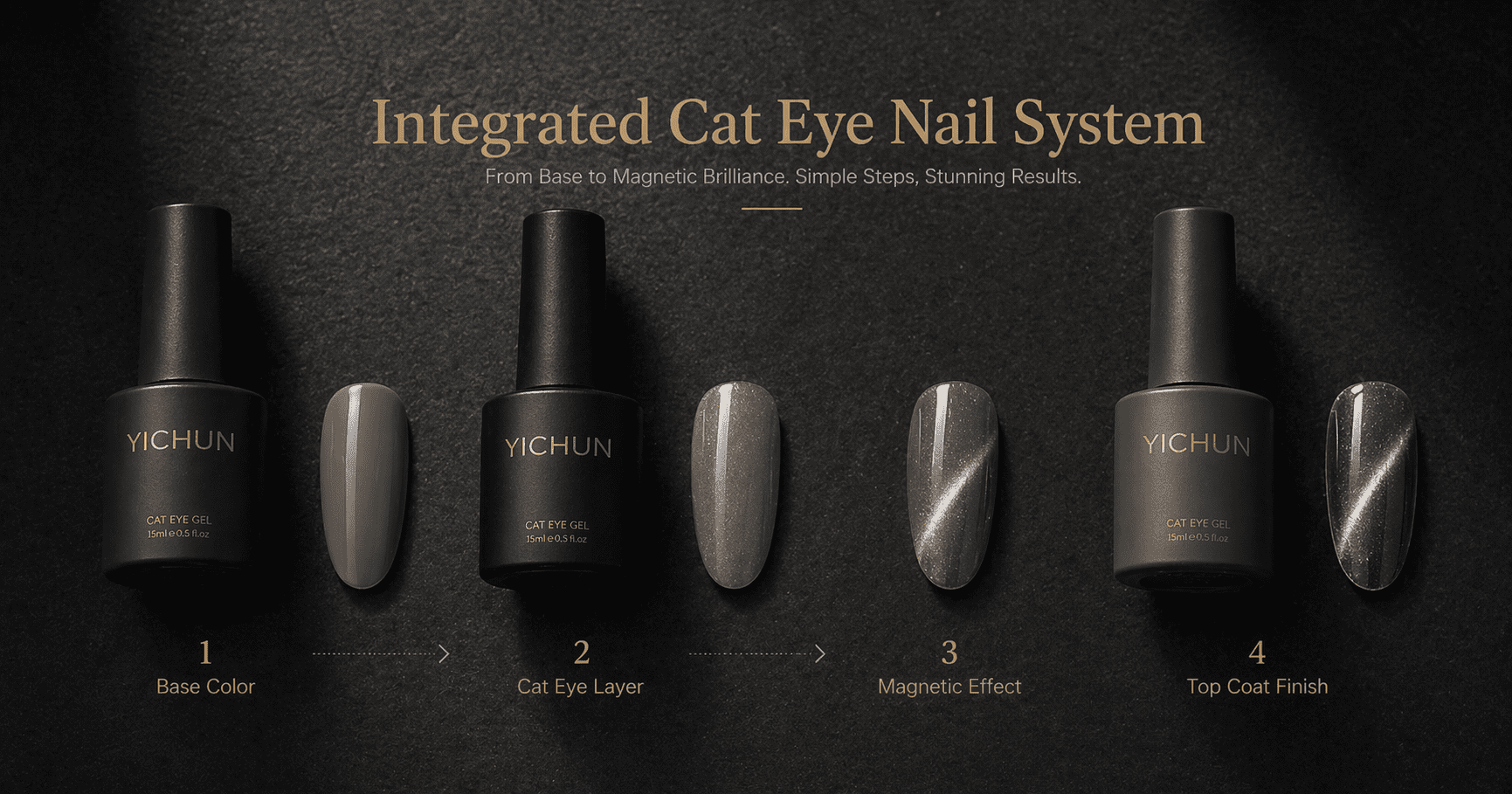
9. X in Integrated Nail Systems
Cat eye gel should never be treated as a standalone magic layer. It belongs inside a complete nail system, and its final appearance depends on that system performing correctly.
A simplified integrated cat eye system often looks like this:
Natural Nail → Prep Logic → Base Layer → Structure or Color Base → Cat Eye Layer → Top Coat
Each stage matters.
The Natural Nail Stage
Even though the visible cat eye effect sits above several layers, the natural nail still affects performance indirectly. If the nail is weak, uneven, oily, or flexible, the support system above it may not hold its shape well. Poor structure below the effect layer can distort the final reflective result.
So cat eye performance begins with ordinary nail-system discipline:
- proper prep
- correct adhesion logic
- correct support or builder selection where needed
The Base Layer Stage
The base layer affects:
- adhesion
- smoothness
- compatibility with upper layers
A poor base layer can create leveling problems that later interfere with reflection quality. In integrated systems, the effect layer is only as elegant as the surface beneath it.
The Structure or Color Base Stage
This is the most relevant stage for the topic of light versus dark bases. Here, the system defines:
- contrast field
- visible background tone
- smoothness
- support for the cat eye layer
This stage may be:
- black gel
- çıplak jel
- white gel
- builder with tint
- another color layer designed to shift the final effect
So in integrated systems, the visual logic of the cat eye result is often determined before the cat eye bottle is even opened.
The Cat Eye Layer Stage
This is where:
- particle density
- formula transparency
- magnetic response
- pattern design
come into play.
But because the cat eye layer remains part of a stack rather than an isolated coat, it should be selected with the underlying structure in mind. This is why the same SKU can behave as multiple visual outcomes.
The Top Coat Stage
Top coat finalizes the surface and determines:
- gloss intensity
- reflection clarity
- final finish character
- perceived depth
In integrated cat eye systems, top coat is not a minor finishing step. It is part of the optical completion of the effect.
Why System Thinking Matters
Many users troubleshoot cat eye performance at the wrong stage. They may say:
- the particles are weak
- the magnet is bad
- the color is wrong
when the true issue is:
- the background is too bright for the intended contrast
- the builder surface is not smooth enough
- the effect layer is too thick
- the swatch was evaluated under misleading light
- the top coat is muting clarity
Integrated system thinking solves this. It asks:
- what is the base field
- what is the effect layer doing
- what is the finish layer contributing
- what was the intended visual direction
That is how cat eye gel should be positioned inside professional nail systems.
Since the final magnetic result also depends on what sits underneath the effect layer, Functional Gel Layering Order Explained is useful for understanding how base, structure, and top layers influence cat eye performance.
10. Role in Professional Product System
From a product-system perspective, cat eye gel is more than a trend item. It is a strategic category that helps brands create value, visual variety, and higher perceived sophistication.
1. It Expands Visual Output Without Requiring Entirely New Chemistry
One cat eye formula can produce multiple sellable looks depending on:
- black base
- nude base
- white base
- gray base
- tinted structure
This allows one SKU to behave as several visual directions. For product systems, that increases flexibility without necessarily multiplying formula complexity.
2. It Improves Swatch and Campaign Diversity
A well-managed cat eye line can generate:
- dramatic dark-base swatches for strong conversion
- soft nude-base swatches for commercial wearability
- luxury close-ups for premium branding
- motion video content for social channels
This makes it one of the best content-capable categories in nail products. But it only works if the brand understands how to demonstrate it correctly.
3. It Supports Tiered Collection Strategy
Brands can position cat eye gel in several ways:
- classic magnetic essentials
- luxury velvet capsule
- seasonal galaxy line
- bridal soft-glow magnetic edits
- gemstone-inspired high-contrast range
The difference between these is not only the bottle formula. It is often the way the brand teaches the base relationship.
4. It Increases Training Value
Because cat eye is interactive, it encourages:
- technician education
- swatch literacy
- design experimentation
- product consultation skill
This makes it more than a commodity color. It becomes part of a technical and aesthetic training ecosystem, which is valuable for both salon brands and OEM programs.
5. It Raises Perceived Product Sophistication
Compared to flat color gels, cat eye gels often feel:
- more technical
- more luxurious
- more premium
- more visually intelligent
That perceived value grows when the brand can explain why the result changes over light and dark bases rather than treating it as an accidental variation.
6. It Reduces the Risk of Misleading Merchandising—If Managed Well
Poor presentation can create complaints. Good presentation can build trust.
For example, if a brand shows only black-base swatches for a cat eye line that customers will often apply over nude, disappointment is likely. But if the brand demonstrates the formula intelligently across multiple bases, the line becomes easier to understand and easier to sell.
This is especially relevant for:
- B2B catalog creation
- distributor education
- ecommerce image systems
- OEM sample approval workflows
7. It Strengthens Premium Differentiation in Crowded Markets
In markets crowded with solid creams, glitters, and ordinary shimmer, a well-positioned cat eye line can distinguish a brand. But differentiation comes from more than offering magnetic gel. It comes from offering:
- better effect control
- better swatch logic
- better base education
- better visual storytelling
This is where professional product systems are built, not only sold.
Once you understand how contrast changes the final magnetic look, browse our Cat Eye Gel Collection to compare cat eye formulas for light bases, dark bases, velvet effects, and high-contrast magnetic finishes.
Sonuç
Cat eye gel looks different on light versus dark bases because the final magnetic effect is created by contrast, reflection, transparency, and layered system structure rather than by the bottle formula alone.
Dark bases usually create:
- sharper contrast
- stronger band visibility
- deeper, richer drama
Light bases usually create:
- softer glow
- lower contrast
- more refined tonal blending
- a subtle luxury effect
Neither is automatically better. They simply produce different effect languages.
That is the most important professional takeaway. Cat eye gel should not be judged as though it were a static color. It should be judged as a base-sensitive optical effect system.
Once that is understood, many problems become easier to solve:
- swatches become more accurate
- collections become easier to plan
- technician expectations become clearer
- brand education becomes stronger
- product positioning becomes more strategic
In short, the reason cat eye gel looks different on light versus dark bases is not inconsistency. It is interaction. And in professional nail systems, understanding that interaction is what turns magnetic gel from a trend product into a controlled design tool.
SSS
Why does cat eye gel look stronger on black than on nude or white?
Cat eye gel usually looks stronger on black because dark bases create higher contrast. The reflective magnetic particles stand out more clearly against a dark background, so the line, glow, or velvet effect appears sharper and deeper.
Does a light base make cat eye gel weaker?
Not necessarily. A light base does not make the gel lower quality or less magnetic. It changes the optical result. On pale bases, cat eye gel often looks softer, more diffused, and more elegant rather than bold and high-contrast.
What is the best base color for cat eye gel?
The best base depends on the intended look. Black is ideal for strong contrast and dramatic depth. Nude and milky bases work well for soft luxury looks. White can brighten the overall tone and make some cat eye shades appear cleaner or cooler.
Can the same cat eye gel create different looks on different bases?
Yes. The same cat eye gel can produce very different visual results on black, nude, white, gray, or colored bases. This is because the final appearance depends on contrast, transparency, and how the magnetic reflection interacts with the color underneath.
Why does my cat eye line look blurry on a light base?
A blurry line on a light base may come from lower contrast, a thicker gel layer, weak magnet positioning, or an uneven surface below the effect layer. Light backgrounds naturally reduce the visual separation between the reflective band and the surrounding color field.
Does cat eye gel need a black base every time?
No. Black is the most common choice because it gives a strong visual effect, but it is not mandatory. Many cat eye gels perform beautifully over nude, milky, white, gray, and even colored bases depending on the design goal.
How does top coat affect cat eye gel appearance?
Top coat can significantly change the final look. A glossy top coat usually sharpens reflection, increases depth, and makes the magnetic effect appear more vivid. A matte top coat softens the effect and can turn the result into a more velvet-like or satin finish.
Why does the swatch look different from the finished nails?
Swatches often differ from finished nails because the final result is influenced by the base color, layer thickness, surface smoothness, magnet technique, and lighting conditions. A cat eye gel should be evaluated as part of a full system, not by bottle color alone.
Is cat eye gel better over dark bases for sales and marketing?
Dark-base swatches often perform better for quick visual impact because the magnetic line is easier to see. However, light-base cat eye designs can be equally valuable for premium, wearable, and bridal-style collections. The better choice depends on the target market and product positioning.
What should brands show in product photos for cat eye gel?
Brands should ideally show cat eye gel over more than one base. A dark-base swatch helps demonstrate contrast and magnetic clarity, while a light-base swatch helps customers understand softness, tone shift, and real-world versatility.
Why do some cat eye gels change color tone on different bases?
This happens because many cat eye gels are not fully opaque. The base color influences the background tone seen through or around the magnetic particles, which changes the perceived shade identity of the final design.
How can salons get more consistent cat eye results?
To improve consistency, salons should standardize the base color, keep the effect layer smooth and even, use consistent magnet positioning, control layer thickness, and evaluate the nails under stable lighting conditions.