
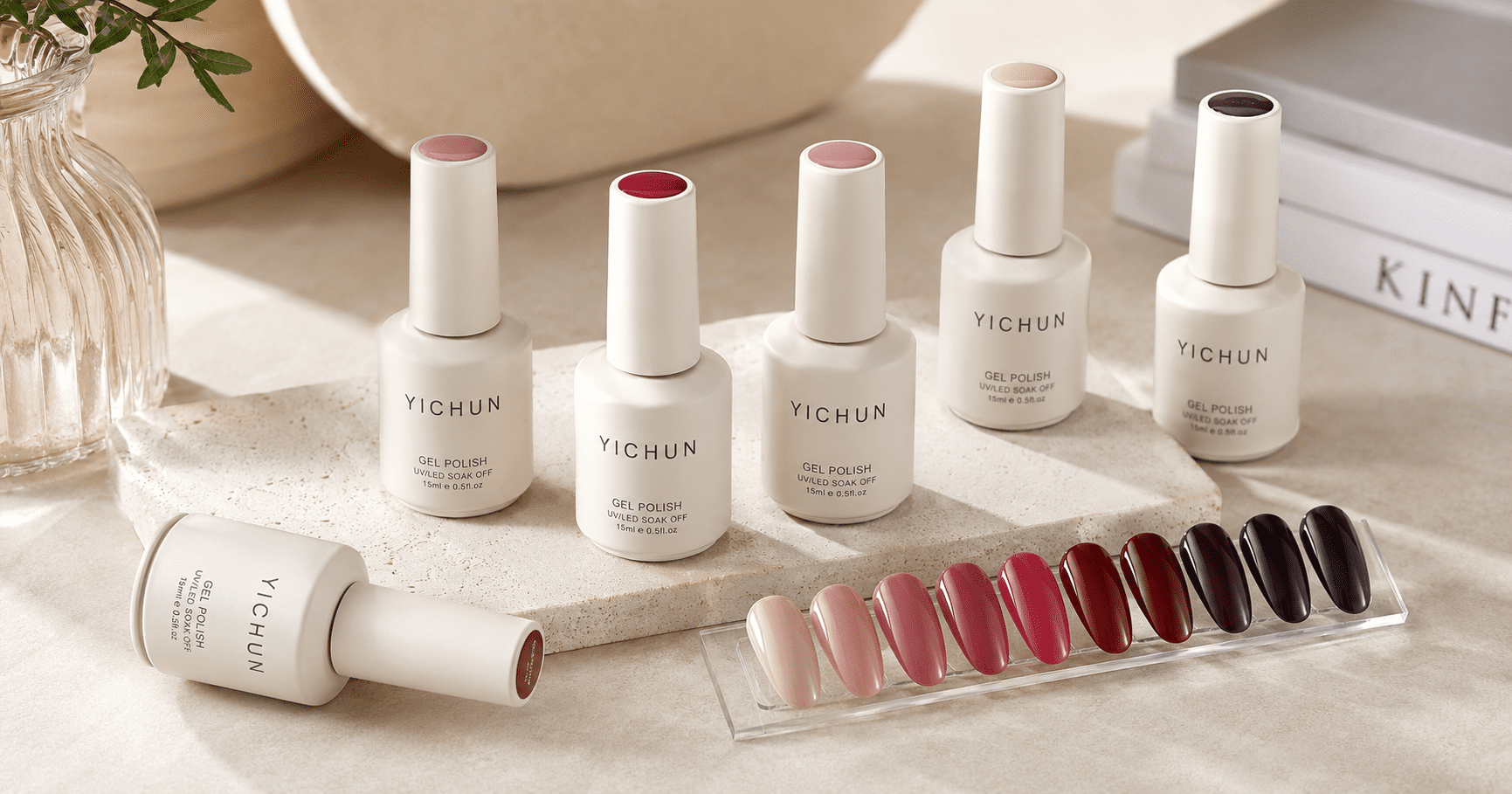
1. Introduction: Why This Product Topic Matters
For many nail brands, one of the most practical questions about طلاء جل خالي من الهيما is not only whether it sounds safer or more modern, but whether it can still perform like the traditional gel systems their customers already trust.
This question matters because gel polish is judged in real use. A product may look attractive on a label, but salons, distributors, Amazon sellers, and private label buyers still need to know how it wears on natural nails, how it cures under common LED lamps, how it works with base and top coats, and whether customers can expect professional-level durability when the system is applied correctly.
In the market, there is a common misunderstanding: some buyers assume that removing HEMA automatically weakens adhesion, while others assume that a HEMA-Free claim alone makes the product safer, better, and more premium. Both views are too simple.
A well-developed HEMA-Free gel polish can offer strong wear performance, but longevity depends on much more than one ingredient. Adhesion, curing, flexibility, viscosity, pigmentation, nail preparation, base coat compatibility, and top coat sealing all affect the final result.
For B2B buyers, this topic directly affects product development, brand positioning, customer education, and repeat orders. If a HEMA-Free formula performs poorly, the brand may face complaints about lifting, peeling, or weak wear. If the claim is communicated incorrectly, the brand may create unrealistic expectations. If the formula is properly designed, tested, and explained, HEMA-Free gel polish can become a strong product direction for professional salons, premium private label brands, and safety-conscious nail collections.
This Product Guide explains how HEMA-Free gel polish can be evaluated against traditional gel polish, what affects long wear, and how nail brands should judge formula quality before launching a private label line.
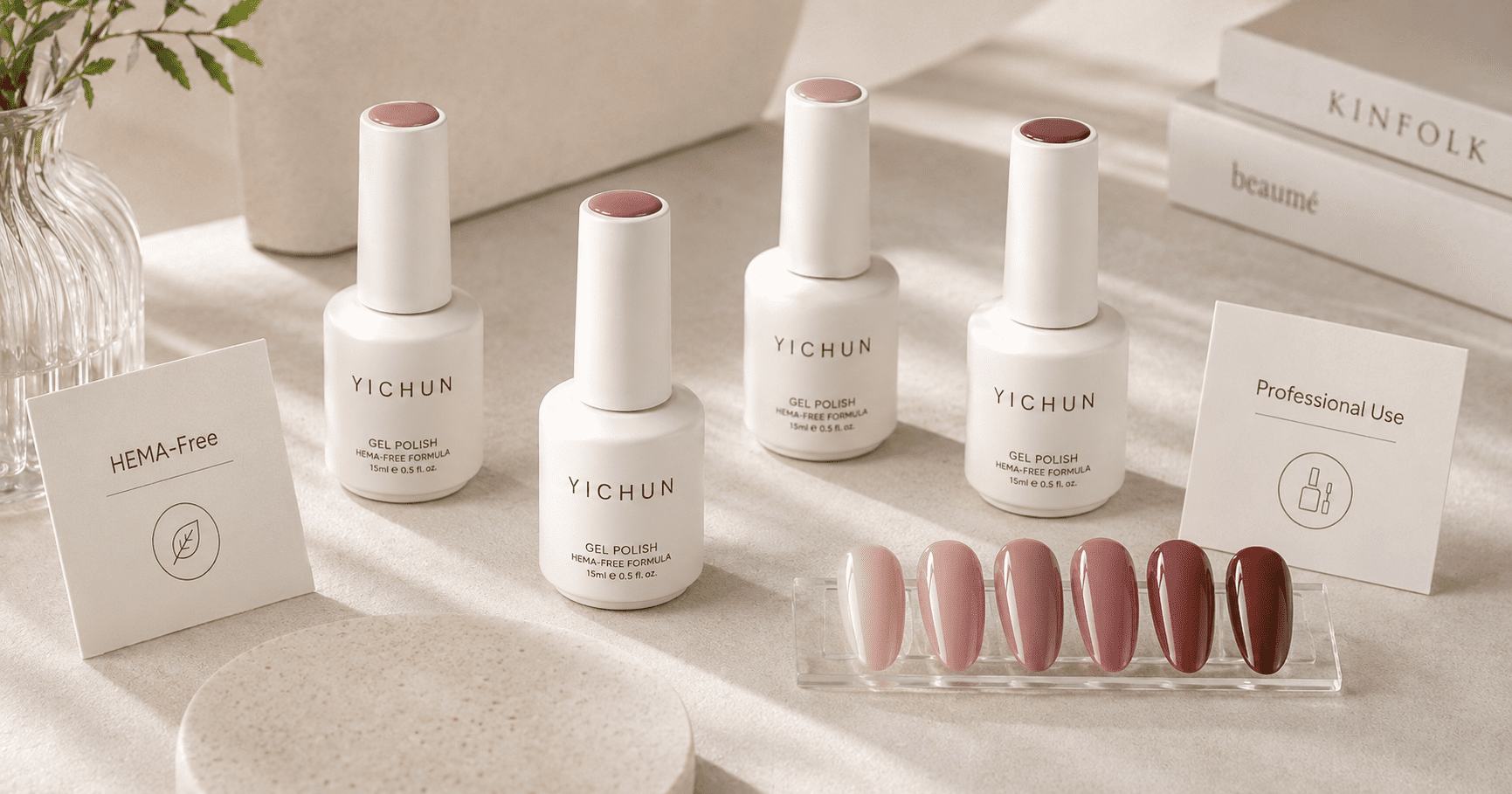
2. What Is HEMA-Free Gel Polish?
HEMA-Free gel polish refers to a gel polish formula designed without intentionally using HEMA as an ingredient.
HEMA, short for hydroxyethyl methacrylate, is a commonly discussed ingredient in gel nail systems because it is associated with adhesion and product performance in many traditional formulas. In simple buyer terms, HEMA has often been used because it can help gel products bond effectively to the nail surface when used correctly within a professional system.
However, as ingredient awareness has increased, many nail brands and salons have started looking for HEMA-Free gel polish options. The goal is usually to reduce exposure to HEMA and position the product line toward a more safety-conscious formula direction.
But HEMA-Free must be understood carefully.
HEMA-Free does not automatically mean:
| Misunderstood Claim | Correct Buyer Understanding |
|---|---|
| Allergy-free | Skin sensitivity can still depend on other ingredients, curing, application, and individual reactions. |
| 15-Free | HEMA-Free focuses on one ingredient claim, while 15-Free refers to a broader excluded-ingredient list. |
| Odor-free | Odor depends on the complete formula system, not only HEMA. |
| Better adhesion by default | Wear depends on total formula balance and application system. |
| Suitable for every user | Professional use, proper curing, and accurate instructions still matter. |
| No testing required | Buyers still need sample testing, curing checks, and wear evaluation. |
For B2B sourcing, the key point is this: HEMA-Free gel polish is not only a label claim; it is a formula design direction.
A supplier should be able to explain how the formula supports adhesion, flexibility, curing response, gloss, soak-off behavior, and color stability without relying on HEMA. Buyers do not need confidential formula ratios, but they do need a clear explanation of product logic.
A strong HEMA-Free formula should not simply remove one ingredient and leave the performance structure weaker. It should be rebalanced so the product still works as part of a professional nail system.
3. How HEMA-Free Gel Polish Works in a Formula
To understand whether HEMA-Free gel polish can last as long as traditional gel, buyers need to look at the whole formula system rather than focusing only on the absence of HEMA.
A gel polish formula usually depends on several functional parts working together:
| Formula Component | Main Function in Gel Polish | Why It Matters for Long Wear |
|---|---|---|
| Adhesion-related monomers | Help the product connect with the nail surface or base layer | Affects lifting resistance and wear time |
| Oligomers and resins | Build film strength, flexibility, and structure | Affects durability, hardness, and chip resistance |
| Photoinitiators | Help the gel cure under LED/UV light | Affects curing depth, surface finish, and stability |
| Pigments and colorants | Create color effect and opacity | High pigment loads can affect curing behavior |
| Leveling agents | Improve smoothness during application | Affects salon application experience |
| Viscosity modifiers | Control texture and thickness | Affects self-leveling, coat thickness, and curing |
| Flexibility balance | Helps the cured film move with the natural nail | Affects cracking, lifting, and comfort |
| Top coat compatibility | Helps protect color and seal the surface | Affects gloss, scratch resistance, and wear |
In a traditional formula, HEMA may be part of the adhesion strategy. In a HEMA-Free formula, the manufacturer must use a different balance of adhesion-supporting ingredients, resins, oligomers, and curing design to achieve strong performance.
This does not mean HEMA-Free gel polish is automatically weaker. It means the formula must be designed more carefully.
A professional HEMA-Free gel polish should consider three major performance targets:
Adhesion Without Over-Reliance on HEMA
Adhesion is one of the biggest concerns for buyers. If the gel lifts from the nail edge or peels within a few days, customers will not care whether the formula is HEMA-Free.
For HEMA-Free formulas, adhesion must be supported through alternative formula structure and product system compatibility. This may include the base coat design, resin selection, flexibility profile, and how well the color gel bonds to the base layer.
The most important buyer takeaway is simple: adhesion is not created by one ingredient alone.
Even traditional gel polish can lift if the nail plate is oily, the base coat is incompatible, the product is applied too thickly, or the curing lamp is unsuitable. Likewise, a HEMA-Free gel polish can perform well when the formula and application system are properly matched.
Flexibility and Film Strength
Natural nails are not completely rigid. They bend slightly during daily use. A gel polish film that is too hard may crack or separate from the nail. A film that is too soft may wear poorly or feel weak.
HEMA-Free gel polish needs a balanced cured film: strong enough to resist wear, but flexible enough to move with the nail.
This is especially important for salon clients with thin, flexible, or damaged nails. In these cases, the base coat, rubber base, or builder layer may play a major role in long wear.
Curing Response and Thickness Control
Curing is another major factor. A gel polish may look dry on the surface but still be under-cured if the layer is too thick, the pigment load is high, or the LED lamp is not suitable for the formula.
HEMA-Free gel polish does not necessarily need a completely different lamp, but buyers should always test curing performance under their target lamp systems. Lamp wavelength, lamp power, curing time, color depth, application thickness, and product viscosity can all affect the result.
Dark shades, highly pigmented colors, cat eye gels, glitter gels, and dense white shades usually require more careful curing evaluation than sheer colors.
For nail brands, curing instructions should be clear, realistic, and based on actual product testing rather than generic claims.
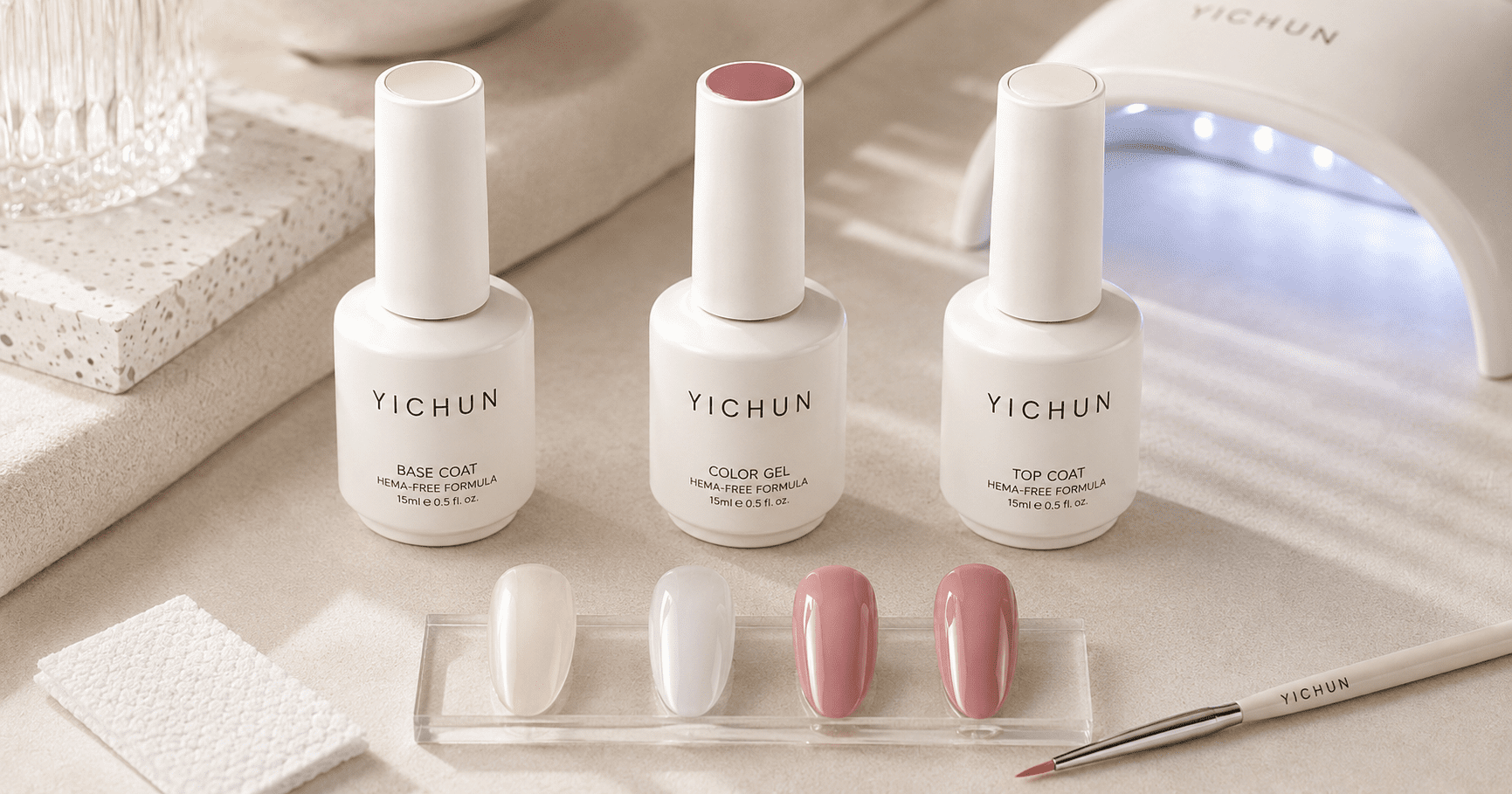
4. Core Roles in a Professional Nail System
HEMA-Free gel polish does not work alone. Its durability depends on how it fits into the complete nail system.
A professional gel polish system usually includes:
- Nail preparation
- Dehydrator or primer if needed
- Base coat
- Color gel polish
- Top coat
- Proper curing at each layer
- Correct aftercare and removal guidance
When buyers ask whether HEMA-Free gel polish can last as long as traditional gel, the answer depends on how these parts work together.
Nail Preparation
Even the best formula can fail if the nail surface is not prepared correctly. Oil, dust, moisture, old product residue, or insufficient cuticle cleaning can reduce adhesion.
For HEMA-Free gel polish, nail preparation is still essential. A safer-positioned formula does not remove the need for professional application.
Base Coat Compatibility
Base coat selection is one of the most important factors in long wear.
Some HEMA-Free color gels are designed to work with a matching HEMA-Free base coat. Others may be tested within a broader professional system. Buyers should not assume every HEMA-Free color gel will work equally well with every base coat in the market.
For private label buyers, this is especially important. If the brand plans to sell a full HEMA-Free system, the base coat, color gel, and top coat should be tested together. If the brand sells only color gel, it should still provide guidance on compatible base and top systems.
Color Gel Performance
The color layer must offer smooth application, stable pigmentation, good curing behavior, and enough flexibility after curing. If the color layer is too thick, too pigmented, or too rigid, long wear may be affected.
HEMA-Free gel polish can be developed in many color styles, including nude, jelly, milky, cat eye, glitter, shimmer, and seasonal color collections. Each color type may need slightly different testing because pigment and effect particles can influence curing and application.
Top Coat Sealing
Top coat helps protect the color layer, improve gloss, and seal the free edge. Poor sealing may cause edge wear, dullness, chipping, or peeling.
A buyer evaluating HEMA-Free gel polish should test not only the color layer but also the complete finished manicure result after top coat.
User Technique
Application thickness is a major variable. A thin, even coat usually cures more reliably than a thick coat. Cap sealing, curing time, brush control, and layer consistency all influence final wear.
This is why two users can get different results from the same product. One may experience excellent wear, while another may see early lifting due to application mistakes.
For brands, product education is part of product performance. Clear instructions reduce complaints and improve customer satisfaction.
5. Product Types, Variations, and Use Cases
HEMA-Free gel polish is not limited to one product type. It can be developed across different categories depending on the buyer’s target market, brand positioning, and product line strategy.
| Product Type | Main Role | Buyer Use Case | Key Evaluation Point |
|---|---|---|---|
| HEMA-Free color gel polish | Provides color and visual effect | Core product line for salons, retail, or private label brands | Color stability, curing, leveling, wear |
| HEMA-Free base coat | Supports adhesion and system foundation | Full HEMA-Free system development | Bonding strength, flexibility, soak-off behavior |
| HEMA-Free top coat | Seals color and provides gloss | Professional salon systems and retail kits | Gloss retention, scratch resistance, yellowing control |
| HEMA-Free rubber base | Adds flexibility and support | Thin or flexible nail users, salon strengthening systems | Flexibility, self-leveling, adhesion |
| HEMA-Free builder gel | Adds structure and overlay support | BIAB-style systems, salon professional lines | Strength, viscosity, curing depth |
| HEMA-Free jelly gel | Creates sheer translucent color | Trend-driven retail and salon collections | Layering effect, transparency, even curing |
| HEMA-Free cat eye gel | Magnetic effect color system | Fashion, social media, premium effect collections | Magnetic response, pigment stability, curing |
| HEMA-Free private label kit | Complete branded product line | Amazon, Shopify, distributors, salons | System compatibility, packaging, instructions |
| HEMA-Free salon-use formula | Professional service product | Salon chains, nail technicians, training academies | Wear performance, application feel, education |
| HEMA-Free retail formula | Consumer-facing product line | E-commerce, TikTok, Instagram beauty brands | Clear instructions, claim wording, user experience |
Different buyer groups may need different HEMA-Free gel polish strategies.
A salon chain may focus on professional wear, smooth application, and technician education. An Amazon seller may focus on packaging clarity, claim wording, customer instructions, and color set planning. A distributor may care about stable batch quality, documentation, reorder consistency, and SKU structure. A private label beauty brand may want a premium HEMA-Free system that supports stronger brand positioning.
For YICHUN gel factory, this is where product planning becomes important. A HEMA-Free product line should not be treated as one isolated bottle. It can be developed as a full system: base coat, color gel, top coat, functional gels, seasonal color collections, and retail-ready packaging.
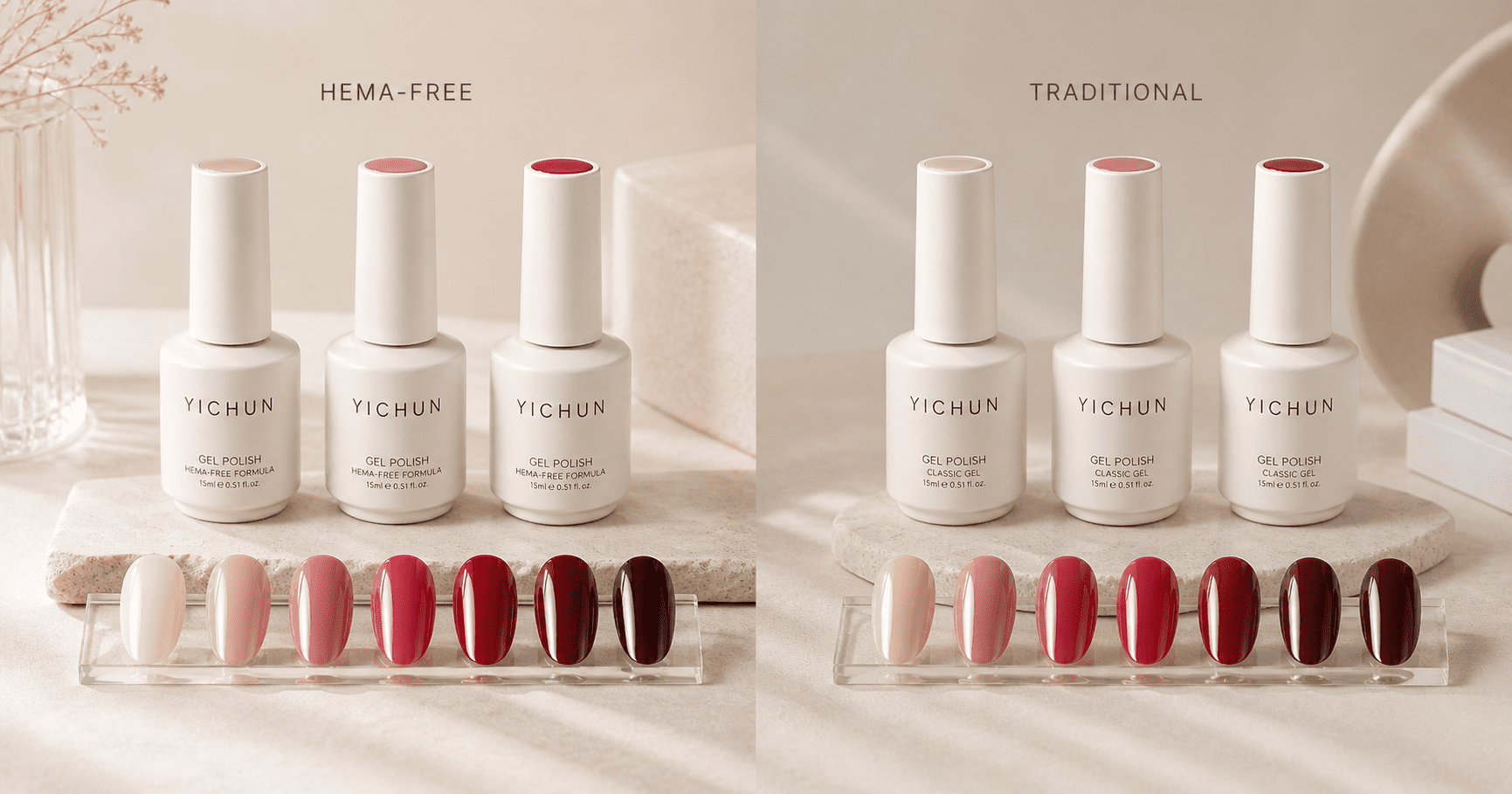
6. Comparison: HEMA-Free Gel Polish vs Traditional Gel Polish
The performance question is best answered through comparison.
HEMA-Free gel polish and traditional gel polish can both perform well when properly formulated and applied. The difference is not that one is always strong and the other is always weak. The real difference is formula strategy, claim positioning, and how performance is supported.
| Comparison Point | HEMA-Free Gel Polish | Traditional Gel Polish | Buyer Takeaway |
|---|---|---|---|
| Ingredient claim | Designed without intentionally using HEMA | May include HEMA depending on formula | HEMA-Free is a specific formula direction, not a full safety guarantee |
| Adhesion strategy | Requires alternative adhesion and film-forming balance | May use HEMA as part of adhesion support | Long wear depends on formula design, not one ingredient alone |
| Wear potential | Can achieve strong wear when properly balanced | Can also achieve strong wear when properly applied | Both need testing under real-use conditions |
| Application sensitivity | May require careful system matching and curing validation | Also depends on prep, base, curing, and technique | Application instructions remain important |
| Customer positioning | Suitable for safety-conscious, premium, or ingredient-aware brands | Suitable for standard professional gel systems | Positioning should match buyer market and claim strategy |
| Allergy communication | Must not be described as allergy-free | Also should not make unsupported safety claims | Accurate wording protects brand trust |
| Odor profile | Not automatically low odor | Odor varies by formula | Odor must be evaluated separately |
| Curing behavior | Depends on pigments, formula, lamp, and thickness | Same core curing variables apply | Buyers should test with target LED lamps |
| Cost structure | May be higher depending on formula and raw material direction | Often available across broad price ranges | Buyers should compare value, not only unit price |
| قيمة العلامة التجارية | Supports modern free-from product positioning | Familiar to many salons and users | Brand strategy should guide sourcing decisions |
Can HEMA-Free Gel Polish Last as Long?
Yes, HEMA-Free gel polish can be developed to last at a professional level, but buyers should avoid absolute assumptions.
The better question is:
Has this specific HEMA-Free formula been tested as a full nail system under realistic application conditions?
A HEMA-Free formula may wear very well if:
- The base coat supports strong bonding.
- The color gel has balanced flexibility and hardness.
- The product cures properly under the target lamp.
- The nail surface is prepared correctly.
- The layers are applied thinly and evenly.
- The free edge is sealed.
- The top coat protects the system properly.
- The formula is tested across multiple colors, especially dark and high-pigment shades.
A traditional gel polish may also fail if these factors are ignored. This is why professional buyers should evaluate the complete product system instead of judging only by the HEMA-Free claim.
Where Traditional Gel May Still Feel Familiar
Some nail technicians are used to the application feel of traditional gel systems. They may judge a product based on flow, brush control, self-leveling, tackiness, curing feel, gloss, and removal behavior.
When developing HEMA-Free gel polish, manufacturers need to consider not only ingredient replacement but also user experience. A formula that performs well technically but feels unfamiliar or difficult to apply may create hesitation among technicians.
This is especially important for salon channels, where technician acceptance strongly affects reorder potential.
Where HEMA-Free Gel Polish Can Support Brand Growth
HEMA-Free gel polish can be valuable for brands that want to build a more ingredient-aware product line. It gives brands a clear product story and helps answer modern buyer concerns about formula transparency.
However, the claim must be supported by:
- Real product performance
- Accurate label wording
- تعليمات استخدام واضحة
- Sample testing
- Supplier communication
- Consistent production quality
For B2B buyers, the goal should not be to choose HEMA-Free only because it sounds trendy. The goal should be to build a product line that combines modern formula positioning with reliable salon performance.
7. Application Logic and Performance Variables
When buyers compare طلاء جل خالي من الهيما with traditional gel polish, durability should not be judged only by the ingredient claim. In real salon use, long wear is created by the full application system.
A strong HEMA-Free formula may fail if the nail plate is poorly prepared. A traditional gel formula may also fail if it is applied too thickly or cured under an unsuitable lamp. This is why professional buyers should evaluate performance through practical variables, not only through marketing descriptions.
Nail Preparation
Nail preparation is the foundation of adhesion.
Before applying any gel polish system, the nail surface should be clean, dry, and free from oil, dust, loose cuticle, or product residue. Even a small amount of oil or moisture can reduce bonding between the base coat and the natural nail.
For HEMA-Free gel polish, this step becomes especially important because buyers may expect the formula to perform like a traditional system while also supporting a different ingredient direction. Proper nail prep helps the formula show its real performance.
Important preparation factors include:
- Gentle surface buffing when appropriate
- Cuticle area cleaning
- Dust removal
- Nail dehydration when needed
- Avoiding skin contact during application
- Applying thin and controlled layers
Poor preparation can cause lifting near the cuticle, sidewalls, or free edge. This is not necessarily a formula failure. It may be a system or application issue.
Base Coat Selection
Base coat compatibility is one of the most important factors when testing HEMA-Free gel polish.
Some buyers make the mistake of testing only the color gel and ignoring the base coat. But the base layer is the first bonding bridge between the natural nail and the gel system. If the base coat does not match the color gel formula, wear time may be affected.
For professional evaluation, buyers should test:
| Base Coat Variable | Why It Matters |
|---|---|
| Matching HEMA-Free base coat | Helps evaluate the formula as a complete safer-positioned system |
| Rubber base compatibility | Useful for flexible or thin natural nails |
| Standard professional base coat | Helps compare with existing salon systems |
| Primer use | May improve adhesion in some cases but should not be overused |
| Soak-off behavior | Affects removal experience and salon service time |
A HEMA-Free color gel may perform better when used with a base coat developed for the same system. For private label brands, launching a complete HEMA-Free base-color-top system is often more reliable than selling color gels alone without clear compatibility guidance.
Layer Thickness
Layer thickness affects curing, adhesion, flexibility, and final wear.
A thick layer may look smooth at first, but it can create curing problems, especially with dark colors, dense pigments, jelly layers, cat eye particles, or glitter effects. If the lower part of the gel layer does not cure properly, the manicure may lift, wrinkle, peel, or feel soft.
For HEMA-Free gel polish, thin and even coats are recommended because they support more stable curing and better film formation.
A professional application usually performs better with:
- Thin base coat
- Thin first color coat
- Thin second color coat if needed
- Proper curing between layers
- Controlled top coat sealing
Buyers should test whether the formula still levels well when applied thinly. A product that only looks smooth when applied thickly may create problems in real use.
Curing Lamp Type
HEMA-Free gel polish does not automatically require a completely different LED lamp. However, curing must still be tested carefully.
Curing depends on:
- Lamp wavelength
- Lamp power
- Curing time
- Product thickness
- Pigment density
- Formula type
- Distance between nail and light source
- Lamp age and bulb quality
A formula that cures well under one lamp may not perform the same under another. This is especially relevant for brands selling to different countries, salons, or retail users with varied lamp systems.
For B2B buyers, sample testing should include the lamp types commonly used by the target market. A salon professional line may be tested under higher-quality salon lamps, while a retail kit may need clearer instructions for beginner users.
Pigmentation and Color Type
Not all HEMA-Free gel polish colors behave the same.
Light nude shades, sheer pinks, and jelly colors often cure more easily because light can pass through the layer more effectively. Dense white, black, deep red, navy, dark brown, and highly pigmented shades may require more careful curing evaluation.
Effect gels also need special attention.
Cat eye gels contain magnetic particles. Glitter gels contain reflective particles. Shimmer gels contain pearl or mica-like effects. These particles can influence how light travels through the product layer.
For this reason, buyers should not test only one easy color and assume the whole collection performs the same. A complete HEMA-Free color line should be tested across different shade groups.
Top Coat Sealing
Top coat is not only for gloss. It also protects the color layer and helps seal the free edge.
If the top coat is too brittle, too soft, incompatible, or poorly cured, the manicure may lose shine, scratch easily, or chip at the edge. A good top coat should support the whole system.
For HEMA-Free product planning, buyers should test:
- Gloss retention
- Scratch resistance
- Yellowing resistance
- No-wipe or wipe-off finish
- Compatibility with color gel
- Edge sealing performance
- Soak-off behavior if relevant
A strong HEMA-Free gel polish system should not rely only on the color formula. The base and top coat must also support the final wear result.
Nail Condition
Natural nail condition affects durability.
Thin, flexible, damaged, oily, or peeling nails may not hold gel polish as well as healthy nail plates. This is true for both HEMA-Free and traditional gel polish.
For clients with flexible nails, a rubber base or builder base may improve support. For clients with oily nails, additional preparation steps may be needed. For clients with damaged nails, professional judgment is important.
Brands should avoid promising the same wear time for every user. A more professional message is that wear performance depends on product system, application method, nail condition, and curing accuracy.
Storage and Product Handling
Gel polish performance can also be affected by storage.
Products should generally be kept away from strong light, direct sunlight, high heat, and contamination. Bottles should be closed properly after use. Brushes should not be exposed to curing lamps during application.
For distributors and private label buyers, packaging quality and storage guidance matter because they affect customer experience after purchase.
8. Suitable and Unsuitable Scenarios
HEMA-Free gel polish can be a strong product direction, but it is not suitable for every buyer strategy or every type of claim. Understanding the right scenarios helps brands avoid unrealistic expectations.
Suitable Scenarios for HEMA-Free Gel Polish
HEMA-Free gel polish is suitable for brands that want to build a more ingredient-aware product line while still offering professional beauty performance.
It can be especially useful for:
| نوع المشتري | Why HEMA-Free Gel Polish Fits |
|---|---|
| Private label nail brands | Supports modern product positioning and differentiation |
| Salon chains | Helps introduce more safety-conscious service options |
| Nail product distributors | Adds a premium product category for professional buyers |
| Amazon sellers | Creates a clearer product story for ingredient-aware consumers |
| Shopify beauty brands | Supports brand storytelling and product education |
| Training academies | Helps teach ingredient awareness and professional application |
| Premium gel polish brands | Builds a more advanced formula image |
| Regional distributors | Provides a product line for markets asking about safer-positioned formulas |
For these buyers, the value of HEMA-Free gel polish is not only the claim itself. The value comes from combining ingredient communication with reliable product performance.
A buyer can build a strong product story around HEMA-Free gel polish if the brand also provides clear usage instructions, professional education, accurate label wording, and tested performance.
Suitable for Full System Development
HEMA-Free gel polish is especially suitable when developed as a complete system.
A full system may include:
- HEMA-Free base coat
- HEMA-Free color gel polish
- HEMA-Free top coat
- HEMA-Free rubber base
- HEMA-Free builder gel
- HEMA-Free color collections
- HEMA-Free retail kits
- Professional curing guidance
- Private label packaging
For a brand, this creates stronger product consistency. It also reduces confusion because customers know which products are designed to work together.
Suitable for Premium Positioning
HEMA-Free gel polish can support premium positioning because it gives the brand a more advanced formula story. However, premium positioning must be supported by real product quality.
A premium HEMA-Free product line should have:
- Stable texture
- Smooth self-leveling
- Good pigmentation
- Reliable curing
- Strong gloss
- Consistent batch quality
- Professional packaging
- Clear claim communication
- Practical customer education
The claim alone is not enough. Buyers should treat HEMA-Free as one part of the brand value, not the entire value.
Scenarios That Need Caution
HEMA-Free gel polish may not be suitable when buyers expect the claim to solve every performance or safety concern.
Caution is needed when:
- A brand wants to market the product as allergy-free.
- A seller wants to claim it is completely safe for everyone.
- A buyer does not plan to test samples.
- A buyer ignores curing instructions.
- A brand wants to sell highly pigmented shades without curing evaluation.
- A distributor does not review labeling expectations in the target market.
- A seller assumes HEMA-Free automatically means low odor.
- A buyer mixes random base, color, and top systems without compatibility testing.
HEMA-Free gel polish should be communicated professionally. It may help reduce exposure to HEMA, but it does not eliminate the need for safe application, curing control, product education, and responsible labeling.
Not a Replacement for Professional Technique
Another important point: HEMA-Free gel polish is not a shortcut around professional application.
Users still need to avoid skin contact, cure each layer correctly, apply thin coats, seal the edge, and remove the product properly. If the product is used incorrectly, performance and comfort may be affected.
For nail brands, this means product instructions should be written clearly. For salons and training academies, technician education remains important.
9. Common Misunderstandings
HEMA-Free gel polish is a valuable product direction, but it is often misunderstood. Correcting these misunderstandings helps buyers build more trustworthy brands.
Misunderstanding 1: HEMA-Free Means Allergy-Free
This is one of the most important misunderstandings to avoid.
HEMA-Free means the formula is designed without HEMA. It does not mean the product is allergy-free. Skin sensitivity can be affected by other ingredients, under-curing, overexposure, repeated skin contact, incorrect application, or individual reactions.
Brands should not market HEMA-Free gel polish as allergy-proof or suitable for everyone. A safer wording is that HEMA-Free gel polish may help reduce exposure to HEMA as part of a safer-positioned formula strategy.
Misunderstanding 2: HEMA-Free Always Has Weaker Adhesion
Some buyers worry that removing HEMA will automatically make the product lift faster. This is not always true.
Adhesion depends on the full formula design, base coat compatibility, nail preparation, curing, flexibility, and application method. A well-developed HEMA-Free gel polish can offer professional wear when the system is properly balanced.
However, buyers should not assume every HEMA-Free formula performs the same. Sample testing is necessary.
Misunderstanding 3: Traditional Gel Always Lasts Longer
Traditional gel polish may perform very well, but it is not automatically superior in every situation.
If a traditional gel is applied too thickly, cured poorly, used with an incompatible base coat, or applied on an unprepared nail surface, it can still lift or peel.
The correct comparison should be formula system versus formula system, not claim versus claim.
Misunderstanding 4: HEMA-Free Means 15-Free
HEMA-Free and 15-Free are different claims.
HEMA-Free focuses on the absence of HEMA. 15-Free usually refers to a broader excluded-ingredient list used for marketing and product positioning. A product can be HEMA-Free without being 15-Free, and a 15-Free claim should be verified according to the specific ingredient list the brand uses.
Buyers should not mix these claims without clear supplier confirmation.
Misunderstanding 5: HEMA-Free Gel Polish Needs a Completely Different Lamp
HEMA-Free gel polish does not automatically require a special lamp. Curing depends on the formula’s photoinitiator system, pigment load, layer thickness, lamp wavelength, lamp power, and curing time.
The professional approach is to test the product under target lamp systems and provide clear curing guidance.
Misunderstanding 6: HEMA-Free Always Smells Better
Odor is affected by the complete formula, not only HEMA.
Monomer system, solvent content, photoinitiators, fragrance, raw material quality, packaging, and storage can all affect odor. A HEMA-Free gel polish may have a pleasant odor profile, but this should be evaluated separately.
Brands should not assume HEMA-Free automatically means low odor.
Misunderstanding 7: All HEMA-Free Formulas Perform the Same
This is not true.
Two HEMA-Free gel polish formulas can feel very different. One may be smooth, flexible, glossy, and durable. Another may feel thick, under-cure easily, or lift faster.
Buyers should evaluate formula performance through actual testing, not only through the ingredient claim.
Misunderstanding 8: Ingredient Claims Alone Determine Product Quality
Ingredient claims are important, but product quality is broader.
A strong HEMA-Free gel polish line should also consider:
- Texture
- Pigmentation
- Curing response
- Adhesion
- Gloss
- Wear resistance
- Soak-off behavior
- Packaging stability
- Label accuracy
- Batch consistency
- Supplier support
A product with a good claim but poor performance will not create long-term customer trust.
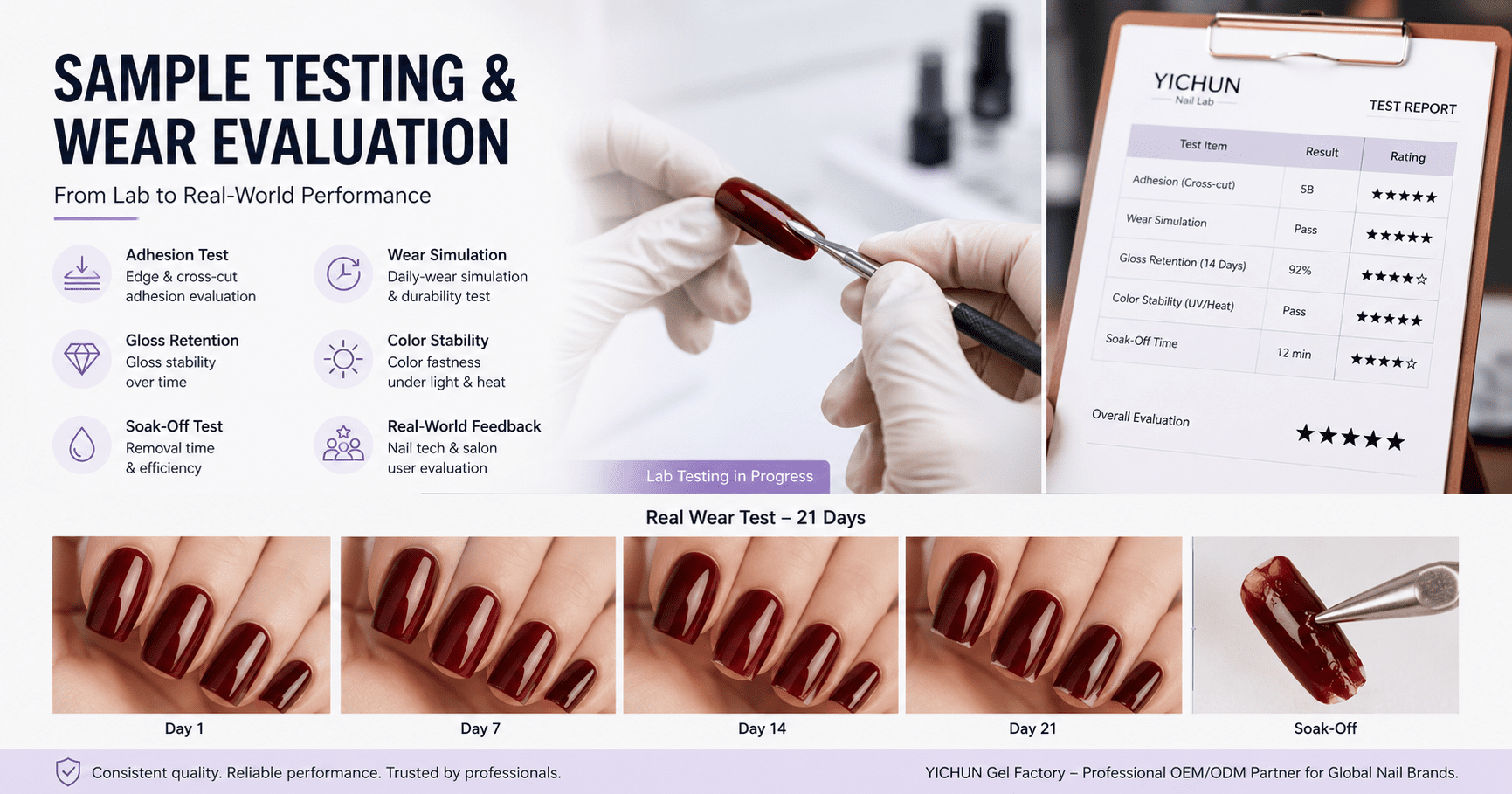
10. Professional Buyer Judgment: How to Evaluate HEMA-Free Gel Polish
For professional buyers, the key question is not simply, “Is this HEMA-Free?”
The better question is:
Can this HEMA-Free gel polish perform reliably in my target product system, target market, and target application environment?
To answer that, buyers should evaluate the product in several areas.
| Evaluation Area | What Buyers Should Check | Why It Matters |
|---|---|---|
| HEMA-Free claim | Confirm whether HEMA is intentionally excluded from the formula | Prevents unclear or unsupported product claims |
| Adhesion behavior | Test wear on different nail types and with different base coats | Shows whether the formula can support real use |
| Curing response | Test under target LED lamps and different shade depths | Helps avoid under-curing and customer complaints |
| Texture and viscosity | Check brush control, self-leveling, and coat thickness | Affects salon application experience |
| المرونة | Observe whether the cured film cracks, chips, or lifts | Important for natural nail movement |
| Pigmentation | Test coverage and curing across light, dark, and effect shades | Prevents color-specific performance issues |
| Gloss and top coat compatibility | Check shine, scratch resistance, and finish stability | Affects final customer satisfaction |
| Soak-off behavior | Test removal time and nail surface condition after removal | Important for salon service and repeat use |
| Odor profile | Evaluate odor separately from the HEMA-Free claim | Helps with brand positioning and customer comfort |
| Label wording | Review whether claims are accurate and not exaggerated | Protects brand credibility |
| Packaging quality | Check bottle opacity, cap seal, brush quality, and leakage risk | Affects storage, shipping, and customer experience |
| Batch consistency | Confirm production control and reorder stability | Important for distributors and growing brands |
Sample Testing Should Be Structured
A serious buyer should not test only one bottle one time.
A better sample testing process includes:
- Test several colors from different shade groups.
- Apply with the recommended base and top coat.
- Test under the target LED lamp.
- Compare thin and slightly thicker coats.
- Observe curing, gloss, leveling, and tacky layer behavior.
- Wear test for realistic daily use.
- Check edge lifting and chipping.
- Test soak-off removal.
- Review packaging and label clarity.
- Confirm whether the product fits the brand’s claim strategy.
This process helps buyers make sourcing decisions based on evidence rather than assumptions.
Ask the Supplier the Right Questions
Before placing a private label order, buyers should ask:
- What exactly does the HEMA-Free claim mean for this formula?
- Is HEMA intentionally excluded from the formulation?
- Is this a ready formula or can it be customized?
- Which base and top coat are recommended?
- What curing time is recommended under LED lamps?
- Has the formula been tested across dark and high-pigment colors?
- Can the viscosity be adjusted for salon or retail use?
- What packaging options are available?
- What label wording is recommended?
- Can the supplier support sample testing and reorder consistency?
A professional supplier should be able to answer clearly without revealing confidential formula ratios.
Evaluate the Whole Product Line, Not One Bottle
For a private label brand, one good sample bottle is not enough. Buyers should think about the full product line.
A HEMA-Free gel polish launch may include:
- Core nude colors
- Popular salon reds and pinks
- Seasonal fashion shades
- Dark colors
- White and black
- Jelly colors
- Cat eye effects
- Base coat
- Top coat
- Rubber base
- Builder gel
- Retail packaging
- Color card
- Product instructions
The buyer should consider whether the supplier can support long-term SKU development, not only a one-time order.
This is especially important for Amazon sellers, Shopify brands, and distributors who need repeatable color quality and stable supply.
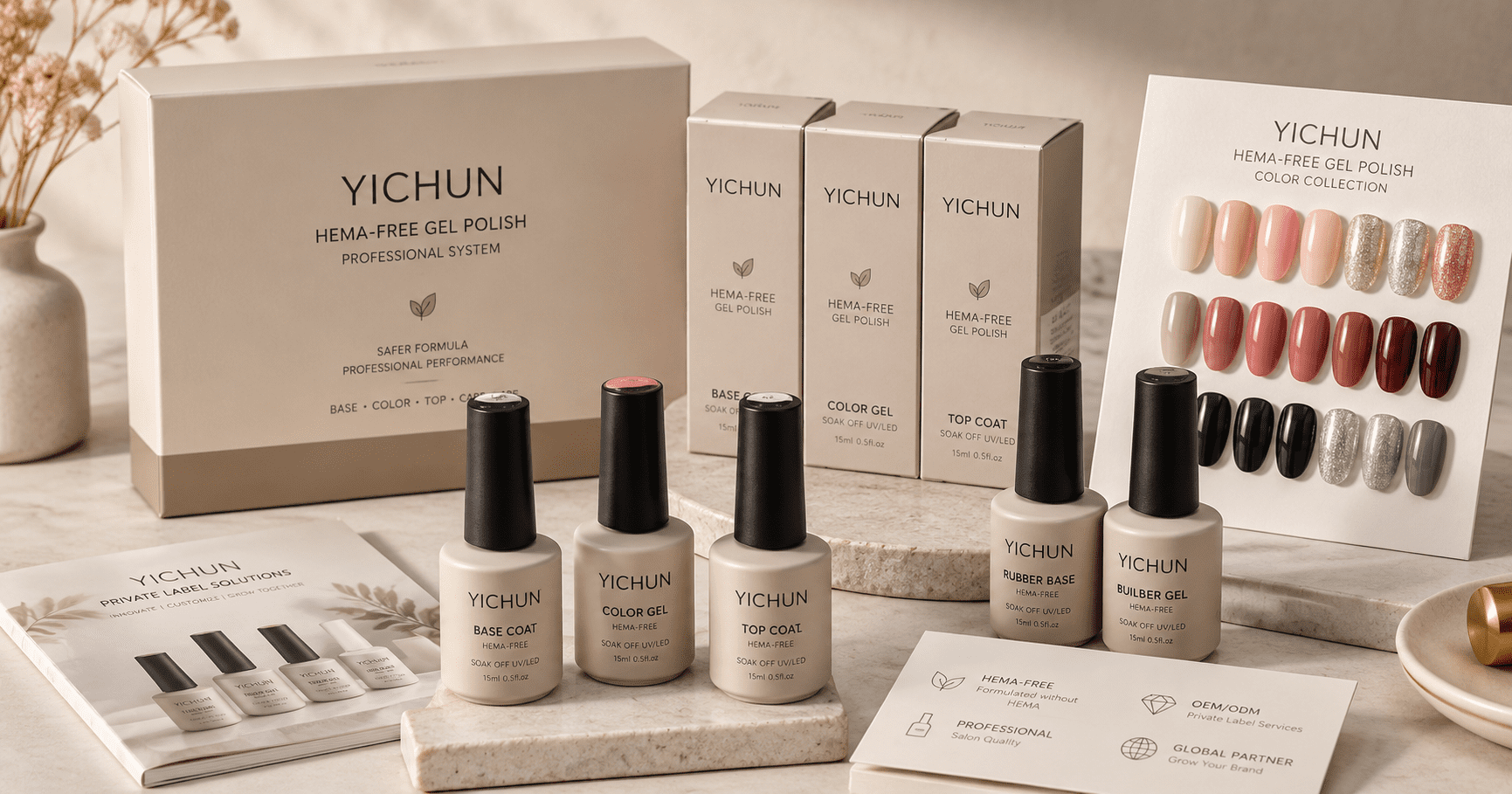
11. Product Development and OEM Considerations
For brands planning to launch HEMA-Free gel polish, product development should be handled as a complete system rather than a simple ingredient switch.
A professional OEM/ODM manufacturer can help buyers connect formula direction, performance testing, packaging, and brand positioning.
Ready Formula Selection
Some buyers may prefer a ready HEMA-Free gel polish formula because it can reduce development time and allow faster market entry.
A ready formula may be suitable when the buyer needs:
- Faster sampling
- Existing color options
- Lower development complexity
- Private label packaging
- Market testing
- Smaller initial product planning
However, buyers should still test the ready formula under their own target conditions.
Custom Formula Development
Other buyers may need customization.
Customization may involve:
- Viscosity adjustment
- Color matching
- Gloss level preference
- Pigmentation strength
- Odor profile direction
- Curing response adjustment
- Base coat system planning
- Top coat compatibility
- Retail or salon texture preference
For HEMA-Free gel polish, customization should focus on performance balance. Removing HEMA is only one part of the formula direction. The final product must still feel good, cure reliably, wear well, and fit the buyer’s market.
Private Label Packaging
Packaging is also part of product trust.
For HEMA-Free gel polish, packaging should communicate a clean, professional, and premium feeling without overusing unsupported claims.
Important packaging elements include:
- Opaque gel polish bottle
- Clear product name
- Accurate claim wording
- Shade name or color code
- Net content
- Usage instructions
- Curing guidance
- Warning information where appropriate
- Batch or lot identification
- Professional label design
For article image planning, the bottle logo should use YICHUN, and the visual style should remain premium, realistic, and suitable for a B2B independent website.
Claim Wording Support
HEMA-Free claims should be written carefully.
Good wording:
- طلاء جل خالي من الهيما
- Formulated without HEMA
- Designed for professional gel polish systems
- HEMA-Free formula direction for ingredient-aware nail brands
- Supports safer-positioned product line planning
Wording to avoid:
- Allergy-free
- Non-allergenic
- 100% safe for everyone
- Prevents allergies
- No sensitivity risk
- Medical-grade safety claim without support
A professional OEM partner should help buyers avoid exaggerated wording and build more trustworthy product communication.
How YICHUN Gel Factory Can Support Buyers
As a gel polish OEM/ODM manufacturer, YICHUN gel factory can support buyers in developing HEMA-Free gel polish lines through formula direction, sample testing, private label packaging, color planning, and system compatibility review.
For B2B buyers, this support is valuable because a successful HEMA-Free product line requires more than a label claim. It requires product performance, application logic, packaging clarity, and long-term supply consistency.
YICHUN gel factory can help buyers evaluate:
- HEMA-Free formula options
- Base-color-top system planning
- Color collection development
- Sample testing feedback
- Viscosity and application feel
- Private label bottle and box design
- Batch consistency
- Reorder planning
The goal is not to overpromise that every HEMA-Free formula will perform exactly the same as every traditional gel. The professional goal is to help buyers build a product line where the HEMA-Free claim, formula performance, and brand communication work together.
12. Buyer Checklist: Can HEMA-Free Gel Polish Match Traditional Gel Wear?
Use this checklist before deciding whether a HEMA-Free gel polish is suitable for your brand.
| Checklist Item | Buyer Question | Pass Standard |
|---|---|---|
| HEMA-Free claim | Is HEMA intentionally excluded from the formula? | Supplier gives clear confirmation |
| Adhesion | Does it resist lifting under correct application? | Stable wear during sample testing |
| Base compatibility | Does it work with the recommended base coat? | No early peeling or separation |
| Top coat compatibility | Does the top coat seal and protect well? | Gloss and edge wear remain stable |
| Curing | Does it cure properly under target LED lamps? | No wrinkling, softness, or under-cured layer |
| Pigmented shades | Do dark and dense colors cure reliably? | Consistent curing across shade groups |
| Application feel | Is the texture smooth and controllable? | Good brush control and leveling |
| المرونة | Does the cured film move with the natural nail? | No easy cracking or brittleness |
| Soak-off | Can it be removed professionally? | Reasonable removal without excessive damage |
| Odor | Does the odor profile fit brand expectations? | Acceptable for target users |
| التعبئة والتغليف | Is the bottle suitable for gel polish storage? | Opaque, sealed, professional |
| Label wording | Are claims accurate and cautious? | No unsupported medical or allergy claims |
| Reorder consistency | Can the supplier maintain stable quality? | Batch and color consistency support available |
The final decision should be based on product testing, not only on whether the formula is HEMA-Free.
A strong HEMA-Free gel polish can compete with traditional gel polish in wear performance when the formula is well developed, the application system is compatible, and the brand provides clear instructions.
13. FAQ
1. Can HEMA-Free gel polish last as long as traditional gel polish?
Yes, طلاء جل خالي من الهيما can achieve professional-level wear when the formula is properly developed and used within a compatible nail system. Longevity depends on formula balance, base coat compatibility, curing, nail preparation, layer thickness, top coat sealing, and user technique. The HEMA-Free claim alone does not determine wear time.
2. Does removing HEMA make gel polish weaker?
Not automatically. HEMA may support adhesion in some traditional gel systems, but professional HEMA-Free formulas can use alternative adhesion, resin, oligomer, and film-forming strategies. A well-balanced formula can still offer strong adhesion and flexibility when applied correctly.
3. Why do some HEMA-Free gel polishes lift faster?
Early lifting may happen because of poor nail preparation, incompatible base coat, thick application, under-curing, oily nail plates, weak edge sealing, or formula imbalance. Buyers should test the full base-color-top system before judging the product.
4. Is HEMA-Free gel polish allergy-free?
No. HEMA-Free does not mean allergy-free. It means the formula is designed without HEMA, but skin sensitivity can still depend on other ingredients, curing, application, skin contact, and individual reactions. Brands should avoid making allergy-proof or medical-style claims.
5. Is HEMA-Free gel polish the same as 15-Free gel polish?
No. HEMA-Free focuses on the absence of HEMA. 15-Free usually refers to a broader free-from marketing claim involving a list of excluded ingredients. A product can be HEMA-Free without being 15-Free, so buyers should confirm each claim separately.
6. Does HEMA-Free gel polish need a different LED lamp?
Not necessarily. HEMA-Free gel polish does not automatically require a special lamp, but curing should always be tested under the target lamp systems. Lamp wavelength, power, curing time, pigmentation, formula type, and layer thickness all affect curing performance.
7. Does HEMA-Free gel polish smell better than traditional gel polish?
Not always. Odor depends on the complete formula system, including monomers, photoinitiators, raw material quality, solvent content, fragrance, packaging, and storage. HEMA-Free and low-odor are different product claims.
8. Can HEMA-Free gel polish be used with regular base and top coats?
Sometimes, but buyers should not assume universal compatibility. For best results, HEMA-Free color gel should be tested with the recommended base and top coat. A full HEMA-Free system often gives brands better control over performance and customer instructions.
9. Is HEMA-Free gel polish suitable for salons?
Yes, HEMA-Free gel polish can be suitable for salons, especially for brands and technicians looking for more ingredient-aware product options. However, salons still need professional application, proper curing, safe handling, and clear client communication.
10. What should private label buyers test before ordering HEMA-Free gel polish?
Private label buyers should test adhesion, curing response, color stability, viscosity, gloss, soak-off behavior, odor profile, base and top coat compatibility, packaging quality, and label wording. Testing should include different shade types, especially dark colors, white, cat eye, glitter, and highly pigmented shades.
14. Final Thoughts
HEMA-Free gel polish can last as long as traditional gel polish when the formula is professionally balanced and used within the right system. The key is not simply whether the product contains or excludes one ingredient. The real performance depends on adhesion strategy, film flexibility, curing response, base coat compatibility, color formulation, top coat sealing, and application technique.
For nail brands, salons, distributors, and private label buyers, HEMA-Free should be understood as a product development direction rather than a simple marketing label. It can support a safer-positioned, ingredient-aware, and premium brand strategy, but it still requires careful testing and accurate communication.
A strong HEMA-Free gel polish line should answer three buyer questions clearly:
- Does the formula support reliable professional wear?
- Is the product claim accurate and not exaggerated?
- Can the supplier support testing, packaging, color development, and reorder consistency?
For brands preparing to launch a HEMA-Free gel polish collection, sample testing is essential. Test the product under your target lamp system, with your preferred base and top coat, across different color types, and under realistic salon or retail use conditions.
As a professional gel polish OEM/ODM partner, YICHUN gel factory can help buyers evaluate HEMA-Free formula direction, develop private label product lines, review performance requirements, plan packaging, and build a more reliable product system for long-term brand growth.
A successful HEMA-Free product line is not built by a claim alone. It is built by formula performance, professional education, responsible wording, and consistent manufacturing support.