
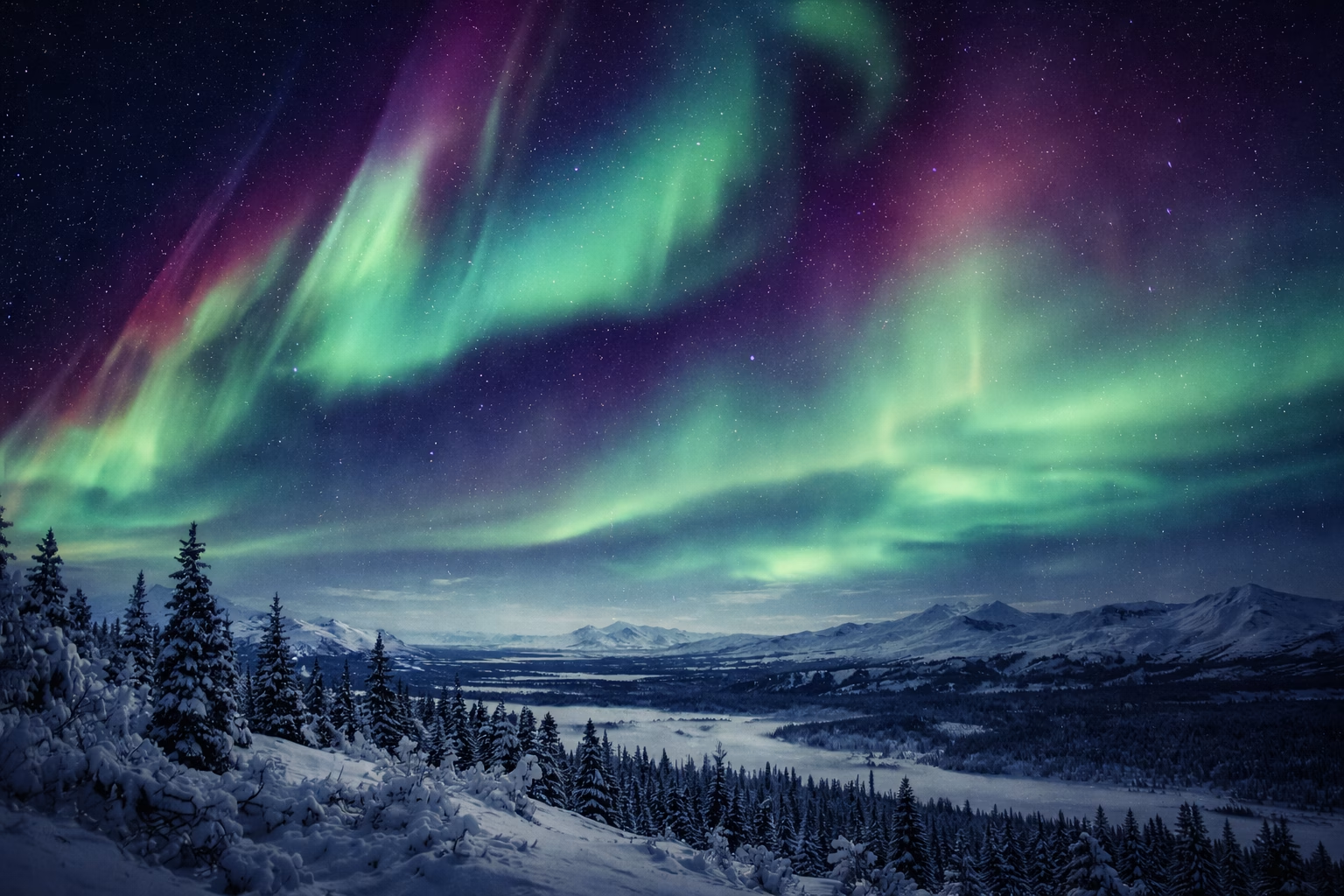
High above the Arctic Circle, darkness becomes a canvas.
In the Yukon Aurora Belt, light does not illuminate space.
إنه moves through it.
There is no sunrise here in winter.
No conventional blue hour.
No gradual transition.
Night dominates.
And within that night, color is born.
The first auroral arcs appear without sound—
a pale green seam stitched across blackness, thin as breath.
Then it thickens.
Breaks.
Unfolds.
Veils of cold emerald ripple overhead.
Violet edges ignite at their margins.
Occasional crimson embers surface at altitude, then dissolve.
Nothing holds still.
The sky behaves like liquid physics.
Color bends, drifts, stretches, collapses, and reforms.
This is not a landscape of surfaces.
إنه منظر طبيعي من fields.
At the Yukon Aurora Belt, color is not attached to matter.
It is attached to energy.
لا يوجد شيء للزينة.
Nothing is fixed.
كل شيء in motion.
A Territory Built for Celestial Thinking
The Yukon Aurora Belt spans a high-latitude zone across northern Canada, centered over Yukon Territory, where Earth’s magnetosphere opens a visible dialogue with the sun.
This region sits beneath one of the planet’s most active auroral ovals—
a persistent ring of geomagnetic interaction encircling the polar cap.
Its governing forces are not geological alone, but cosmic:
- Solar wind particle streams
- Magnetospheric field lines
- Atmospheric gas excitation
- Extreme seasonal light imbalance
- Long-duration night cycles
- Low humidity and high clarity winter air (when conditions align)
Unlike coastal systems—where color diffuses outward across water—
or alpine systems—where color is engineered by snow load and stone—
the Yukon’s palette is built by collision and emission.
Here, fast electrons ride magnetic field lines into the upper atmosphere.
They collide with oxygen and nitrogen atoms.
Those atoms shift energy states.
When they return, they release photons—
light at specific wavelengths.
That is the aurora.
Color here is not pigment.
إنه a byproduct of physics.
Green (oxygen) tends to dominate lower auroral altitudes.
Red (oxygen) appears at higher, thinner layers and is often rarer.
Violet and blue (nitrogen) define edges, surges, and high-energy moments—
often arriving as margins, flashes, or crown-like bursts.
The land below—tundra plains, frozen rivers, black spruce corridors, glacial lakes—functions as a grounding plane.
It does not compete.
It waits.
The true scene is overhead.
Color in the Yukon is never broad.
إنه vertical.
It is layered in altitude, not distance.

The Physics of Night Color
Darkness does not erase color.
إنه selects ذلك.
In temperate cities, night is never truly dark—
ambient light fills the air with grey contamination.
In the Yukon, when the sky clears and the moon is absent, night becomes optically honest.
That honesty changes what color can be.
Saturation becomes more precise, because there is no competing spectrum.
Edges become sharper, because there is less haze.
Glow becomes more intense, because the surrounding field is truly black.
And yet, the aurora is not “bright” the way daylight is bright.
It is bright the way a signal is bright—
a clear message against silence.
Aurora behaves differently from reflective light:
- It has no physical surface.
- It does not cast predictable shadows.
- It does not flatten.
- It does not stabilize.
It can look like smoke, silk, curtain fabric, liquid metal—
but these are metaphors only.
What is actually happening is a shifting geometry of emission.
This is why auroral palettes cannot be “sampled” like a landscape palette.
They must be interpreted as behavior:
- sudden intensification
- drifting lateral motion
- vertical folding
- edge sharpening
- rapid collapse into darkness
The Yukon is not a place where color sits still long enough to become decoration.
It is a place where color proves that space is alive.
The Yukon Aurora Color Field
Across long polar nights, a distinct but disciplined chromatic system repeats—
not as fixed swatches, but as recurring spectral events:
- Electron Green — dominant oxygen emission, cold-luminous, high clarity
- Aurora Mint — lower-energy wash zones, softer and more diffuse
- Magnetosphere Teal — transition field tones when green shifts toward blue
- Ion Violet — nitrogen edge excitation, sharp, electric, unstable
- Plasma Lavender — overlap zones where spectral layers blend briefly
- Crimson Altitude — high-layer oxygen red, distant, slow, rare
- Solar Ember Red — surge-driven red traces, momentary and thin
- Stellar Indigo — deep sky behind the aurora, still carrying starlight
- Ultraviolet Black — near-total chromatic absorption between events
- Frozen Horizon Grey — snowfield reflection under auroral glow, neutralized
- Spruce Shadow Black — dense boreal silhouettes with zero bounce
- Glacial Smoke Blue — faint atmospheric scatter on colder nights
لا يوجد أي من هذه الألوان بمفرده.
They arrive as stacks.
Green core.
Violet edge.
Black void.
Occasional red high above like a distant warning.
The aurora does not “blend” like paint.
إنه interferes like waves.

السلوكيات المادية، وليس المؤثرات البصرية
What makes the Yukon Aurora Belt exceptional is not range, but non-materiality.
Every dominant tone corresponds to a physical state, not a surface choice.
- Electron Green
→ high luminance, low warmth, high spectral cleanliness
→ demands “signal clarity” rather than decorative saturation - Ion Violet
→ short wavelength behavior, high volatility
→ must read electric, never romantic - Crimson Altitude
→ high altitude emission, lower intensity, slower appearance
→ must feel distant, never foreground - Ultraviolet Black
→ optical absence
→ black as space, not black as pigment
This palette rejects glitter as cliché.
If reflectivity appears, it must behave like plasma—continuous, wave-like, field-driven.
If glow exists, it must appear suspended, never applied.
If gradient exists, it must feel like altitude separation, not “ombre.”
الضغط والتحرير الموسمي
How the Sky Changes Color Without Changing Law
In most landscapes, seasons repaint space.
In the Yukon Aurora Belt, seasons do something more subtle:
they change the stage on which color is allowed to appear.
Auroral physics does not switch on in winter and off in summer.
Solar wind continues.
Magnetic fields persist.
Atmospheric excitation never truly stops.
What changes is visibility.
During Arctic summer, the sun refuses to leave.
Even at midnight, the sky holds a permanent blue veil.
Auroras may occur—but they are swallowed by light.
Winter does not introduce aurora.
Winter removes interference.
As daylight collapses in late autumn, darkness returns in layers.
First twilight lengthens.
Then night begins to hold.
Then night becomes dominant.
With that dominance comes optical permission.
The sky clears its palette.
Blues drain.
Warmth disappears.
The spectrum narrows.
Black becomes absolute.
And only then does auroral color achieve its full authority.
During deep winter, the landscape itself becomes visually compressed.
Snowfields flatten reflectivity.
Forests collapse into silhouette.
Rivers vanish into matte absence.
The ground retreats.
The sky expands.
Color is no longer horizontal.
It becomes vertical architecture.
When spring approaches, release begins—not as bloom, but as dilution.
Daylight leaks back into night.
Auroral events must compete.
Edges soften.
Contrast weakens.
Green fades first.
Red becomes almost impossible.
This is not seasonal transformation.
إنه signal-to-noise shift.
The aurora does not change its nature.
The environment changes its ability to receive it.
Temporal Color: Reading Time Through Energy
In agricultural landscapes, time is visible as growth.
In alpine landscapes, time is visible as erosion.
In the Yukon Aurora Belt, time is visible as frequency.
How often auroras appear.
How fast they move.
How violently they surge.
How long they sustain before collapse.
Time is not measured in color transitions.
It is measured in field behavior.
A quiet night produces slow arcs, pale greens, smooth drapery forms.
A disturbed magnetosphere fractures the sky—
sharp violet margins, pulsating coronas, sudden vertical jets.
Here, “season” is less relevant than solar weather.
A single hour can contain more chromatic change than a coastal year.
This produces a unique temporal condition:
The Yukon sky does not age.
إنه activates.
There is no patina.
No mellowing.
No long fade.
There is ignition.
Oscillation.
Extinction.
Color appears fully formed.
Then disappears without residue.
This teaches a radically different reading of time:
Not accumulation.
Not decay.
لكن recurrence.
The same greens return after centuries.
The same violets trace the same magnetic arcs.
The same blacks reassert themselves between events.
Time here is cyclical but not gentle.
It is pulsed.
Translating Celestial Physics into Design Logic
The Yukon Aurora Belt does not inspire palette expansion.
إنه يلهم spectral discipline.
Design translation must not imitate the aurora’s appearance.
It must adopt its rules.
Auroral logic is not decorative.
It is operational.
مبادئ الترجمة الأساسية
Emission over Reflection
Auroral color exists because it emits light.
Design analogs must privilege internal glow over surface shine.
Field over Object
Color should feel like an environment, not an applied layer.
Instability over Finish
Edges should feel alive, never fully resolved.
Darkness as Structure
Black is not background.
Black is the system that allows everything else to exist.
Vertical Behavior
Gradients must imply altitude, not fade.
Aurora is not “beautiful light.”
إنه organized energy.
Design that borrows from it must feel governed, not expressive.

Aurora Color Systems in Product Logic
1. Electron-Core Luminous Gels
الكلمات المفتاحية: luminous gel polish, glow gel, high-clarity green gel
Inspired by Electron Green and Aurora Mint.
منطق التصميم:
- ultra-clean chromatic channel
- controlled luminosity (no neon aggression)
- spectral clarity without milkiness
- internal light effect rather than surface glitter
These colors must read as self-illuminated.
Not pearlescent.
Not reflective.
Not metallic.
They function as signal colors—
the core of any auroral system.
2. Ion-Edge Accent Gels
الكلمات المفتاحية: violet gel polish, electric purple gel, edge-tone gel
Inspired by Ion Violet and Plasma Lavender.
منطق التصميم:
- narrow hue windows
- sharp spectral identity
- high contrast against dark bases
- used in margins, lines, overlays, not fields
These are not base colors.
هم boundary colors.
They exist to define transitions.
3. Altitude Reds and Plasma Corals
الكلمات المفتاحية: red glow gel, aurora red gel, plasma tone gel
Inspired by Crimson Altitude and Solar Ember Red.
منطق التصميم:
- lower saturation ceiling
- controlled translucency without weakness
- depth-first formulation
- rare usage philosophy
Red in auroral systems must feel distant.
Never dominant.
Never warm.
Never cosmetic.
It is atmospheric.
4. Ultraviolet Blacks and Stellar Darks
الكلمات المفتاحية: black gel polish, space black gel, night gel
Inspired by Ultraviolet Black and Stellar Indigo.
منطق التصميم:
- extreme optical depth
- minimal surface glare
- perfect neutrality under colored overlays
- compatibility with luminous systems
These tones are not fashion colors.
هم infrastructure.
They carry everything.

التفسير البصري والتعبئة والتغليف
Darkness as Architecture
A Yukon Aurora–inspired visual system should feel nocturnal, suspended, and untethered from surface logic.
النغمات الأساسية
- Ultraviolet Black
- Stellar Indigo
Secondary Fields
- Electron Green
- Plasma Lavender
Rare Accents
- Crimson Altitude
- Solar Ember Red
معالجات السطح
- deep matte blacks
- soft-touch void finishes
- subtle internal glow layers
- minimal external reflectivity
لمسات معدنية
- cold iridescent titanium
- spectral chrome
- interference-film finishes
التخطيط الهيكلي
- large negative space
- floating typography
- minimal borders
- emphasis on vertical alignment and central emergence
Packaging should feel like equipment for light observation, not cosmetic display.
Nothing crowded.
Nothing warm.
Nothing ornamental.
The object should appear as if it belongs in darkness.

السجل العاطفي
Awe Without Warmth
The Yukon Aurora Belt does not comfort.
إنه overwhelms quietly.
It evokes scale.
Distance.
Cosmic participation.
The emotional temperature is not cold.
إنه extraterrestrial.
This palette communicates:
- humility
- alertness
- expanded awareness
- الدقة
- non-human order
It is not romantic night.
إنه planetary night.
Color here does not decorate the self.
It places the self inside a system.
الانعكاس اللوني
The Yukon Aurora Belt teaches that color is not a surface event.
إنه cosmic transaction.
Here, nothing is applied.
Nothing is chosen.
لا يوجد شيء للزينة.
Light arrives as consequence.
Particles strike atmosphere.
Energy excites matter.
Matter releases wavelength.
Color happens.
This reverses the usual design instinct.
Instead of asking what color should be placed,
the auroral sky asks:
what conditions must exist for color to occur?
Darkness must be total.
Air must be thin.
Magnetic fields must align.
Solar wind must arrive.
Only then does green emerge.
Only then does violet trace the margins.
Only then does red whisper at impossible altitude.
In the Yukon Aurora Belt, black is not emptiness.
Black is permission.
It is the environment that allows light to exist meaningfully.
It is structure.
Auroral color, in turn, is not pigment.
إنه behavior.
It stretches.
It folds.
It fractures.
It dissolves.
It refuses containment.
It teaches that the highest form of color expression is not beauty, but legibility of energy.
What is seen above the Yukon is not sky.
It is physics rendered visible.
And in that visibility, a profound design truth emerges:
Color is not something we add to objects.
It is something that happens when matter, light, and field enter agreement.
The aurora is not decoration.
It is the planet speaking in spectrum.
الموقع المرجعي
المَعْلَم: Yukon Aurora Belt
المنطقة: Yukon Territory
البلد: كندا
الإحداثيات: approx. 64.0000° N, 135.0000° W