

When morning drifts over Canterbury Cathedral, it does not arrive with drama but with quiet inevitability.
Light slips through medieval mist, climbs the worn flint walls, and glides across flying buttresses that have held their posture for nearly a thousand years. Nothing here is rushed. Nothing announces itself loudly. This Canterbury color story begins the same way each day has begun for centuries—soft grey light touching old stone, the kind of light that feels older than time.
Inside the cathedral precincts, the air feels stored rather than moving.
Gravel paths curve past cloisters; archways open into silence; the massive nave rises like a carved canyon of limestone, each ribbed vault an echo of prayer. The architecture folds, rises, fractures, and reforms—almost geological. Centuries of rebuilding, fire, restoration, and devotion have layered the structure the way sediment layers a cliff face.

In certain angles, Canterbury resembles not a church but a living manuscript:
stone margins annotated by centuries, stained glass glowing like illuminated pages, shadows moving like quiet commentary. If Big Bend is a library of dust, Canterbury is a library of light—every corridor a sentence, every window a luminous footnote.
By midday, the cathedral shifts character again.
Sunlight turns sharper, reducing details into silhouettes. The creamy Caen stone warms into honey; the cloister greens deepen; the leaded roof glints faintly like brushed pewter. Yet even in brilliance, the palette remains restrained—meant for contemplation, not spectacle. Canterbury teaches that light is not something that “arrives,” but something that enthüllt.

From this long history emerges a precise and distinctly English chromatic vocabulary:
- Pilgrim Stone — soft limestone weathered by centuries of footsteps.
- Chapterhouse Ivory — warm, creamy stone under interior candlelight.
- Canterbury Grey — quiet northern sky against the cathedral towers.
- Clerestory Amber — stained-glass sunlight spreading across old floors.
- Martyr Red — deep crimson echoing Thomas Becket’s legacy.
- Pewter Lead — cold metallic tones of the ancient roofline.
- Cloister Moss — deep desaturated green living between shade and stone.
- Vespers Plum — evening shadows pooling under arches.
- Bell Tower Black — ironwork darkened by centuries of ringing.
- Scribe Gold — the muted gleam of medieval manuscript gilding.
- Monastic Blue — twilight hues softened by centuries of chants.
- Incense Smoke — a warm grey suspended between air and memory.
Each tone is not just a color—it is a continuation of time.
“Pilgrim Stone” has absorbed a thousand years of movement; “Martyr Red” recalls the moment history shifted; “Clerestory Amber” carries the weight of prayers that were whispered long before modern nations existed. In Canterbury, color is not an aesthetic choice but the residue of centuries.

At night, the cathedral becomes another universe.
Floodlights amplify buttresses into sculptural shadows. “Bell Tower Black” blankets the roofs, while “Scribe Gold” lingers in the windows like a memory of candles long extinguished. The silence is monastic, the colors pared down to blue-black, slate-grey, and deep wine-plum. Canterbury at night is not dark; it is reverent.
For designers, artists, and formulators, Canterbury offers a rare palette—
one built on devotion, repetition, and endurance. These colors are not decorative. They feel earned.
When the visual language of Canterbury Cathedral crosses continents and enters the calibrated environment of Yichun Gel Fabrik, it meets a different kind of discipline:
precise temperatures, engineered viscosity, controlled adhesion curves, optical clarity tests, and reproducible gloss coefficients. The emotional weight of Canterbury—its stone, silence, and stained light—must be translated into pigments and resins without losing its gravity.
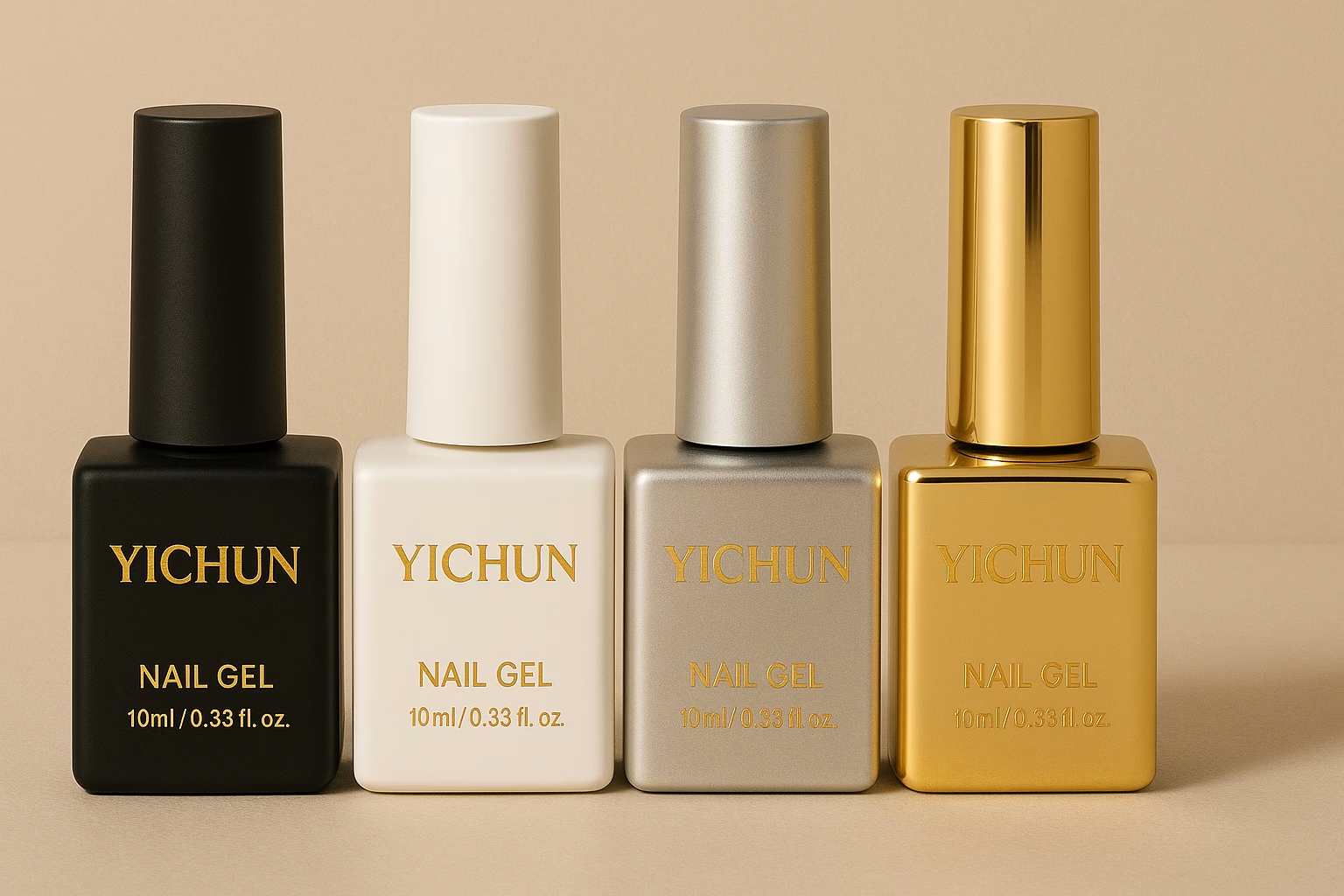
Yichun’s formulation philosophy aims not to replicate a place, but to interpret es.
Color becomes architecture; texture becomes atmosphere. Every shade must express:
- Density – whether it feels carved or glazed.
- Translucency – like stained glass or shadowed stone.
- Surface memory – matte like cloister dust or glossy like polished manuscripts.
- Emotional resonance – calm, solemn, luminous, contemplative.
With this approach, Canterbury’s palette dissolves into functional categories:
- Pilgrim Stone und Chapterhouse Ivory form the basis of builder gels und neutral rubber bases, shades close to natural nail undertones yet spiritually quiet.
- Martyr Red und Vespers Plum become opaque color gels and signature jellies, blending depth with soft inner light.
- Scribe Gold, Pewter Lead, und Clerestory Amber evolve into metallic detailers and cat-eye gels, where light refracts like candle-struck metal.
- Monastic Blue und Bell Tower Black become deep, stable low-VOC pigments suitable for premium salons needing elegance with longevity.
- Cloister Moss und Incense Smoke inform soft-focus bases, understated tones for sophisticated, quiet-luxury manicures.
Every shade must undergo behavioral validation—
Does it hold under warm salon lamps?
Does the shimmer read as refined metallic rather than glitter?
Does translucency mimic stained glass without becoming overly sweet?
Yichun adjusts opacity curves, nanoparticle dispersion, and resin clarity to ensure that each color feels like it carries the weight of stone, glass, or illuminated manuscripts.

Within Yichun’s system, the Canterbury story unfolds across multiple product lines:
1. Cloister Light Jelly Gel Series
“Clerestory Amber,” “Monastic Blue,” and “Incense Smoke” become translucent gels that behave like diffused cathedral light.
Soft, contemplative tones ideal for syrup nails and minimal gradients.
2. Pilgrim Base & Builder Collection
“Pilgrim Stone,” “Chapterhouse Ivory,” and “Cloister Moss” transform into medium-viscosity builder gels and neutral rubber bases.
Universally wearable, stable, and architecturally quiet.
3. Canterbury Magnetic Cat Eye Line
“Scribe Gold,” “Pewter Lead,” and “Vespers Plum” shift into magnetic cat-eye gels.
The line refines shimmer into narrow beams—like candlelight on metal chalices.
4. Martyr Red Signature Opaque Series
Bold, deep reds inspired by Canterbury’s history.
Opaque coverage, high-stability pigments, and low streaking—intensity without aggression.
5. Twilight Choir Night Gel Toppers
“Bell Tower Black” and “Monastic Blue” as ultra-sheer night toppers.
The effect is celestial but solemn—like stars glimpsed through a gothic arch.
Across all categories, the formula logic respects a cathedral principle:
restraint, intentional depth, and enduring beauty.

For a Canterbury-inspired collection, packaging reflects monastic refinement and architectural rhythm:
Primary Box Language
Outer box: Pilgrim Stone matte beige with a micro-grain stone texture.
Accent panel: Vespers Plum or Pewter Lead, mimicking the alternating tonal bands of gothic stonework.
Flaschen-Design
- Bottles in muted matte finishes—Pilgrim Stone, Chapterhouse Ivory, Cloister Moss.
- Caps in Scribe Gold or Pewter Lead, echoing cathedral ornaments.
Printing & Finishes
- Foiling in antique gold, not bright yellow gold.
- Spot-gloss outlines referencing rib vaults or window tracery.
- Debossed logo channeling carved inscriptions.
Color Card
Quiet rows of swatches arranged like gothic arches.
Thin separators mimic lead lines of stained-glass windows.
The message:
Sacred minimalism, not decorative excess.

Canterbury is often described as “holy,” but what it teaches is something more subtle:
endurance shaped by care.
Color here is the long record of hands that carved, voices that echoed, candles that burned, and prayers that lingered. The palette is not loud because the centuries themselves speak loudly enough.
For Yichun’s clients, this becomes a creative invitation:
- What if color expresses reverence rather than excitement?
- What if a palette speaks softly but carries centuries of atmosphere?
- How might a brand embody quiet luxury, the way Canterbury embodies quiet eternity?
Each bottle becomes a small architectural fragment—
a portable piece of a cathedral that has outlasted wars, kings, reformations, and empires.
📍 Standort
Canterbury Cathedral, Kent, United Kingdom
Koordinaten: 51.2798° N, 1.0837° E