

When dawn touches the asphalt of Route 66, it arrives without ceremony.
No skyline announces the morning—only the faint hum of distant tires, the cooling metal of a roadside diner sign, and the long silver line of pavement dissolving into the horizon. Bit by bit, the desert wakes: warm bronze flashing on the hood of a rusted Chevrolet, pale gold sliding across abandoned gas pumps, and neon tubes still glowing from the night before, refusing to let the dark fully go.
This is a place where light never behaves the same way twice.
It bends across chrome, sharpens along faded paint, softens into dust, and then ignites again in the glass of old motels. Route 66 is not simply a highway—it is a strip of American mythology, stretched across eight states and a century of stories. Every mile is a different decade; every town is a mixture of ruin, memory, and persistent color.
Here, the land is a patchwork of contradictions.
Desert openness meets human invention. Abandonment sits next to celebration. A derelict neon sign flickers in front of a sunset that could be from ten thousand years ago. The palette of Route 66 does not obey seasons or trends; it emerges from weathered metal, roadside heat, motel lights, and endless dust.

In this strange in-between world, a distinctly modern chromatic vocabulary is born:
- Chrome Horizon — polished metal catching the first strip of sun.
- Vintage Shell Red — old gas pump enamel, sun-faded but unbroken.
- Motel Neon Blue — buzzing tubes glowing through desert dusk.
- Sunbaked Amber — roadside gravel heated into gold.
- Road Dust Taupe — the powdery haze kicked up behind a passing car.
- Thunderbird Teal — the signature color of retro convertibles.
- Desert Rose Mauve — weather-softened paint on abandoned diners.
- Rusted Ember — oxidized metal warmed by desert air.
- Route Asphalt Black — the quiet, heat-soaked centerline of the highway.
- Mirage Violet — twilight reflections in chrome and glass.
- Cactus Sage Green — desert plants clinging to life beside the asphalt.
- Sunset Neon Pink — the leftover glow of old signage in the evening haze.
- Midnight Gas Station Blue — the deep shadow behind a lone fluorescent lamp.
- American Copper — worn, metallic warmth from vintage car trim.
Each of these tones is not merely a color—it is a timestamp.
“Chrome Horizon” belongs to sunrise; “Sunset Neon Pink” belongs to late-night diners; “Rusted Ember” belongs to forgotten engines cooling on sand. Route 66 teaches that color is simply light passing through memory.

When the Route 66 palette reaches the controlled environment of Yichun Gel Factory, it encounters a different form of precision:
temperature-stable pigments, engineered viscosity curves, controlled translucency, and long-wear polymer systems.
The goal is not imitation but resonance.
Colors must evoke chrome, dust, neon, or asphalt—not with literal imagery, but with emotional physics:
- Weight — does the shade feel metallic or atmospheric?
- Sheen — does it reflect like chrome or diffuse like desert dust?
- Translucency — does it glow like neon or absorb light like asphalt?
- Memory — does it feel old, new, or timeless?
The Route 66 palette therefore separates into functional chromatic groups:
✔ Chrome Horizon & American Copper
→ high-shine metallic gels with precise particle size, engineered to mimic reflective car trim.
✔ Vintage Shell Red, Rusted Ember, Desert Rose Mauve
→ opaque creams and jelly tints with soft retro undertones—nostalgia without heaviness.
✔ Motel Neon Blue, Sunset Neon Pink, Mirage Violet
→ electric, translucent neons with low-VOC intensity and stable curing.
✔ Road Dust Taupe & Cactus Sage Green
→ natural-tone rubber bases inspired by desert greens and dusty asphalt.
✔ Route Asphalt Black & Midnight Gas Station Blue
→ deep blacks and blue-blacks formulated for one-coat coverage and high durability.
Testing is obsessive.
Shimmer is tuned to avoid cheap glitter.
Neon brightness is controlled so it remains elegant, not fluorescent chaos.
Each shade must survive salon lighting, daylight, and camera flash—Route 66 is a photographic subject, and so must the gel collection be.
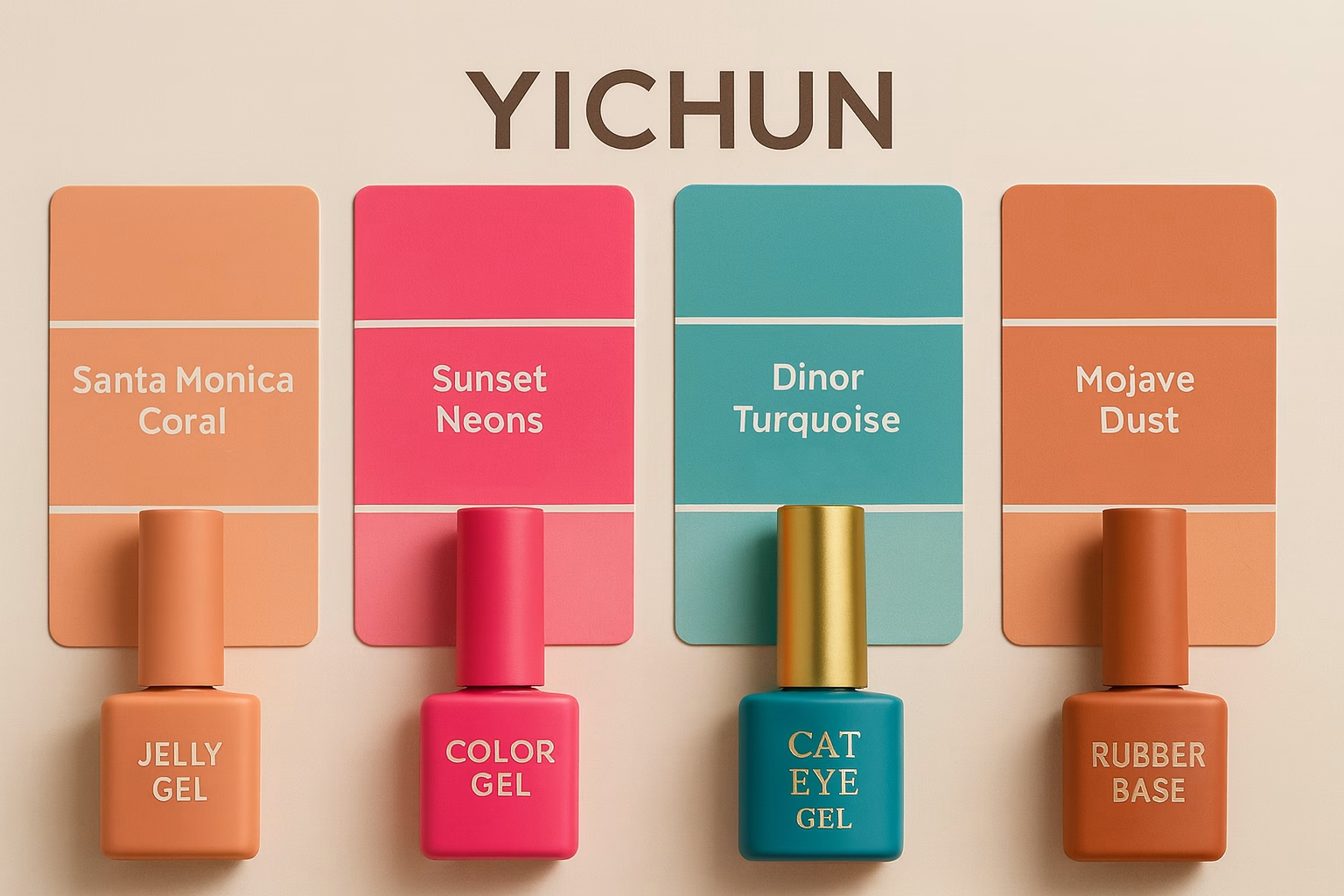
1. Neon Mile Jelly Gel Collection
Inspired by Motel Neon Blue, Sunset Neon Pink, Mirage Violet
These translucent gels glow like old roadside signs transitioning from day to night.
They are ideal for syrup nails, gradient glows, and artistic overlays.
2. Chrome Ride Metallic Gel Series
Built from Chrome Horizon, American Copper, Rusted Ember
These metallics behave like polished bumpers and vintage trim—reflective, but refined.
3. Desert Road Rubber Base Set
Shades include Road Dust Taupe, Desert Rose Mauve, Cactus Sage Green
Soft-touch neutrals calibrated for daily wear, inspired by desert tones that accompany the highway for hundreds of miles.
4. Route Asphalt Cat Eye Line
Featuring Route Asphalt Black, Midnight Gas Station Blue, Rusted Ember
Iron-particle gels with directional highlights, echoing headlights sweeping across empty roads.
5. Retro Americana Solid Creams
Colors such as Vintage Shell Red and Thunderbird Teal
High-opacity classics that feel like restored Americana—not historical replicas, but modernized elegance.
Each family reflects one essence of the 66 experience:
movement, chrome, dusk, dust, neon, memory.

A Route 66–inspired collection extends beyond color—it becomes a form of industrial nostalgia:
Box Design
Outer box:
– matte Road Dust Taupe with micro-grain texture, like the surface of a well-traveled road
– side panels in Vintage Shell Red or Thunderbird Teal for retro contrast
Bottle Design
Bottle bodies:
– matte finishes in Desert Rose Mauve, Cactus Sage, Asphalt Black
– soft-touch texture echoing old diner tables and worn dashboards
Caps:
– metallic Chrome Horizon or American Copper
– slightly brushed finish to resemble vintage car trim
Printing & Finishes
Logo: subtle metallic foil—not loud gold, but refined chrome-bronze
Finishing:
– Matte + spot gloss to mimic reflective motel signs
– optional neon edge stripe around the label to echo classic signage
Color Card
A geological-style layout, but inspired by “layers of decades”:
large color blocks arranged like stacked motel signs, no gradients, no clutter—just quiet retro geometry.
The message is clear:
This is not a “tourist souvenir Route 66 kit.”
This is modern Americana minimalism, engineered for refined brands.

Route 66 is often described as “nostalgic,” but nostalgia is too simple a word.
What survives along the road is not longing for the past—it is evidence of survival:
- signs that still light up
- engines that still turn
- roads that still carry travelers
- stories that still hum under the desert sun
The color story of Route 66 is ultimately about endurance:
chrome that refuses to rust completely, neon that refuses to go dark, and desert that refuses to swallow the road.

For designers, formulators, and brand builders, the question becomes:
- How do we design for endurance instead of novelty?
- How do we translate memory into modern palettes?
- How do we create color that feels lived-in rather than manufactured?
Route 66 reminds us that beauty does not always come from perfection—
sometimes it comes from being weathered, persistent, and still glowing.
📍 Location
Route 66 – Chicago to Los Angeles, United States
Coordinates (historic midpoint): 35.2100° N, 97.4440° W